The Australian Connection
One of the weirder things about William Egan Colby, CIA director for a few years in the mid 1970s, were the connections he had with The Lucky Country, connections that existed before, during and after his intelligence career. By the mid 1970s, these connections included the occult-libertine “Sydney Push” social sphere and its mob-backed monopoly on the Australian capital’s abortion trade.
What was the “Sydney Push”? For students of the US counter-culture, think “Laurel Canyon” and the “Beat Poets”. Here’s how The Dictionary of Sydney describes the Push:
Left wing intellectual group whose common bond was rejection of conventional morality and authoritarianism. Formed in the late 1940s, many of its ideas were adopted by society in general by the 1960s therefore undermining its perceived subversive position.
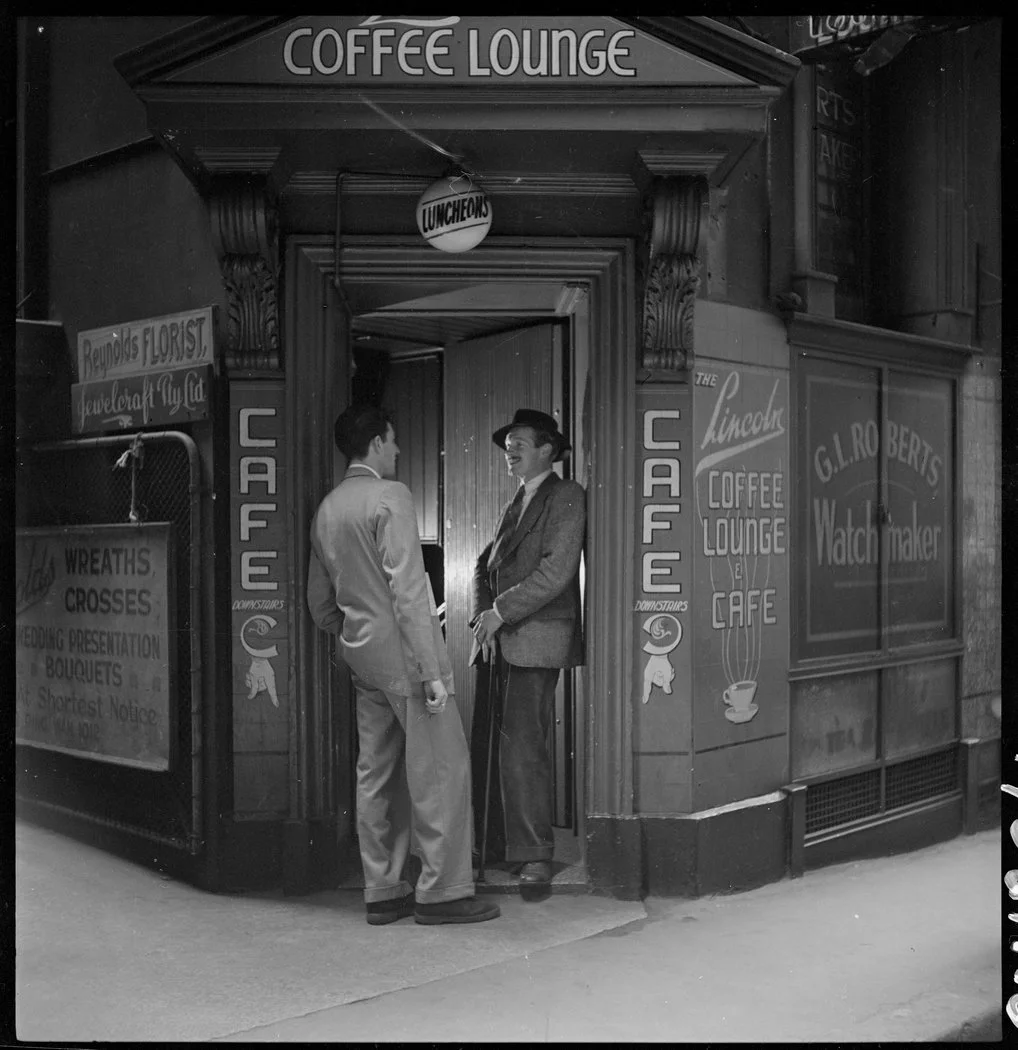
Please look at the title image above. It is a photograph of Sydney’s “Lincoln Coffee Cafe” taken by Brian Bird sometime in the late 1940s. This kaffeehaus was a celebrated hangout for the “Sydney Push” in much the same way that the Viennese Café Central was for the Ringstrasse’s ‘intellectual group’: cocaine dealer Sigmund Freud; Young Vienna writers Hugo von Hoffmannsthal and Peter Altenberg; spy Col. Alfred Redl; and future Eastern European dictators like Leon Trotksy, Tito and Stalin. (Remember that the Ringstrasse wanted economic control of Eastern Europe!) These counter-culture luminaries would while away hours by gambling with Tarot cards as sex traffickers wandered between tables. The Push wasn’t much different.
Viennese “Cafe Society” found its way to Sydney after WWII with the help of Ringstrasse emigres and sex traffickers. Just like the Galician Gang, the “Sydney Push” scene was top-heavy with wealthy medical doctors. The Push’s premiere abortionist, Dr. Geoffrey Davis, was almost certainly the privileged abortion doctor whom Sydney authorities identified as a top investor in Bill Colby’s Nugan Hand Bank. Nugan Hand was the bank which the CIA used to channel money to covert operations and launder drug money after its Pritzker-backed Castle Bank and Trust was outted by former FBI employees in Florida.
But Colby’s Australian connections predate the 1940s. These connections stretch back to his Midwestern roots in Minnesota, an iron-mining state, where his mother’s family was powerful in mob-dominated Democratic politics, a.k.a. “Bossism”. By the 1890s American Midwesten and Western mining operations had attracted investment from European families such as the Rothschilds, who sought to corner global markets in non-ferrous ores. Having gained control of these American mines, financial manipulation of Australian mining stocks listed in London was the Rothschilds’ next order of business. This Australian exploitation— always at the cost of Australia’s national interest and workers— was organized by one of the family’s mining surveyors named Herbert Clark Hoover, whose despotic WWI-era political career was underwritten by Duluth, MN’s robber barons.
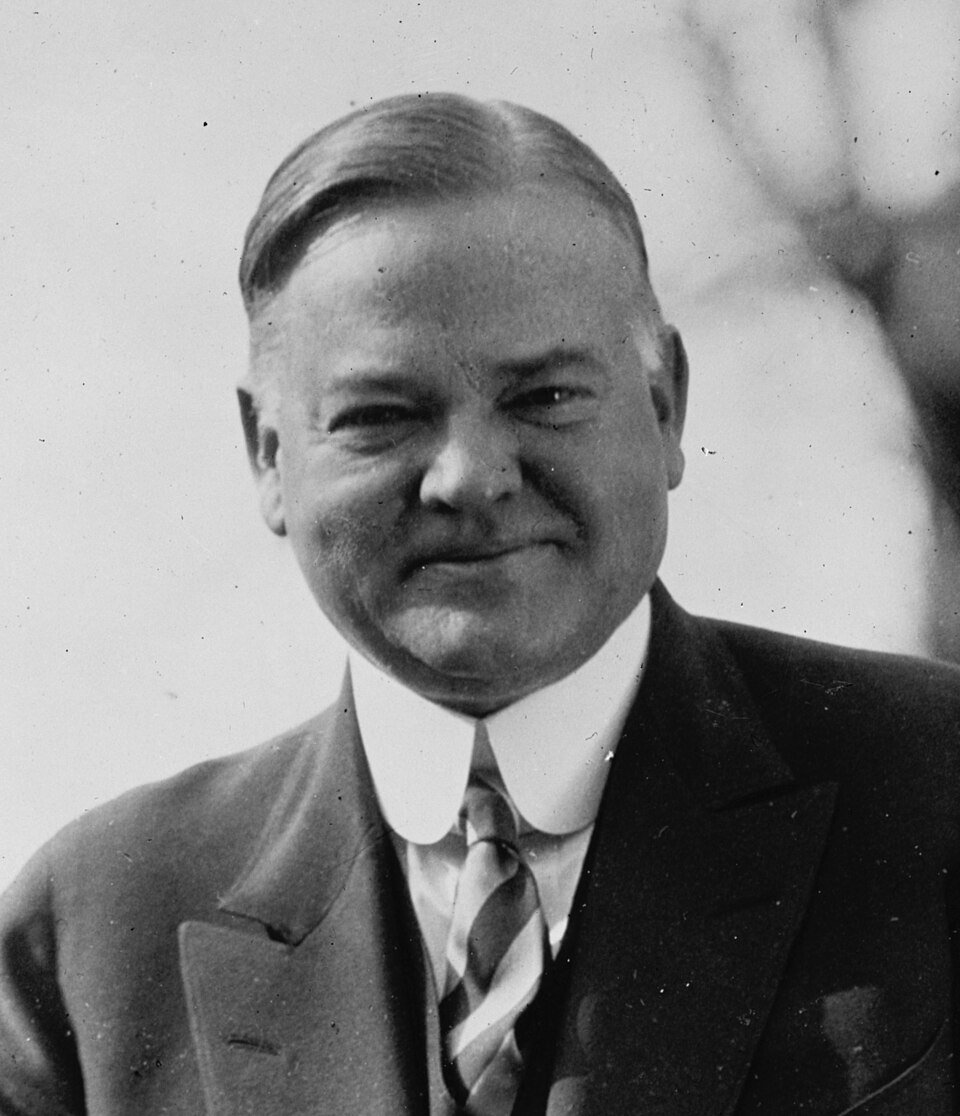
Herbert Hoover was a Quaker kid from a family of land swindlers and American Indian social service providers. A man with an eternal baby face, Hoover reminds me of Ludwik Stasiak’s famous paining, Allegory of Satan (Lord of the World) from 1900. By the time Stasiak had completed that image, Hoover had started his Rothschild career and was busy denuding China via London’s financial markets. (In our time another Rothschild stock market wunderkind, Jeffery Epstein, would become a macher on Hoover’s level.) You can read all about Hoover’s Rothschild career and international swindles in Walter Liggett’s biography of the president.
The zenith of Hoover’s Minnesota barons, barons who were Roosevelt family satellites, began with the Wilson Administration and WWI. Influential magnates like Chester Congdon had provided Teddy Roosevelt with industrial spies in the mining industry, a network which would later blossom into the “Central Intelligence Agency”— the employer of both James Jesus Angleton and William Egan Colby. President Wilson was elected because of Teddy Roosevelt’s calculated torpedoing of the Republican Party through his “Bull Moose” campaign. Teddy, never popular among Republican stalwarts who viewed him as a war-hungry maniac, had lost control of the party under Taft and was willing to partner with the Democrats to place a sheltered, controllable academic in the White House.

Remember this? President Woodrow Wilson with some of the White & Case lawyers involved in the despoliation of China alongside Herbert Hoover. I wrote about this creepy firm with respect to Monroe WI’s WWI-era theater, The Princess.
Franklin Delano Roosevelt’s maternal uncle, Frederic Adrian Delano, was a partner in Russell & Company, a leading opiate supplier to China’s vast network of indigenous drug lords. The Delanos will later feature in the career of William Egan Colby.
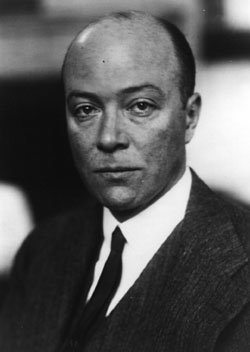
William Christian Bullitt and his psychoanalyst/co-author Sigmund Freud wrote a book about Woodrow Wilson, who they called “Little Tommy”. That’s the same Sigmund Freud who sold the Ringstrasse families Merck’s cocaine. Nervous maladies plagued Bullitt and the Ringstrasse, who collectively attributed this mental illness to fine breeding and being overly-cultured.
FDR would make Bullitt his ambassador to beloved ally Joseph Stalin, of the Cafe Central, until Marjorie Merriweather Post’s husband could be disentangled from the Ziegfeld Follies set in Florida named “Mar-A-Lago”. We live in a very small world. readers.
Teddy’s Minnesotans first profited from Hoover’s “Belgian Relief Administration”, a nominally private organization championed by Wilson’s ambassador to Great Britain and other war-minded men in London. The Holland American Shipping Line provided the freight service to Hoover’s Belgian Relief. (Holland American will surface again with Colby in Australia.) Once Wilson had officially entered the war, he created an even bigger version of Belgian Relief named the “United States Food Administration,” to which he appointed Hoover as head. The USFA was a socialistic price fixing scheme: Hoover underpaid American farmers for grain which he sold dear in Europe. (Don’t let anyone ever tell you that rich people don’t like socialism!) Middlemen like Julius H. Barnes, and quite likely James Angleton’s grandfather-in-law Chester Congdon, reaped vast fortunes from this swindle. These same Minnesota men followed Hoover to Washington D.C. during the Great Depression and the despoliation continued.
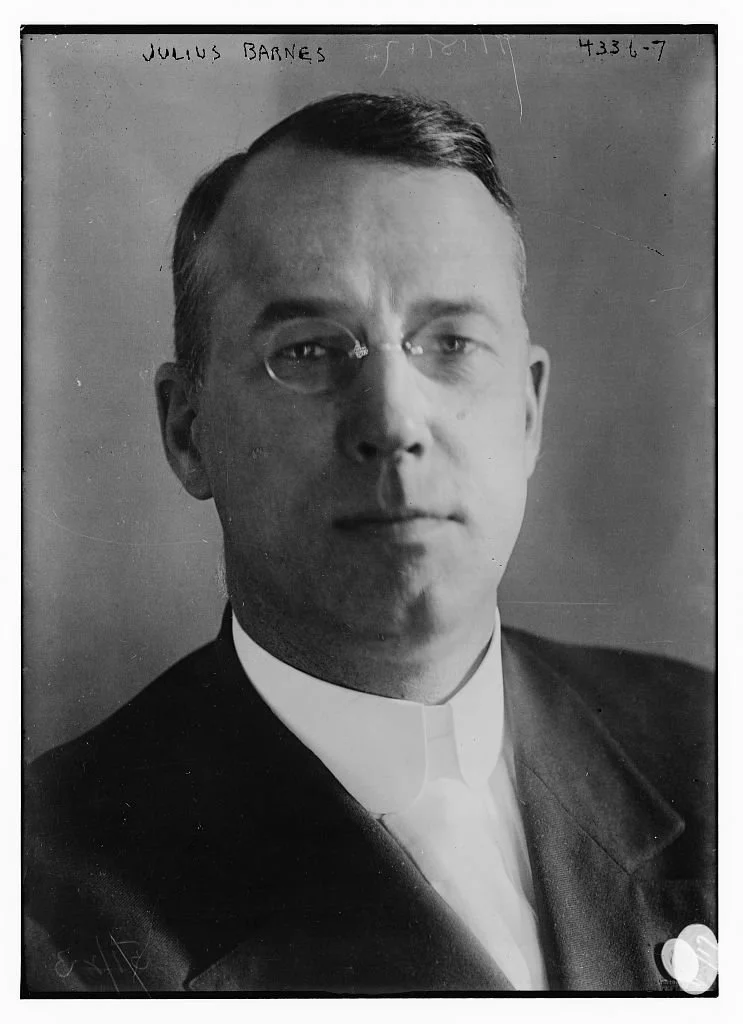
Duluth, MN’s Julius H. Barnes, war profiteer extraordinaire. This was an image supplied to the Bain News Service, a respected photography concern serving the leading newspapers of his era. If readers understand the significance of a portrait without a tie, do let me know. Library of Congress.
Fresh from his grain swindles, Barnes became a shipping magnate on the back of White House-originated shipbuilding contracts under Wilson. Money for both private freight carriers and warships commissioned for WWI and WWII built the “Barnes-Duluth Shipbuilding Company”. Then power in Washington D.C. shifted from the right foot to the left: Teddy Roosevelt’s nephew-in-law Franklin Delano Roosevelt was elected president and more war would follow. (Eleanor was a Roosevelt both before and after her marriage. Throughout history and across cultures organized crime families tend to practice consanguineous marriage.)
FDR spent much of his first administration winning over business interests and on-boarding other organized crime families like the Princes and Kennedys in Boston. In 1943 the “Barnes-Duluth Shipbuilding Company” was bought by Walter Butler, the chairman of the Democratic Party’s finance committee in Minneapolis, MN and a good friend of Franklin Delano Roosevelt. Power shifted from Duluth to Minneapolis, MN, the stomping ground of the Egans. The Duluth company changed its name to “Walter Butler Shipbuilders” but all the military contracts remained the same. According to leading contemporary investigative reporter Fulton Lewis Jr., Walter Butler boasted that he controlled the AFL-CIO in Minnesota and could hit any of his subcontractors with illegitimate strikes should they fail to contribute to FDR’s political endeavors. These mob-backed abuses of unionization are where Democratic party political families like the Egans came in. With the end of the war in 1945, all of Butler’s Navy contracts dried up and President Truman made him the United States’ first ambassador to Australia.
Regular readers may remember that it was at Ambassador Butler’s celebration party that the only known photograph of “Commander William Egan” was taken.
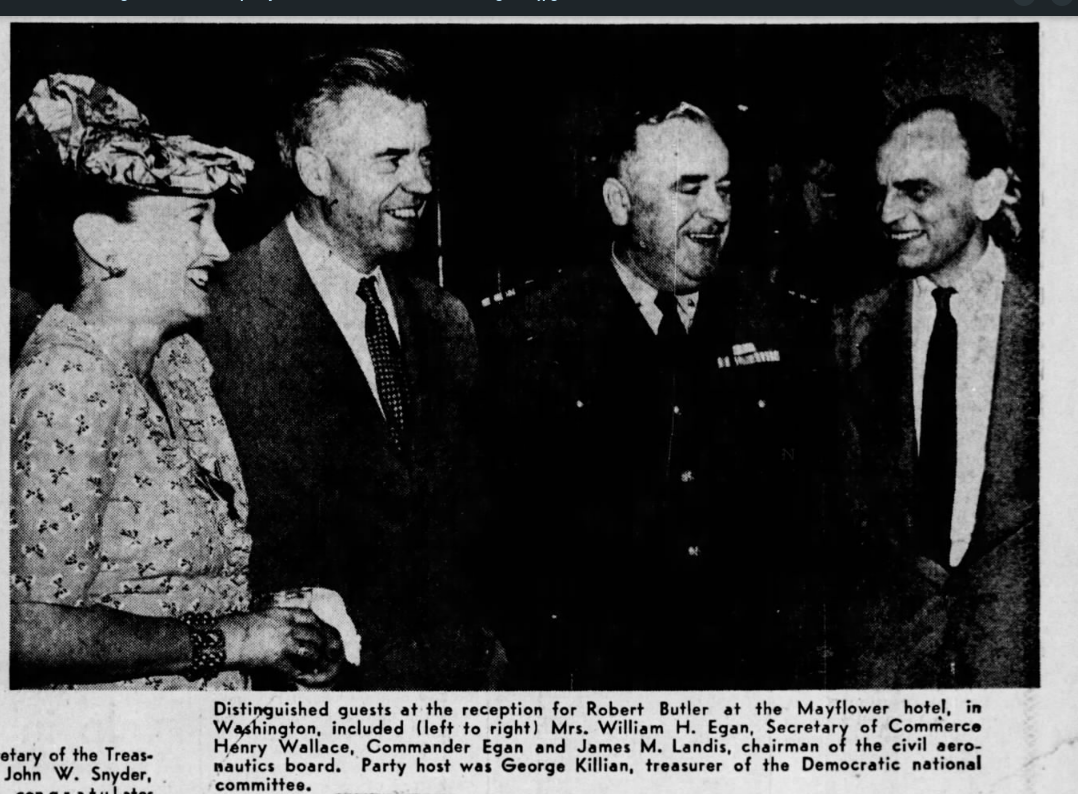
Minnesota Star Tribune, August 4, 1946.
I cannot prove that Commander William H. Egan was William Egan Colby’s maternal uncle of the same name, as Colby’s uncle’s genealogical records after 1940 have been scrubbed from Ancestry.com; no military records of Commander Egan are available; and the above is the only in-print reference to the commander or uncle which I could find. I can tell you, however, that the commander is wearing a Navy uniform.
Butler’s Australian connection is important because the mob-union contacts he exploited in Minneapolis were part of a larger organized crime problem, a problem centered around the Democrat Farmer-Labor Party, Minneapolis’s Bossism party, in which the Egan family were “participants” per William Colby’s autobiography. Besides corrupting elections and buying politicians, the Minneapolis mob was an extension of the Galician Gang. They were into human trafficking, prostitution and drug dealing too— especially drugs from German companies like Merck Pharmaceuticals. Read about their Monroe, WI and Chicago branches in Leon Goetz’s Mann Act Indictment. By the 1930s the gang’s Twin Cities honcho was the notorious Charlie Ward, per Walter Liggett. Liggett’s widow fingered Charlie Ward as the man who paid Kid Cann to shoot her husband after the Liggetts reported on Ward’s connection to the Farmer-Labor Party. Liggett wasn’t the only local journalist to be murdered during this period, either. High-profile murders of inconvenient journalists were tolerated in the Twin Cities, where the O’Connor System of organized, tolerated corruption ruled.
How interesting then that, having been fired from the CIA for his public disclosure of company secrets, William Egan Colby became the US attorney for an Australian bank named “Nugan Hand” which existed to 1) launder drug money out of South East Asia and 2) sell mobsters legal advice on how to avoid taxes. Colby built his CIA career overseeing American intelligence operations in SE Asia, an opioid hot-spot, while Colby was by profession a lawyer. Perfect fit!

Advertisement for Colby’s Nugan Hand Bank, which liked to portray itself as technology-forward. This image was probably justified, as Telex technology was closely associated with the Central Intelligence Agency and its corporate partner AT&T, a Lincoln-era telecommunications monopoly. Not just anybody could use Telex, AT&T had to give customers a special registered terminal. Telex would also feature in “The Finders” CIA child trafficking scandal, a precursor to the Franklin Scandal in which Bill Colby involved himself to such mediocre effect.. Sydney Morning Herald, September 26, 1978.
Nugan Hand Bank was, even before the time Colby claimed to work for the bank, a mob bank. By 1973 the Nugan family, wealthy WWII-era immigrants from Spain, had already been implicated (not convicted) in stealing from their investors; in money laundering; and in drug smuggling using a squad of dubious former police detectives. (See SMH “The Man Behind Nugan’s Recent Growth”, 11/7/77; “Nugan Case: Former Detectives Cleared”, 11/6/79; “Why Did Billion Dollar Banking Director Die?” 2/3/80; and “Bank Appealed to a Limited Clientele”, 3/5/80). Nugan criminality seems to have gone into overdrive around 1973, when the Castle Bank & Trust was exposed. That same year the Nugan fruit company went public and their son Francis formed a bank with a gaggle of American “green berets” from Colby’s sphere of command in Vietnam, co-lead by a pudgy former beret named Michael Hand. The “Nugan Hand Bank” was able to take the position of the recently-exposed Pritzker Family/CIA operation, Castle Bank and Trust, supplying covert funds to CIA operations around the world and helping Sydney families analogous to the Chicago Pritzkers avoid taxes.

The Pritzkers, a highly cultured family, have a proud military tradition just like the Colbys. Here, Jennifer Pritzker stands center:
“Ret. Army Lt. Col. Jennifer Pritzker, founder of the Pritzker Military Museum and Library in Chicago, poses with two Soldiers with the 144th Army Band prior to a rededication memorial in Chicago’s Bronzeville neighborhood, July 5, 2019.”
Jennifer also sponsored a book about sex trade empress Bertha Palmer’s gorgeous dresses via the Chicago History Museum and curator Timothy A. Long.
Who were those Syndey families analogous to Chicago’s Pritzkers? The nature of the Australian gangsters who Nugan Hand helped provides a fascinating look at how the Galician Gang metastasized into Australia following the rise of Adolf Hitler in the 1930s. Hitler’s government, like Mussolini’s, made tackling organized crime a priority, as did popular American politicians like New York Governor Thomas E. Dewey, who helped Mrs. Liggett defend herself against COMINTERN attacks after her husband’s murder in Minneapolis. In the 1930s most developed economies were suffering from international gangs of organized criminals who were originally from the former Austria-Hungary.
Vienna’s Hapsburg-era Ringstrasse families, while not the bag-men or wet-work specialists of Austria-Hungary’s mob scene, acted as “intercessors” or shadlanut between Jewish street thugs and the Hapsburg government. (While the Ringstrasse families were overwhelmingly Jewish, they were not entirely so, and some had mixed Jewish-Gentile ancestry.) The Ringstrasse may even be described as the ‘shadlanut for the shadlanut’, as regional intercessor families developed around hubs of the trafficking trade, like in Trieste, and these regional potentates relied on Ringstrasse intercession from Vienna when traffickers fell afoul of local laws. (An excellent examination of this system is The Port Jews of Habsburg Trieste, by Lois Dubin.)
The Ringstrasse had determined to leave Vienna thirty years prior to Hitler’s rise because the democratic system they had originally championed after 1848 became too diverse to serve their interests and the heir to the throne, Archduke Franz Ferdinand, was an unreliable ally. Hitler’s rise certainly accelerated this immigration and many moved: some to Turkey, where the community had historic ties through the White Slave Trade, but most to the Anglo sphere— New York, London and even Sydney. Prominent “Sydney Push” members from privileged families in German Europe include: metaphysicist George Molnar (a graduate student of Sydney Push guru John Anderson); Lillian Roxon, originally ‘Ropschitz’ (a journalist for the Packer family); Michael Taussig (a Marxist/Frankfurt School anthropologist and Guggenheim Fellow); and finally Bettina Arndt (a feminist sex therapist and pedophilia advocate) . Jelesko Grancharoff a.k.a. “Jack the Anarchist” was a Bulgarian professional revolutionary on the non-communist left, who originated from the same political sphere as Tito and Stalin.
The “Sydney Push” philosophy is exactly what you would expect from the children of rich people in the 1950s: supporting casual sex and recreational drug use; against conscription; ‘formerly communist’ and great at self-promotion. They were basically a clone of the Frankfurt School and its revolutionary paradigm of “permanent criticism” of European Christian Culture. University of New South Wales historian James Franklin describes them as “Critical Drinkers” and “Corrupting the Youth” through the activism of Molnar and his newspaper Sydney Libertarians Broadsheet. Social commentator Richard Ackland in Justinian calls them “a pack of hoary narcissists and their doxies”. Ackland’s is an astute criticism, given that Freud developed his theory of narcissism by studying his own social class.
It does seem that the Push existed to recruit teens, especially from Sydney’s artist’s model population, who were then used for sex by its older members and indoctrinated with Molnar’s ideology, Socrates-style. Lyn Gain, in her autobiography Witch Girl and the Push, details how she was liberated from school and put on the pill so she could be used by “stick men” at Push hangouts. Gain’s attitude toward her abusers is precisely that noted by Charles von Onselen among Galician Gang grooming victims: Stockholm Syndrome. (See the tragic case of sex trafficking victim Rachel Silver in The Fox and the Flies, 2007.) The Push scene was noted for the number of young models milling around its watering holes. (Below: Bird subjects at Lincoln Cafe, 1948-52. Anne Barrett, Margaret Meagher, unknown Greek girl. See “Cigarettes and the White Slave Trade”.)


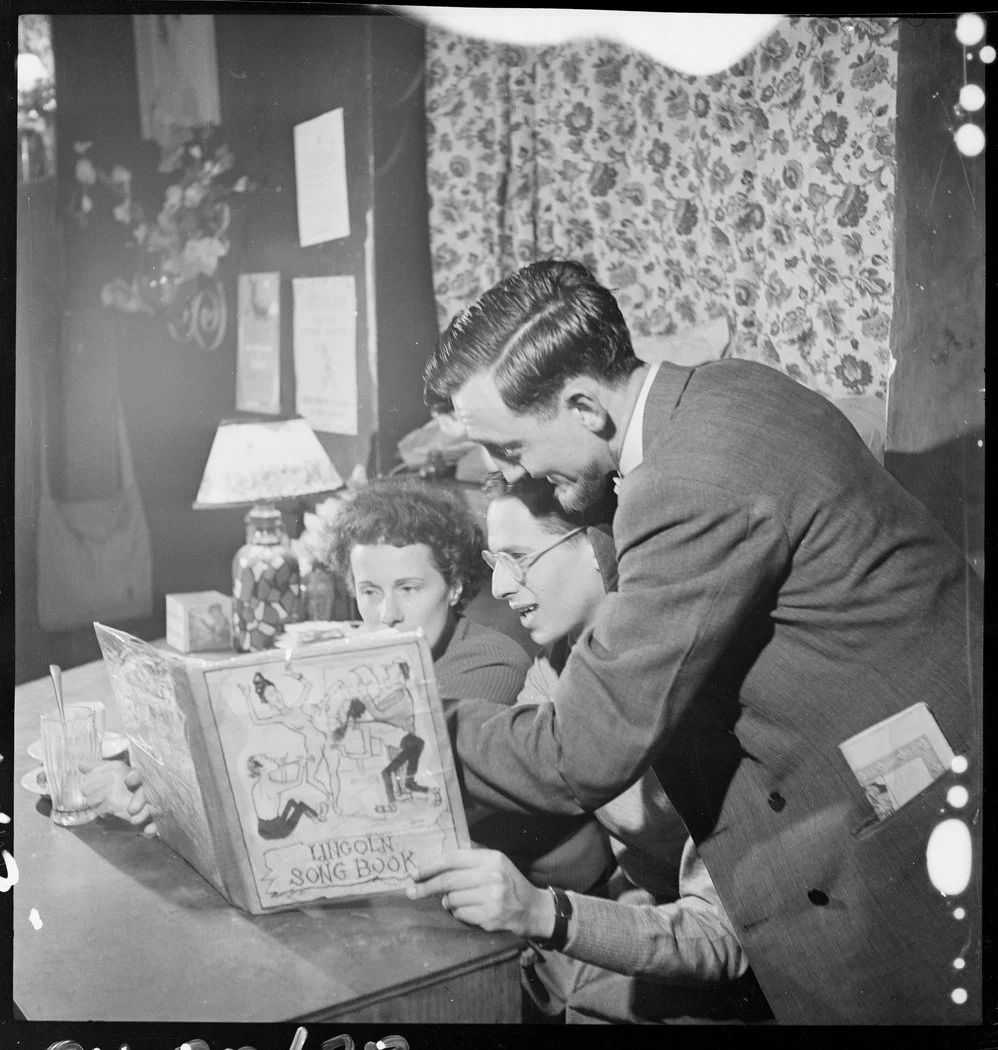
“Ede Cohen (usually on cash register); or Martin Edie from Lincoln Coffee Lounge and Cafe, Rowe Street, Sydney - photographed by Brian Bird c. 1948-195”
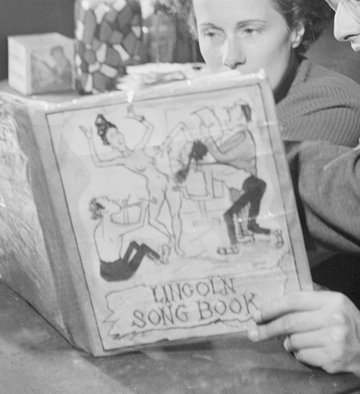
It was and still is common for bordellos to offer pornography or bawdy entertainment to get clients in the mood.
While Sydney Push politics were simplistic and self-serving, their impact on Australian government, particularly via the spending of social services money, was profound. As one proud Pusher Richard Brennan elaborates via The Guardian:
It was not a future that a lot of us saw coming towards her [NSW Council of Social Service Director Lyn Gain] but neither would many have predicted a career for Roseanne Bonney in the Bureau of Crime Statistics, or Andre Frankovits’ long involvement with Amnesty, or Irina Dunn’s election as a Nuclear Disarmament senator or John Maze morphing from his long tenure as lecturer and tutor in the Psychology Department to the authorship of a series of fantasy novels for young adults.
The Push were a marketing putsch for the lifestyle promoted fifty years earlier by Aleister Crowley— however the Sydney Push did not promote itself as an occult organization. Rather, they publicly took the Marxist stance that religion was just superstition and a control mechanism. Everything else about the Push was Crowleyan, especially his mandate “Do what though wilt shall be the whole of the law”. The Push’s Marxist stance was an effective, palatable half-way point between Australia’s Protestant culture and the Hermetical underpinning of their social engineering.
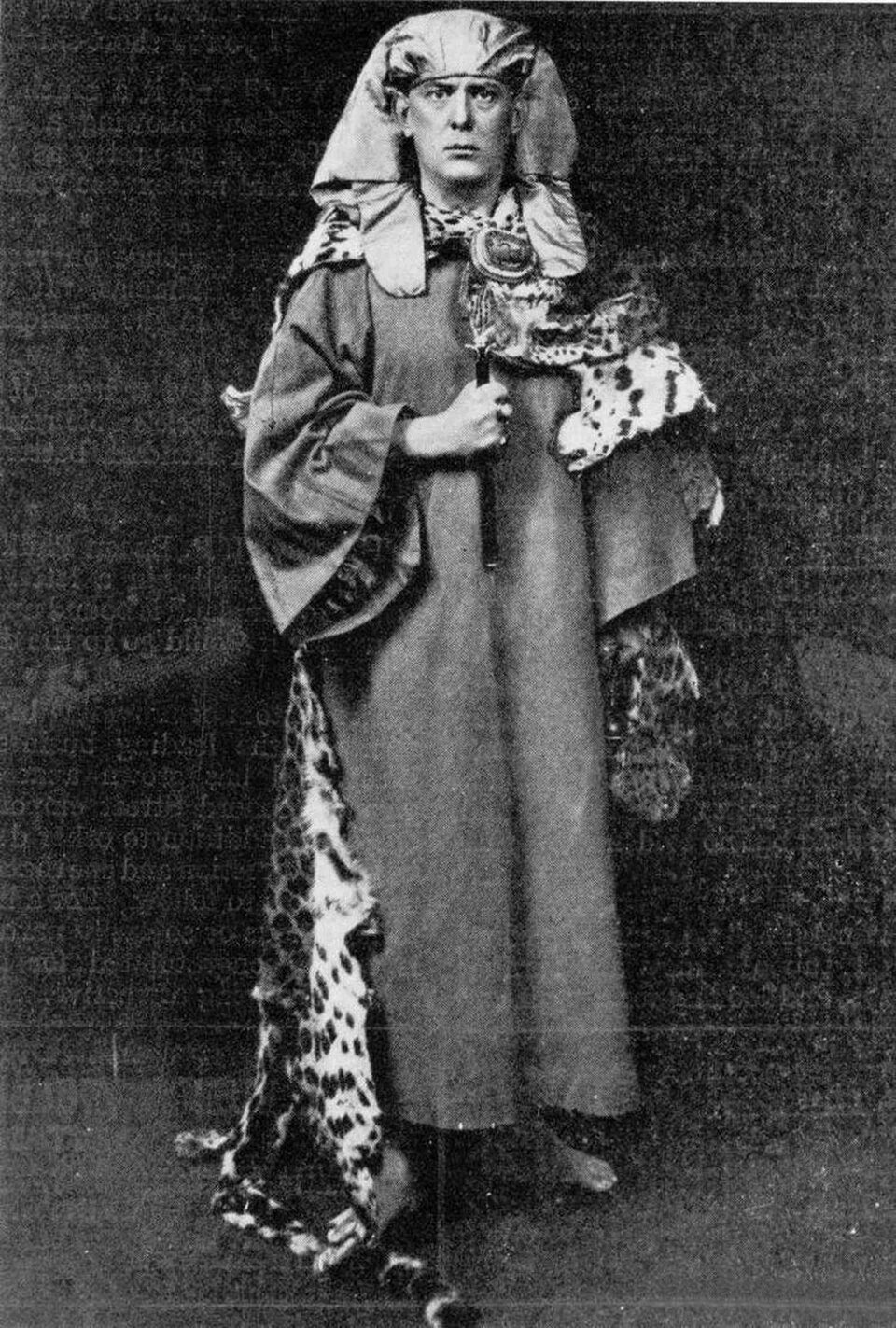
“The Beast” Aleister Crowley in getup he invented for his “Golden Dawn” cult. I wrote about another Crowley devotee named Kenneth Anger who was warlock to the Rolling Stones— a warlock with a lot of CIA connections, beginning with the non-communist left “Congress for Cultural Freedom”. We can trace the origins of the 1960s “Cultural Revolution” to 1890s London.
However, behind the scenes, where the Push went Crowleyesque occultists followed. Take for example Rosaleen Norton, a young artist’s model who hung out in the Push recruiting neighborhood “Kings Cross” in Sydney’s Central Business District. Norton was a devotee of The Beast exactly like her American alter Marjorie Cameron. Before becoming a witch, Cameron served as a secretary to the US Joint Chiefs of Staff, while Norton was the author wife of an Australian commando named Beresford Lionel Conroy. Norton met her occult sponsors while writing for a wartime entertainment periodical titled Pertinent. Although Pertinent closed its doors in 1947, Norton found succor at the University of Melbourne's Rowden White Library which showcased her pornographic occult paintings, paintings which cultivated the same witchy themes as Marjorie Cameron’s artwork. Crowley himself was an artist and an espionage agent for the British Government.
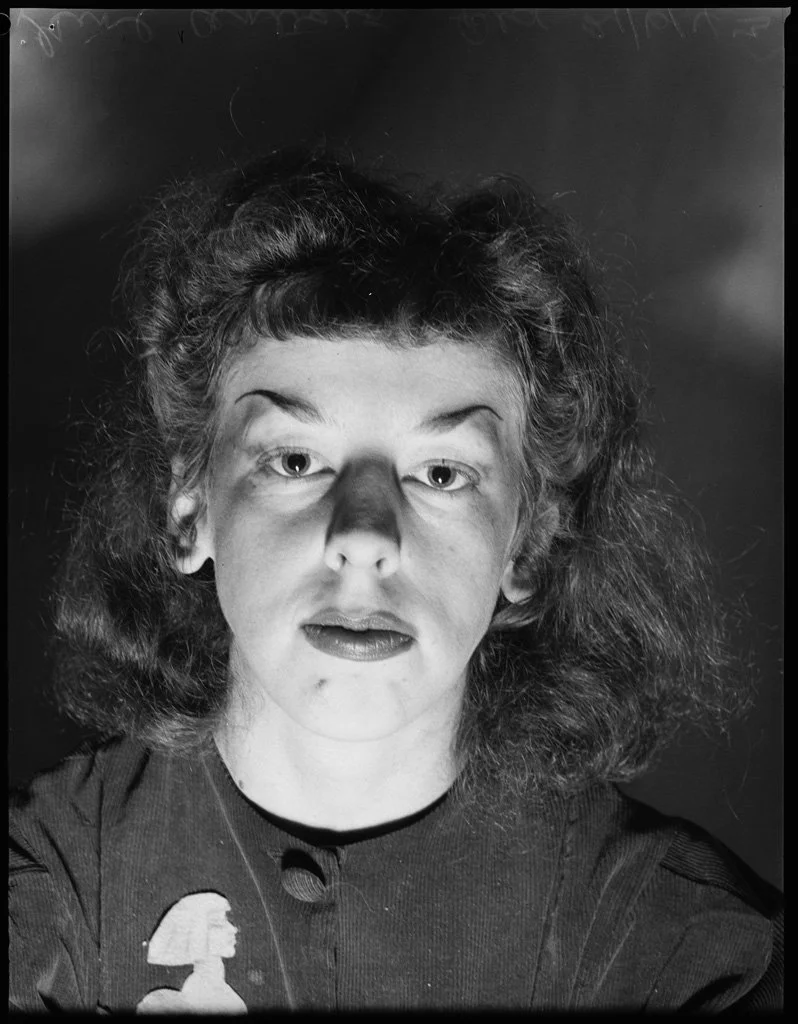
Rosaleen Norton in 1943.
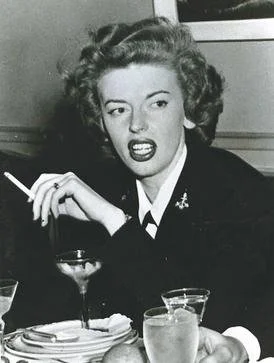
Marjorie Cameron circa 1943.
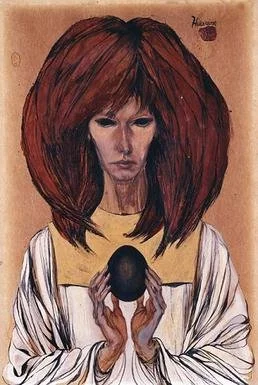
“The Black Egg”. Marjorie Cameron’s self-portrait.
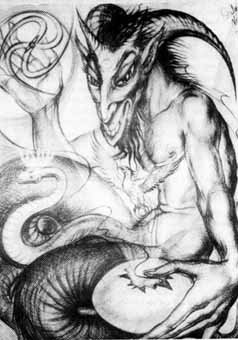
Rosaleen Norton’s “Fohat”. Satanic egg imagery was the fashionable way to be different the same.

Still from Inauguration of the Pleasure Dome, Cameron’s film peon to Aleister Crowley. Here Cameron is depicted conjuring a luciferian entity.
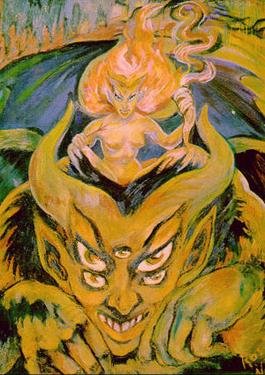
Rosaleen Norton’s “The Seance”.
In modern culture Marjorie Cameron and Rosaleen Norton are obvious prototypes for the rebranding of “Morgan Le Fay,” Thomas Malory’s sexually predatory enchantress and pretender to the English crown in Le Morte d'Arthur, as a feminist icon. Occult scholarship typically looks no further back than to the 1980s for this rebranding, particularly the sci-fi work of Marion Zimmer Bradley, probably because real people make uncomfortable goddesses.
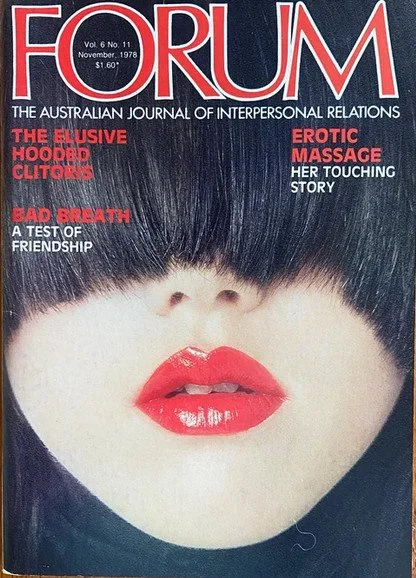
So that’s the “Sydney Push” schlock, but what about the Sydney Push money? The richest Push members were abortionists, or the financial backers of abortionists. The first on the scene was Dr. Gerry Davis, employee of an American sex toy company. This sex toy company had a subsidiary that sold abortion services to humanitarian aid organizations like Planned Parenthood International and the United Nations. Dr. Davis practiced in Australia under the auspices of this subsidiary. The second abortionist was a corporate media nepo-baby named Clyde Packer. Packer joined up with casino magnate Gordon Barton to bankroll Davis’s abortion competition: the “Preterm” organization. (Both Barton and Packer were Liberal party operators who founded their own ‘Bull Moose’ splinter Liberal parties.) Packer ran an adult sex magazine with Bettina Arndt titled Forum, and as you can see below it was as much an academic journal as Cosmopolitan. Jealous of each other’s profits, the dueling mobsters Davis vs. Packer most likely firebombed each other’s abortion clinics in the 1970s. Both attacks are acknowledged to be cases of arson, but neither was ever solved by Sydney police.
When Preterm appeared on the scene in 1974, Dr. Davis’s formidable profits were undermined. Davis’s competition was duly attacked by arsonists in 1975, putting them out of business for 18 months and allowing Davis to consolidate his hold on the market:
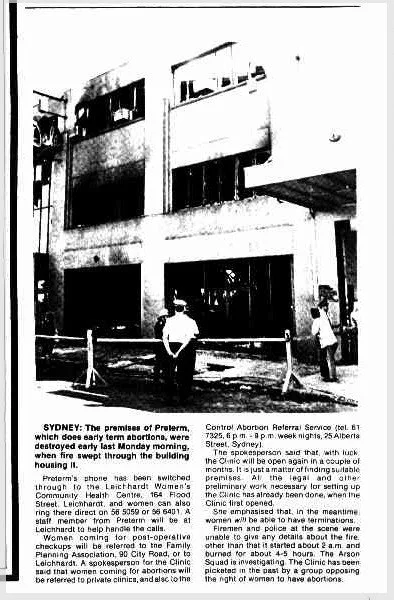
Sydney Tribune, April 9, 1975
Preterm’s director came forward with her suspicions about the arson attack:
But Nolan [Preterm clinical director Dorothy Nolan] has darker suspicions. One of the doctors who had run a lucrative abortion business in Arncliffe until Preterm came on the scene had been making threatening calls to her home at all hours of the night and day. His gardener lived near the clinic. She believed he had paid off his gardener to set fire to the clinic because it had been undercutting his business. “There was a strong suspicion but we never had proof,” Nolan says.- Forging A Safe Abortion System, Sydney Morning Herald, Sept 13, 2019.
Some proof came later, when disgruntled feminist employees left Dr. Davis’ PSI clinic and distributed this letter from the doctor, which dated from shortly before the Preterm fire:
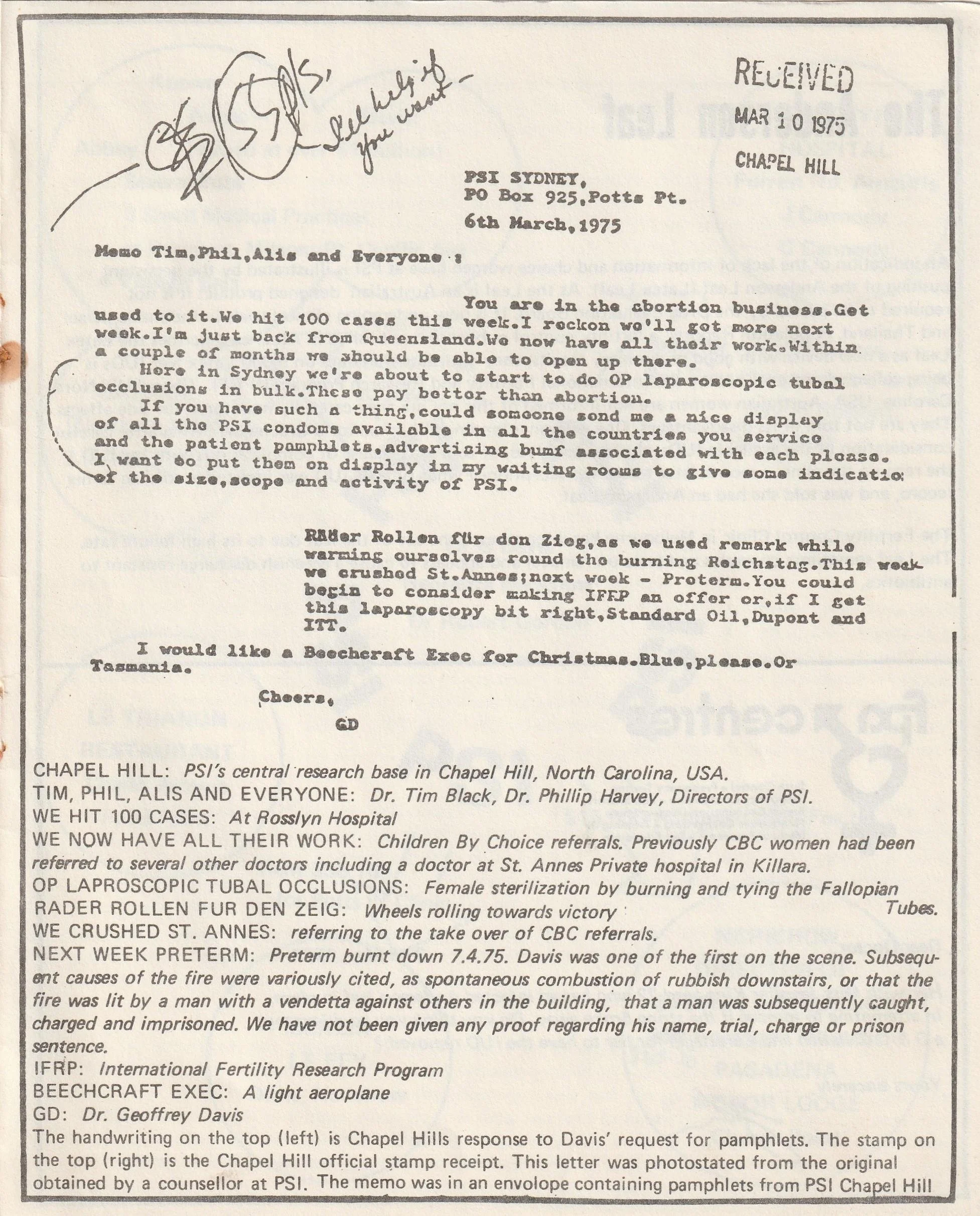
Image reproduced from “Abortion: Our Bodies Their Choice”, a manifesto printed by the Feminist ex-employees of Dr. Geoffrey Davis. In this letter, Davis claims camaraderie with the COMINTERN agents who burned the Reichstag parliament building in 1933. Very Push. Note how the good doctor is keen to court American money.
Exactly two years later Packer’s crew probably got back at Davis. Packer had the best motive in furtherance of the squabble over profits and territory. Though, as I stated, neither arson attack was ever solved:

Sydney Morning Herald, April 13, 1978 The “feminist abortion organization Control” was an disgruntled offshoot of both Davis’s and Packer’s organizations.
Abortion has always been handmaiden to sex trafficking, and these Push abortionists’ attitudes towards women reflect the Lustmord sickness of the Galician sex trade. Shortly after their founding, both Davis’s PSI clinic and Packer’s Preterm clinic (Bettina Arndt sat on Preterm’s board) saw a mass exodus of their feminist staff for precisely these misogynistic attitudes: the feminists realized that they had been dupes. Bettina, of course, stuck by her Push sponsors.

Woroni (feminist magazine), September 9, 1980 page 19. PSI’s Geoffery Davis would receive an adverse judgement in a malpractice suit in 1984 when he left an aborted baby’s head in their mother.
What follows is an example of the Lustmord attitudes reported by the former PSI employees, who also disclosed that Davis’s abortion business was funded by the Ford Foundation and USAID, both of which worked closely with Colby’s CIA:
On one occasion when a health worker from another clinic commented on the [PSI] practice of smoking in the theatre, she was told by the manager, "Don't worry, around here we use cunts as ashtrays." [Abortion: Our Bodies, Their Choice.]
Bettina Arndt, the skirt behind whom Packer and Davis hid, would take up another Ringstrasse cause in her later promotion of pedophilia. Just like Ringstrasse psychoanalyst Sigmund Freud, Bettina Arndt blames the children who are victims of sexual predators for their abuse. From news.com.au, “Rosie Batty speaks out against Australia Day award winner Bettina Arndt” January 7, 2020:
Last year Ms Arndt drew criticism after she gave a sympathetic interview to twice-convicted paedophile Nicolaas Bester. Bester was 58 when he groomed and repeatedly sexually assaulted a 15 year old student, Grace Tame, while he was her maths teacher at an elite private school in Hobart.
On arrest in 2011, Bester was also found to be in possession of 28 piece of child pornography. Following his sentence for the sexual abuse and child pornography charges, Bester was rearrested in 2015 for production of child exploitation material. He also boasted on social media that the sexual abuse of Grace Tame was “awesome” and that other men would be “envious”.
Yet in a sympathetic interview with the paedophile, Ms Arndt accused the victim of engaging in “sexually provocative behaviour” adding that school girls should not “exploit their seductive powers to ruin the lives of men”.
Just like NAMBLA spokesman Allen Ginsberg, Bettina thinks pedophilia should be socially acceptable. From the same source:
Ms Arndt has previously attracted criticism for her views on domestic violence as well as her views on paedophilia.
In 2005, she described Robert Potter, a convicted paedophile and former scout master, as a “good bloke” in an article she penned in the Courier Mail. Potter was found to have sexually assaulted four scouts, one of whom later attempted suicide. At the time, Ms Arndt lamented the “moral panic over paedophilia”, saying “such minor abuse rarely has lasting consequences”.
Prior to that, in 1997, Ms Arndt defended a Canberra doctor who had molested multiple patients, including a 12-year-old child, arguing that the sex offender should not be charged over the molestations, because in another context masturbating a person would be a “loving and pleasurable” act.
Rosie Batty says that such views are incompatible with an Australia Day honour.
“Bettina Arndt represents who we are trying to educate and bring on the journey with us and I can’t believe someone with her thinking is being publicly rewarded and acknowledged in this way. How could this happen? How could we get to this place. I am in utter dismay.

Sydney Push luminary Bettina Arndt has a fascinating family history. Her grandfather was a German chemist who went to Istanbul to develop the University’s chemistry faculty and was forced out of his Breslau University chair when the Nazis gained power. (See my work on the OSS in Istanbul and Hospital Gangsters.) Bettina’s father made the Ringstrasse exodus out of German Europe to Oxford University. (See my writing on Bertha Szeps Zuckerkandl.)
Dr. Geoffrey Davis was an even creepier character than Clyde Packer or Bettina Arndt. Davis had been practicing abortions from before they were legal in Australia, and had previously had his license to preform abortions withdrawn in the U.K.— the reasons for this were not disclosed, but gross negligence in his work was discovered in 1984. In the early 1970s Davis worked in tandem with Los Angeles “psychologist” Harvey Karman, in reality a convicted back-room abortionist, to develop a type of experimental morning-after pill, which was sold in L.A., New York and London. (Newsday, Suffolk Edition. Jul 19, 1972) Karman would later go into the notorious “Super Coil” abortion business with Kermit Barron Gosnell, a convicted American serial killer and abortion doctor with drug charges— he was one of those Oxytocin slingers for the Sacklers. Interestingly, when Gosnell’s clinic was raided, officers found a very dirty operating environment just like Davis’s. Gosnell’s criminal activities were historically Galician Gang strongholds and he died in prison this March.
Davis was the only known doctor in Sydney’s abortion scene who made obscene amounts of money from his practice and for this he was known as the “abortion king”. (“Abortion Profiteer Runs Clinic, says MP” SMH, 5/4/80). From the early 1970s Davis was an employee of an American sex-toy company named “Adam & Eve,” which, also with the help of a Ford Foundation Fellowship, has become the largest employer in Hillsborough, North Carolina. The sex toy company started an abortion services subsidiary named “Population Services International” (PSI) under the auspices of which Davis worked in Sydney as well as in the Third World.
When Bill Colby’s Nugan Hand bank was exposed, The Sydney Morning Herald identified a rich abortion doctor as being a major investor in the bank:

The Sydney Morning Herald, May 4, 1980.
That fact that Dr. Geoffrey Davis was the only doctor in Sydney’s abortion scene who was likely to have half a million dollars to throw around, paired with his repeated use of funds from known CIA covers, strongly suggests that Davis was the abortion doctor who the SMH alluded to in the article above. So let’s talk about Davis’s American connections, the source of his power.
As I mentioned previously, Davis’s ultimate employer, the North Carolina-based company “Adam and Eve” operated a subsidiary, “Population Services International” (PSI), that by 1971 was a United Nations and Planned Parenthood International subcontractor which provided large-scale abortion services in third world countries like Kenya. Davis worked for PSI as a for-hire abortionist. Davis hit his stride in Bangladesh in 1971, where Pakistani soldiers had systematically raped hundreds of thousands of Bangladeshi women and children with the same barbarity we see among the Pakistani Muslim Grooming Gangs in Great Britain today. While he was performing these abortions, he was also hawking Karman’s/Gosnell’s dangerous “Super Coil” abortion procedure to the rape victims. The UN and Planned Parenthood had sent Davis in to abort these babies, 100 a day he says, ostensibly to “save” these rape victims from Bangladeshi society, which does blame the victim in rape cases. From BDNews24, “1971: Rape and its consequences” December 15, 2010:
While rape was a victimisation process that involved the Pakistanis, the response to the raped and the impregnated by the Bangladeshis were horrific. According to Dr. Davis these mothers of raped children were treated in the worst possible way by many of their husbands or family members. He says, "And the men didn't want to talk about it at all! Because according to them the women had been defiled. If they had been defiled they had no status at all. They might as well be dead. And men killed them. I couldn't believe it!" Rape victims suffered from both sides.
Of course, one of the most chilling testimonies given by Dr. Davis is about the attitude of the rapists, the Pakistani soldiers. Taking about the rape strategy, Davis says, "They'd keep the infantry back and put artillery ahead and they would shell the hospitals and schools. And that caused absolute chaos in the town. And then the infantry would go in and begin to segregate the women. Apart from little children, all those were sexually matured would be segregated while the rest of the infantry tied… And then the women would be put in the compound under guard and made available to the troops."
Dr. Davis adds, "The West Pakistani officials didn't get why there was so much fuss about that. I interviewed a lot of them. And they were saying, 'What are they going on about? What were we supposed to have done? It was a war."
In reality, Dr. Davis was there for eugenic purposes rather than the mental health of the rape victims. (“Population Services” was the clue!) Because these purposes were so controversial, he had to lie about who was funding him, the doctor speaks:
He [Davis] worked under the auspices of International Planned Parenthood, the UNFPA and the WHO. He begins by remembering that no particular organisation wanted to claim him as one of their own due to the extremely sensitive nature of his work.
Dr. Davis remembers, “I was trying to save of what have survived of the children born during the time that the West Pakistani army had Bengali women incarcerated in their commissariats. And all of the ones who had not come to term, our brief was to endeavour them to abort the foetuses so that they didn't bear children as diseased and undernourished as was the case. And that we succeeded in doing.”
In truth, Dr. Davis had no way of telling which among these Bangladeshi children and women were sex trafficked, as often happens at greater scale in war, and whether his abortion services were used to keep them working, as Planned Parenthood abortion services are used by sex traffickers in the United States today. This ugly business stood Davis in good stead to set up his Sydney abortion practice with Population Services International under his holding company named “Merlin Lafey Pty Ltd”. As in Wizard Merlin, one of Crowley’s “Gnostic Saints”, and Merlin’s sexually predatory half-sister, enchantress Morgan la Fey, who I discussed with respect to Aleister Crowley above. It’s a good time to talk about Davis’s personal beliefs.

The Toronto Star, August 24, 1972.
Davis never left a manifesto. He never spoke to the press about which aspects of the Sydney Push philosophy he adhered to, he simply threw parties for them at his lavish home. His home, however, can tell us something about how he saw himself.
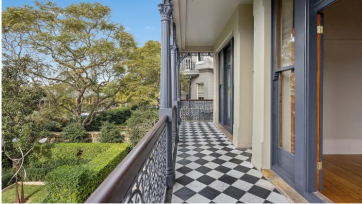
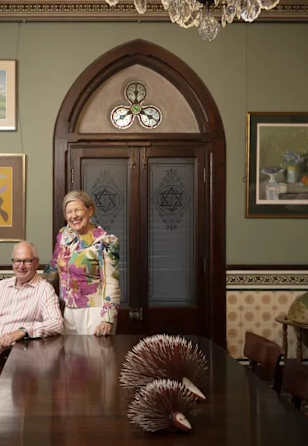
Davis lived in one of the eight famous “Witches Houses” (as the general public has dubbed them) in the Annandale suburb of Sydney. The doctor’s home was named “The Abbey,” a gothic fantasy replete with ghosts, gargoyles and masonic imagery, see below. (The other seven houses on Johnston Street were named Oybin, Greba, Rozelle, Claremont, Hockindon, Kenilworth and Highroyd.) It was in “The Abbey” that Davis would host parties for the “Sydney Push” crowd I described earlier. Aleister Crowley chose the same name for his cult base in Cefalù (Sicily, Italy): “The Abbey of Thelema”. Rolling Stones warlock Kenneth Anger’s lost BBC documentary was an exploration of the ruins of this small Sicilian house.
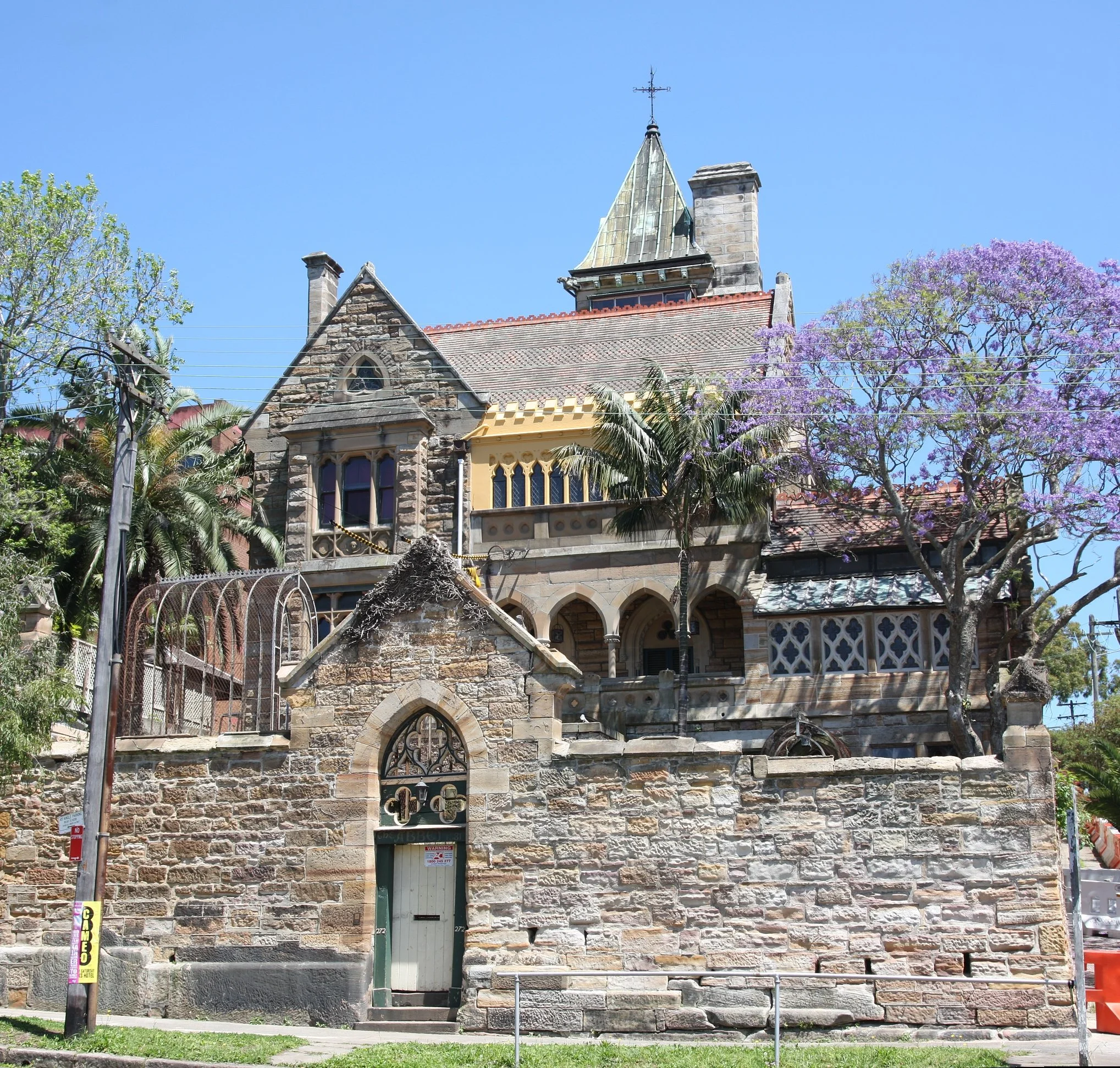
The Abbey, Annandale suburb, Sydney. I bet that gardener had a lot of work to do.

The Abbey’s door: enter at your own risk.
Checkered stone floors and six-pointed stars are among the Masonic symbols which decorate the remaing three houses of the original seven “Witches Houses” designed by John Young.
Davis’ disgruntled feminist employees provided the following diagram explaining Merlin Lafey Pty Ltd in the context of Davis's larger entertainment business empire:
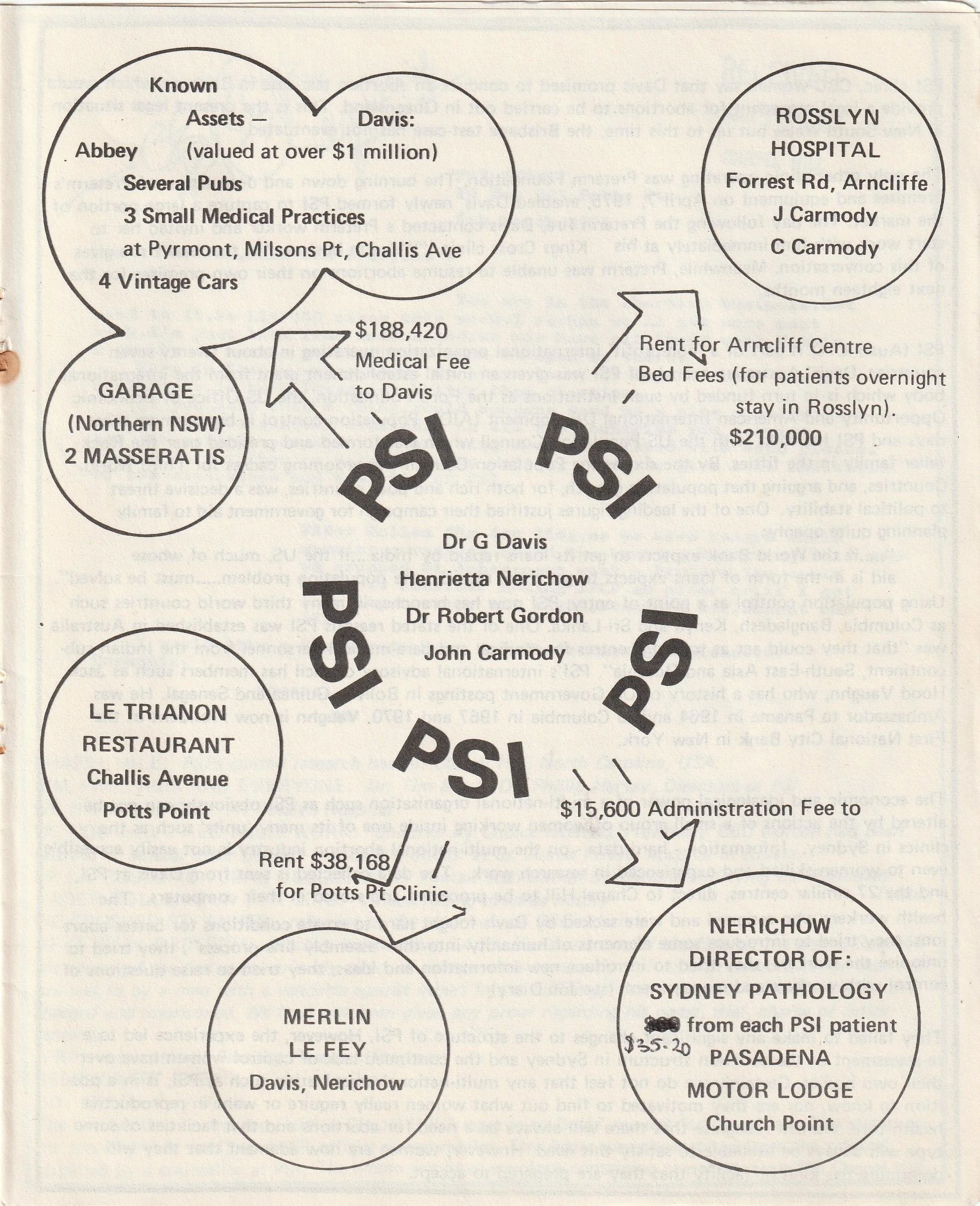
Note how Dr. Davis is investing in restaurants, pubs, cheap motels and the lifestyle accoutrements one might expect from a pimp.
I put it to readers that practitioners of the occult, particularly satanic practices, associate “the destruction of innocence” with attaining a very high degree of spiritual power. It’s not unlike the spiritual progression of Prince Arjuna in the Bhagavad Gita, as the prince devolves into a maniac willing to sacrifice his people to the gnashing fangs of Krishna in exchange for magical power. In more prosaic terms, high control groups like the Mexican cartels will order initiates to kill innocent people as a way to break the initiate psychologically and encourage dissociation, making the initiate suggestible and controllable. This is the function of the cartels’ “terror schools”. From an occult perspective, the abortion trade is a wizard-factory. I will speculate that Davis was “king of the Sydney warlocks”, too.
Occultists tend to fetishize the implements of their magickal workings. Consider then that someone from Dr. Davis’s estate donated his abortion tools— those tools for killing many thousands of babies, tools which his feminist employees claimed were never properly cleaned between procedures in smokey operating theaters— to Australia’s “Powerhouse Collection”. What is the Powerhouse Collection?
Powerhouse is custodian to more than half a million objects of national and international significance. The Powerhouse Collection is considered one of the finest and most diverse collections in the world.
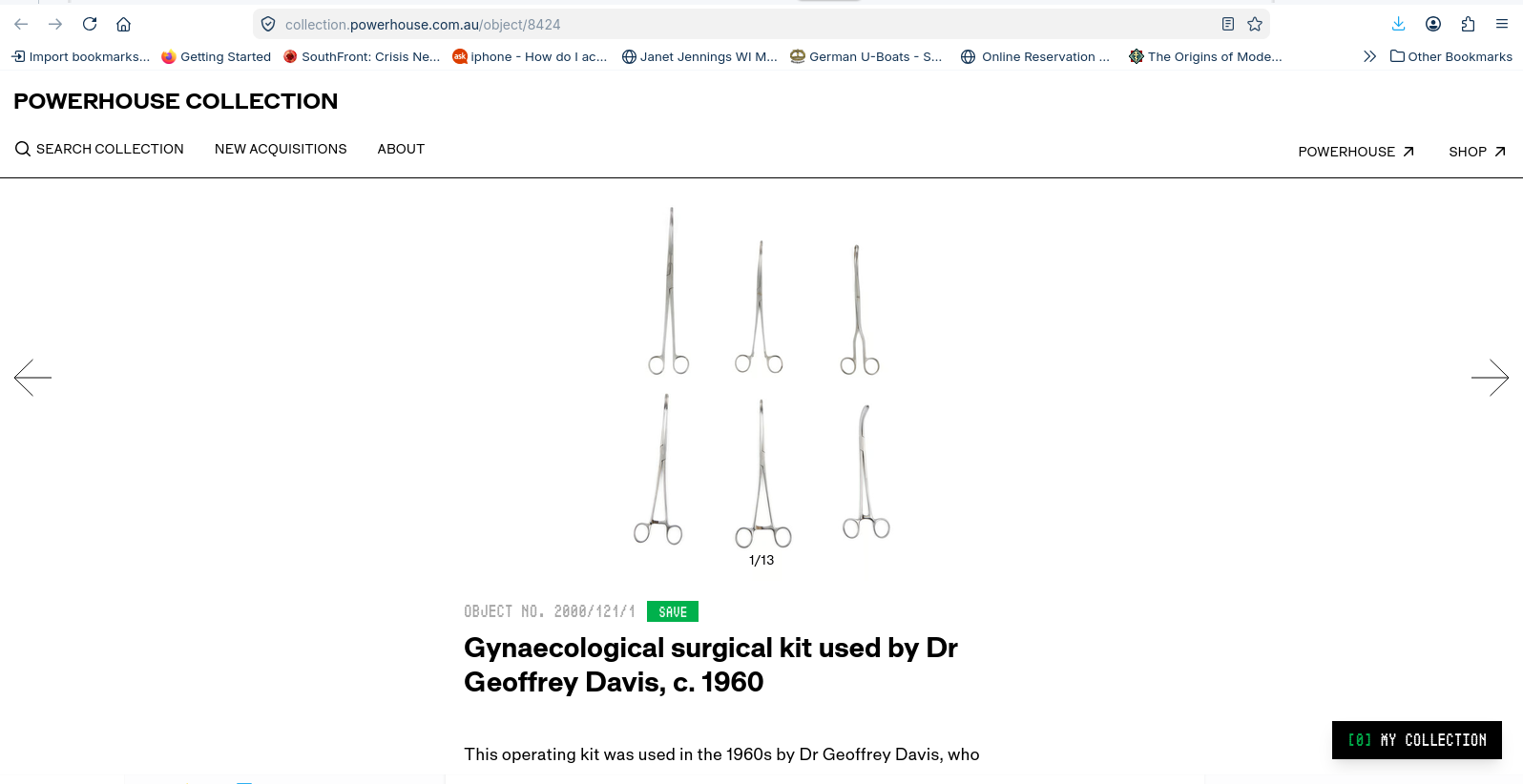
Screen capture from the index of object 8424 in Australia’s macabre Powerhouse Collection.
Given the OSS/CIA’s penchant for partnering with drug dealers and sex traffickers in the United States, it really shouldn’t be too surprising that they would do the same thing in Australia. When we look at Nugan Hand Bank’s other activities beyond Geoffrey Davis, we find the same “Supermob” lines of business which we are sadly accustomed to in the United States.
Just like in the USA, Nugan Hand’s mobsters lent money to celebrities like “international footballers” (soccer players) and local television personalities. (SMH “Lawyers ask: Was Banker’s Suicide Faked?” 04/13/80). Nugan Hand transferred money on behalf of an American criminal lawyer in Australia named Harry Wainwright who was involved in a huge marijuana importing scheme with former Australian policeman and convicted drug dealer Murray Riley.
Murray Stewart Riley was famous for importing tens of millions of AU dollars worth of “Buddha Sticks” from Thailand— that’s a type of pot treated with hash oil and molded onto a bamboo skewer like a green hotdog. Back in the 1970s there was a lot of money to be made in these. You can see pictures of “Thai Sticks” here, they were a type of grass popular with surfer hippies/ CIA groupies like Ram Dass.
“Buddha Stick” Riley was also a business associate of the American Teamsters gangster Michael Rudy Tham, who was based just over the Pacific in San Fransisco. Tham specialized in the type of mob-controlled strike action that Robert Butler bragged about in Duluth. During the investigation of Frank Nugan’s death and associated drug trafficking, Riley testified that he and Tham were setting up a beef and lobster tail export business. (“Heroin was not ‘moral’ for Riley”, SMH, 3/26/80) Please see my work on mob takeover of the food industry, “James Angleton and the Mobbing of the US Economy”.

Sidney Morning Herald caricature of Riley during his testimony to the New South Wales Royal Commission on Drug Trafficking in 1980.
Just like Jeffery Epstein’s modeling agency pals, the Sydney-based Wainwright was co-investor in a modeling agency/photography business where Australian members of parliament would go to have “a few drinks”. Wainwright’s blackmail factory, named “Twain’s Modeling Agency,” was located in Angel Place, Sydney’s central business district, and its overseer (pimp?) was named Danny Good. (“Lawyer Denies Citizenship Plea”, SMH, 3/28/80). Nugan Hand was also into a different type of human trafficking: resettling thousands of Indo-Chinese “refugees” to work industrial developments in the Turks and Caicos Islands, all financed using United Nations money. (“Nugan Hand’s Refugee Plan”, SMH 5/8/80)
Following the ‘suicide’ of Francis Nugan— who was found with Bill Colby’s business card in his pocket— the names of Nugan Hand’s benefactors slowly leaked into the Australian press, largely through the conservative Fairfax Family’s Sydney Morning Herald. Many of Nugan Hand’s few depositors— we are talking maybe 100 people total— were Overseas Chinese who wanted to move cash between their bases of operation. To this end Nugan Hand misleadingly marketed itself as a “Swiss Bank” in Hong Kong. On the opposite side, Nugan Hand’s general manager Graham Edelsten claimed that while he didn’t really understand the bank he ran, there was a list of about 180 companies and individuals which should make up for Frank Nugan’s lack of loan-accounting. Besides these random personal loans, Colby’s bank put their deposits into untraceable ANZ Banking Group “bearer certificates of deposit”. Why would a bank like ANZ be issuing untraceable securities in the 1970s? I can’t think of a good reason. (“Bank appealed to a limited clientele” SMH, 5/3/80.)

The joint US-Australia signals intelligence campus “Pine Gap”. Skyring, CC BY-SA 3.0 <https://creativecommons.org/licenses/by-sa/3.0>, via Wikimedia Commons
When Colby was outted as working with the Nugan Hand crew, it was to the backdrop of conflict between UKUSA beneficiaries and the previous Labour Government of Gough Whitlam (1972-75). UKUSA is an intelligence sharing partnership between the United States and the British Commonwealth, including Australia of course. In 1973 Whitlam took steps to nationalize Australia’s vast mineral resources: he sought out shady Pakistani financing sources to buy Australian mining companies back from the heirs of those Rothschild and Minnesota interests who funded Herbert Hoover. The same interests which set up Teddy Roosevelt’s industrial espionage network, which eventually became Colby’s and Angleton’s employer.
Whitlam was never under any illusions about who his enemies were. He, like Colby, considered the Angleton branch of the CIA a danger to himself. Shortly after taking office his administration conducted a police raid on the Melbourne office of the Australian Security Intelligence Organisation (Australia’s liaison with the CIA). This action was called the “Murphy Raid” because it was lead by Senator Lionel Murphy, who believed that the ASIO was hiding information about threats against Yugoslav Prime Minister Džemal Bijedić, a Muslim Socialist who was about to visit Australia, i.e. Murphy believed that the ASIO was putting the pro-Soviet head of state in danger. Whitlam, like Colby, was sympathetic to the Soviets and promoted the same ‘liberal’ and ‘social justice’ policies, which the men’s critics might describe as “Cultural Marxism”— a.k.a. Sydney Push politics. In a sense, both Colby and Whitlam were on the same mission to embarrass the CIA during the mid 1970s.
In addition to the Murphy Raid, Whitlam was considering closing the CIA’s satellite signal interception hub Pine Gap. Pine Gap is a joint Australian–United States satellite communications and signals intelligence surveillance base run by the Australian Defence Force, the CIA, the US National Security Agency, and the US National Reconnaissance Office. In the 1970s Pine Gap was how the US monitored Soviet missile testing and the USSR would have been glad to see it closed. It is widely believed that the CIA and MI6 organized the ouster of Whitlam’s government through the actions of Sir John Kerr. I believe the CIA probably did orchestrate Whitlam’s downfall, but then again I believe that Whitlam was probably working closely with the USSR… so I struggle to feel too badly about it. Anyway, Colby was out on his ear shortly after Whitlam was. Two points for the “Christians”?
I’ll end this post with a little comic relief at the expense of Colby, whose involvement with the Nugan Hand drug bank was revealed when his client, Frank Nugan, was found dead in his car with one of Colby’s business cards in his pocket. Colby, who couldn’t remember how long he’d been employed by Nugan Hand, was very sure that his involvement with the bank had nothing to do with his intelligence past, The Age, May 1, 1980:
Asked about the [business] card this week, Mr. Colby said it was "quite natural for me to have given Frank Nugan a card or two because he was my client".On the back of the business card was written: "27/1/80 to 8/2/80 H. K. Mandarin Hotel, 29/2/80 to 8/3/80 Singapore Coudat Bros."
This was apparently a reference to a trip Mr. Colby was to make with his wife to Hong Kong and Singapore.
Mr. Colby says he may have mentioned his plans to Nugan. But he says he did not see any Nugan Hand representatives during his Asian tour.
According to Mr. Colby's son Johnathan, senior associate in the Singapore office of the US-based international law firm Coudert Bros, his father and mother were in Singapore for four or five days in late February and early March for family reasons.
They arrived from Hong Kong on the Holland American Line cruise ship SS Rotterdam. Mr. Colby was engaged to lecture to the mainly middle-aged and elderly passengers on board.
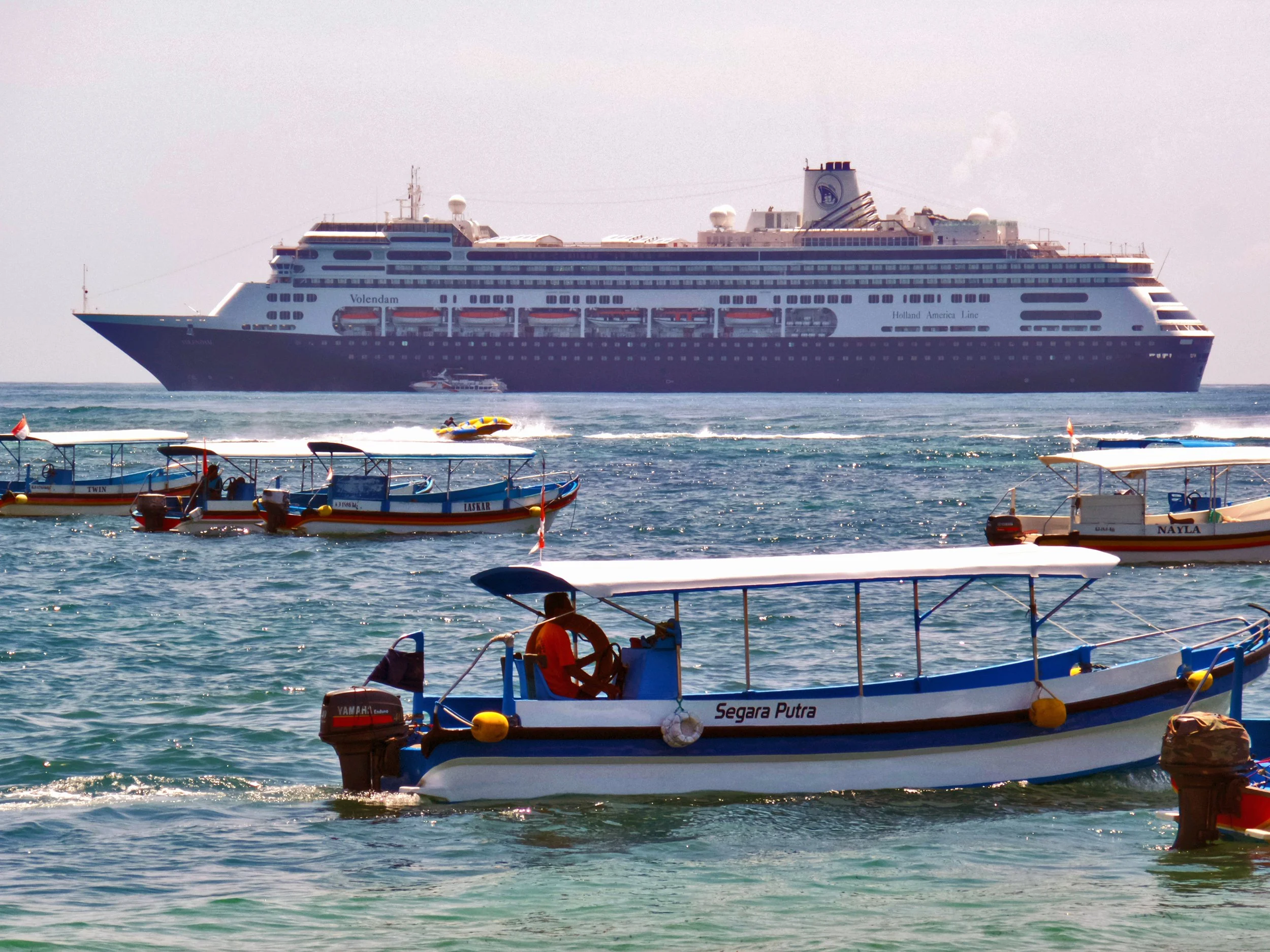
The Holland American Line still runs cruises between Singapore and Hong Kong, unfortunately Mr. Colby is no longer part of the on-deck entertainment line up.
BxHxTxCx (using album), CC BY-SA 2.0 <https://creativecommons.org/licenses/by-sa/2.0>, via Wikimedia Commons
LOL. When Bill Colby wasn’t running cover for drug banks or torpedoing child sex trafficking inquiries, he was lecturing blue-hairs on cruise ships. God save us all.
But, dear readers, there’s an element of truth in Jonathan Colby’s implicit lies. The Holland American Line was one of the original conduits that enabled the career of Bill Colby, via its role enriching some very unethical men in Duluth. How fitting then that it should also be a cover for the work which would presage Colby’s ignominious end.
One more curio for my students of international organized crime families. How did Geoffrey Davis get tied up with Colby and his lot in the first place? Consider, please, this article from The Sydney Morning Herald, January 21, 1990:

Tony Delano, the man trusted to write a biography of likely Mossad agent Robert Maxwell— Ghislaine’s dad, that Maxwell who was business partners with James Angleton’s friends in The Beatles business— was a family relation to the creepy Dr. Geoffrey Davis.
The Delanos Stateside were participants in Monroe, Wisconsin’s counterfeiting ring during our Civil War. (A Delano helped Arabut Ludlow set up his National Bank.) Another Delano relation, Franklin Delano Roosevelt’s uncle, was one of the larger drug dealers in Asia via his partnership with Russell & Co. While Delano family genealogists recognize a branch of the family in Australia, I cannot pinpoint where exactly Tony fits in (if at all). The rarity of the Delano name, and the fabulous connections it seems to carry with it wherever it goes, imply that dear Tony does fit in, somewhere. More to come!
** UPDATE ** Tony Delano was an employee of Robert Maxwell, a director of “Maxwell’s electronic media operation,” according to Delano’s biography of Maxwell. The book never mentions Mossad, and only mentions Israel once, in the context of “Israel Bank” and its new chairman Sir Henry d’Avigdor-Goldschmid, one of Maxwell’s associates. The book is full of flattering pictures of Maxwell and is largely complementary. I don’t think Bob could have paid for better press, given the circumstances.