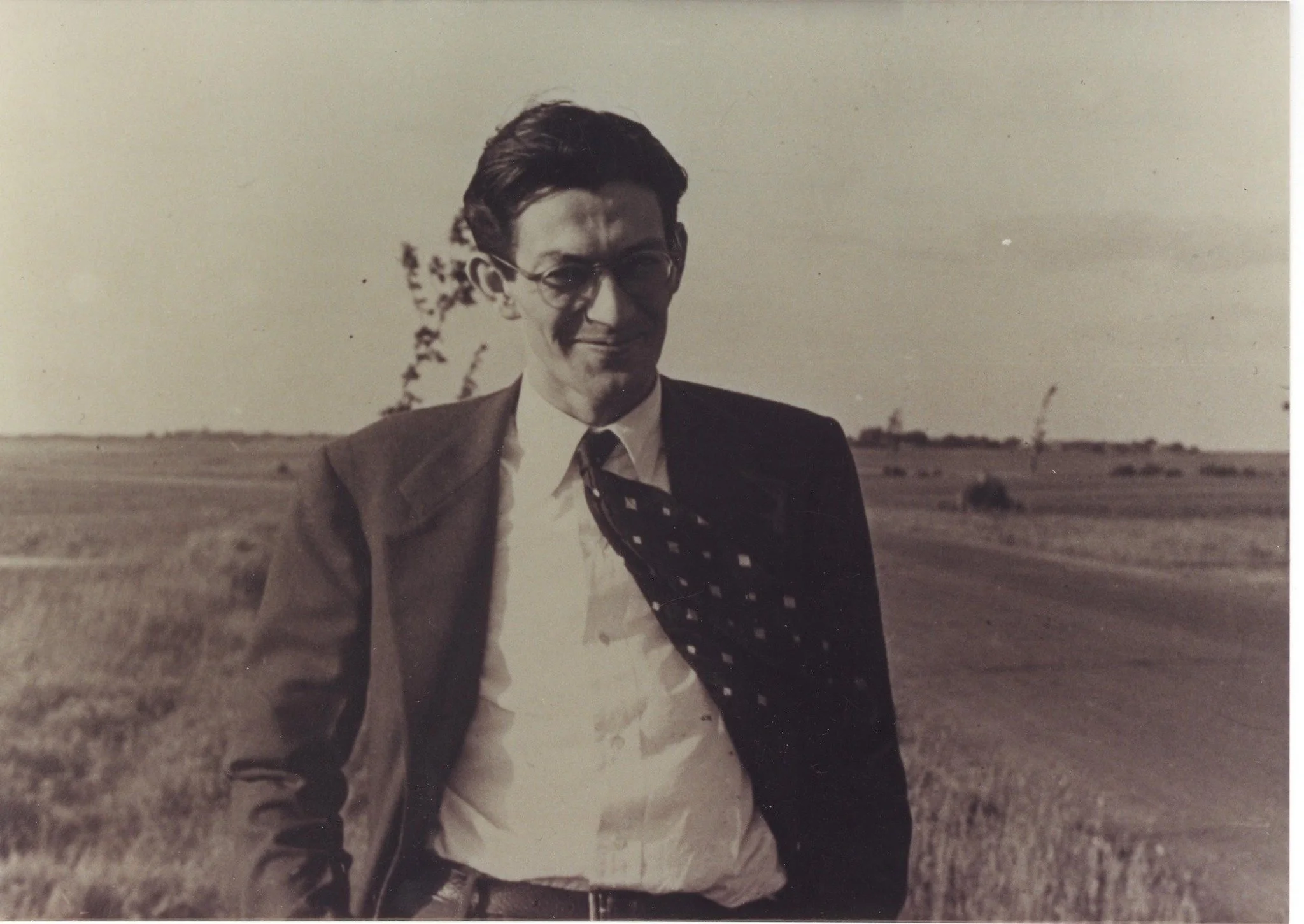
James Angleton: Boarding School and the Arts
I am writing this today to clear up misconceptions about James Jesus Angleton’s “elitism”; his views on the Arts; and “soft power” culture ops he may have actually sponsored at the “Central Intelligence Agency” (CIA).
Angleton is not a figure favored by the CIA’s leadership, it’s fair to say that the controllers of the agency which Angleton helped build view him as an anathema. The reason that CIA leadership fear him is because James Angleton was a common person with working man’s views. These views threatened the truly elitist politics of the Roosevelt family who, more than any other political junta, were responsible for the creation of the espionage network which was named “the CIA” in September, 1947.
What were Angleton’s frightening opinions? Most obviously, that the agency was open to infiltration by people who were also working for the Soviets. (Quite often the Roosevelts were working for the Soviets!) On a deeper level, Angleton held a positive view of European culture and the cultures of the Americas which derived from it. He was comfortable in his own skin, so to speak. Men like NAMBLA rep Allen Ginsberg and Brooklyn novelist Richard Elman (neither of whom admitted to working for the CIA) accuse Angleton and a shadowy troupe of “Christians” at the agency of “putting money into” “High Culture”. [See Saunders, p 248] Here’s Ginsberg explaining why “High Culture” is bad:
“T. S. Eliot Entered my Dreams”, 1978:
On the fantail of a boat to Europe, Eliot was reclining with several passengers in deck seats, blue cloudy sky behind, iron floor below us. “And yourself,” I [Ginsberg] said, “What did you think of the domination of poetics by the CIA. After all, wasn’t Angleton your friend? Didn’t he tell you his plan to revitalize the intellectual structure of the West against the so-to-speak Stalinists?” Eliot listened attentively— I was surprised he wasn’t distracted. “Well, there are all sorts of chaps competing for dominance, political and literary… your Gurus for instance, and the Theosophists, and the Ideologues. I suppose I was one such, in my middle years. But they were petty— well meant but of no importance to Literature.” “I thought they were of some importance,” I said, “since it secretly nourished the careers of too many square intellectuals, provided sustenance to thinkers in the Academy who influenced the intellectual tone of the West… After all, Intellectual tone should be revolutionary, or at least Radical, seeking roots of dis-ease and Mechanization and dominance by unnatural monopoly… And the Government through foundations was supporting a whole field of ‘Scholars of War’… The subsidization of magazines like Encounter which held Eliotic style as a touchstone of sophistication and competence… failed to create an alternative free vital decentralized individualistic culture. Instead, we had the worst of Capitalist Imperialism.
Angleton’s literary contacts are always cited as ‘evidence’, but no actual operations are named. I’m gonna give you a real “High Culture” op today, which supports Ginsberg’s and Elman’s innuendos. Sit tight!
Allegedly, when Angleton and his crew sponsored soft power operations, it was through poets like T. S. Eliot, e e cummings and the writers of Ezra Pound’s circle. These were literary connections in line with the “New Criticism” school, represented by men who were swept from US Universities in the 1960s to make way for Marxists like Ginsberg. New Criticism and Pound-style Modernism had lost the struggle to “influence the intellectual tone of the West”, as Ginsberg put it, well prior to the 1970s. What was the difference between the art which the “Christians” sponsored and say, that of Jackson Pollock and the Guggenheims?
Ezra Pound was the driving force of the Modernist movement, a movement which embraced abstraction, but at the same time he didn’t see any need to break from what was good about Europe’s cultural heritage. What does that mean in practice? An effective artist still needs training in how to draw, write, or combine musical notes in harmony. Paint splatters don’t count as art. Here’s a visual representation of the type of art Pound championed, via the work of his good friend the sculptor Henri Gaudier-Brzeska, killed at 23 years by the bankers’ Great War:
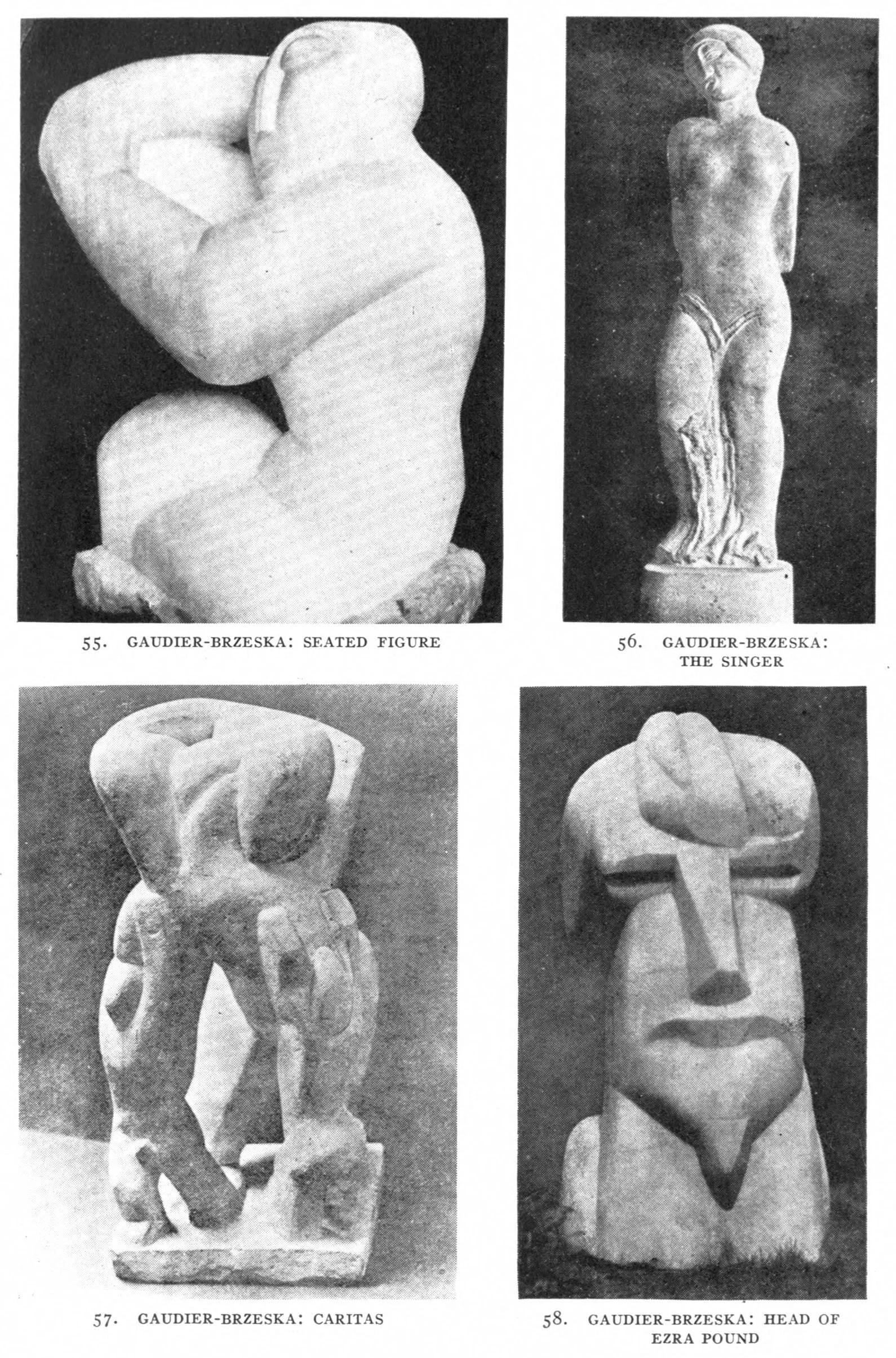
These are images from Ezra Pound’s book on Gaudier-Brzeska.
To be able to twist natural forms in an intentional way which heightens their emotional impact on the viewer, an artist needs to have masterful understanding of natural form and control of his tools. Here are working studies drawn by Gaudier-Brzeska:

Henri Gaudier-Brzeska, CC0, via Wikimedia Commons
Pound wanted to build on the cultural tradition of the West, guys like Pollock (the Guggenheims) wanted to break with it completely. It’s actually rare for an artist to be classically trained in an atelier these days, read all about it. The “break away” impulse was first articulated in Vienna by the Ringstrasse queen Bertha Szeps Zuckerkandl in the context of the failure of Jewish society to integrate into aristocratic German society, a goal cherished by her father’s generation. Again, CIA affairs were merely the extension of an earlier European culture war which predated the agency.
Far more influential at the agency were socially-predatory East Coast businessmen like the Guggeneheims, Rockefellers and Vanderbilts; or sex trade dons like Meyer Lansky. These people, often cocktail socialists and insecure in their social position, wanted a firm break with European culture. (They didn’t measure up well against it.) To this end, their henchmen promoted “Modern” artists like Jackson Pollock and (most likely) beat poets like Allen Ginsberg. Usually their “art” had a heavy dose of pornography added. (Pornographers Hugh Heffener and Bob Guccione banked with Castle Bank & Trust, a CIA-affiliated financial institution working to destabilize Cuba.) Often these Roosevelt-aligned figures were bigoted against European culture, were anti-Christian and sometimes just plain anti-White. Many of their henchmen had fought with the Soviet-funded “Popular Front” soldiers— communists, anarchists, socialists— during the Spanish Civil War. The most famous of these henchman was the double agent Ernest Hemingway, a Soviet spy who worked for the ONI, OSS and FBI and was okay’d to participate in the CIA’s soft power drives in Europe during the Cold War. (See Frances Stonor Saunders, The Cultural Cold War. p 305) In the 1970s, the powerful CIA faction was lead by the highly-conflicted William Egan Colby, an ACLU lawyer and son of Irish mob gangsters in the Twin Cities.
So what was Angleton’s real “soft power” op? James Angleton had a “protest painter” in-law, Luciano Guarnieri, a classical artist who painted representational art. Here’s an example of Guarnieri’s work.
Guarnieri was called a “protest painter” because in the 1960s he created a series of color lithographs protesting the Soviet invasion of Czechoslovakia. I’m going to call this series “HT SHADOW OVER PRAGUE”. From The Idaho Statesman newspaper, October 26, 1969:
Luciano Guarnieri paints of his own time but with the timelessness of the past. His work has been called remindful of the moods of Goya, the influences of Tiepolo and Raphael.
But his subjects are things of today. He is involved with our times. He has painted his protests of the invasion of Czechoslovakia and the devastation of the flood in Florence. …
Shortly after the Czech crisis, he visited the old town of Prague, made a dozen sketches of the old square, the fine old buildings, and added looming shadows of soldiers, tanks, cannon
Two hundred portfolios of "Shadow Over Prague" were printed for the U.S., but sold out before they ever left Italy. "It was the only voice in Communist Italy that came out against the Russians," said his wife [James' sister Dolores].
I put it to readers that if you’re looking for a “soft power” op sponsored by Angleton, you won’t find a more likely candidate than “Shadow Over Prague.”

The Idaho Statesman newspaper, October 26, 1969
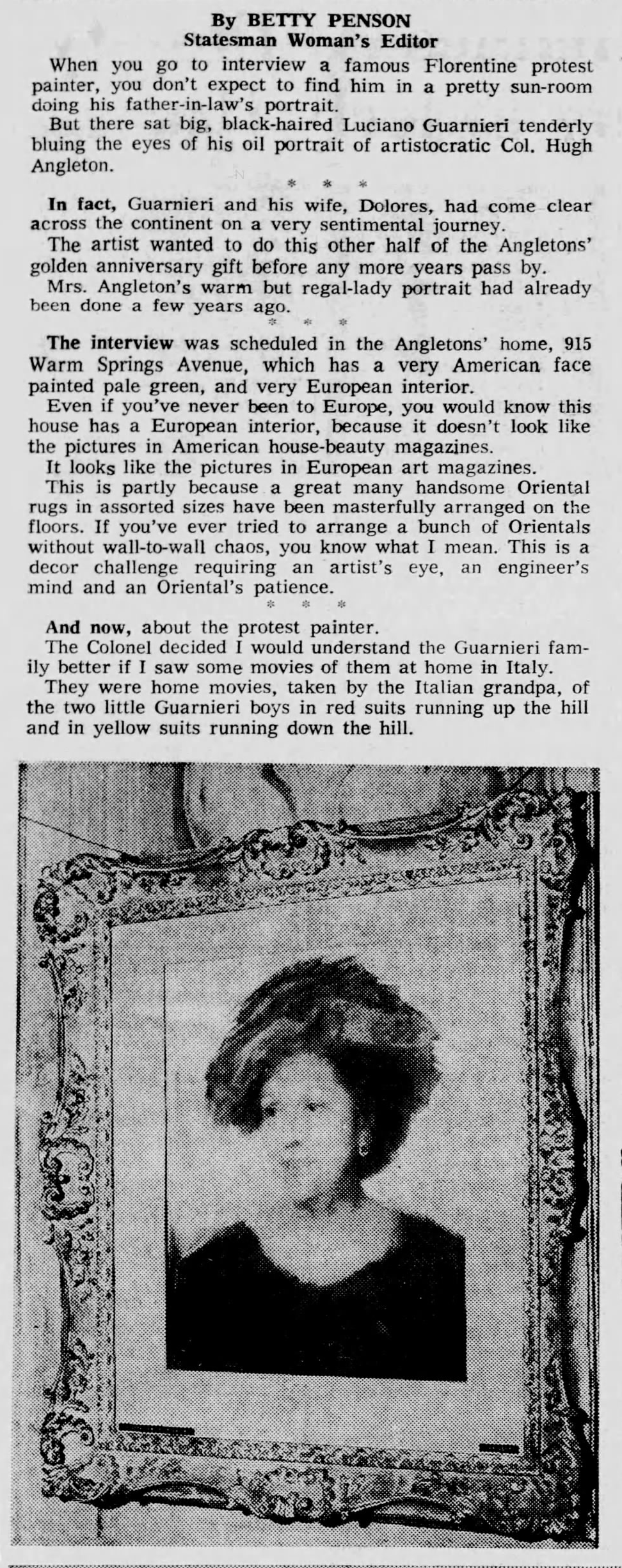
The Idaho Statesman newspaper, October 26, 1969. Column 1.
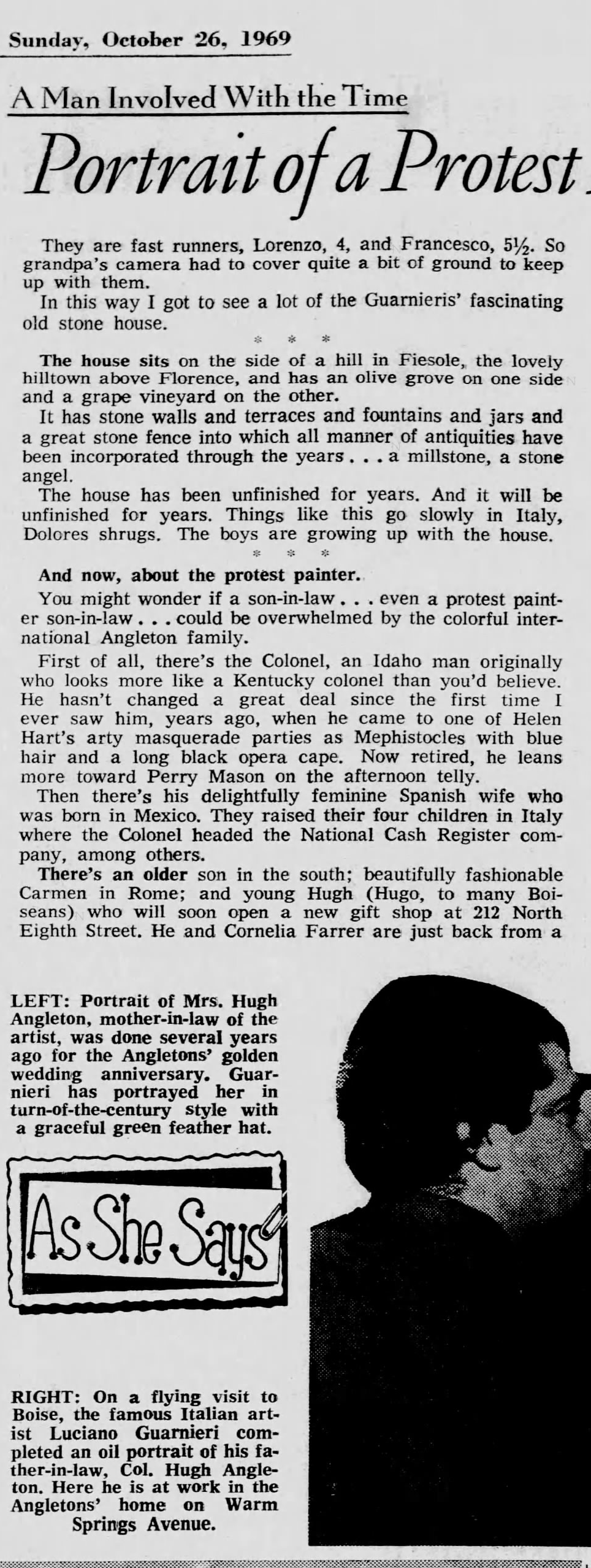
The Idaho Statesman newspaper, October 26, 1969. Column 2.
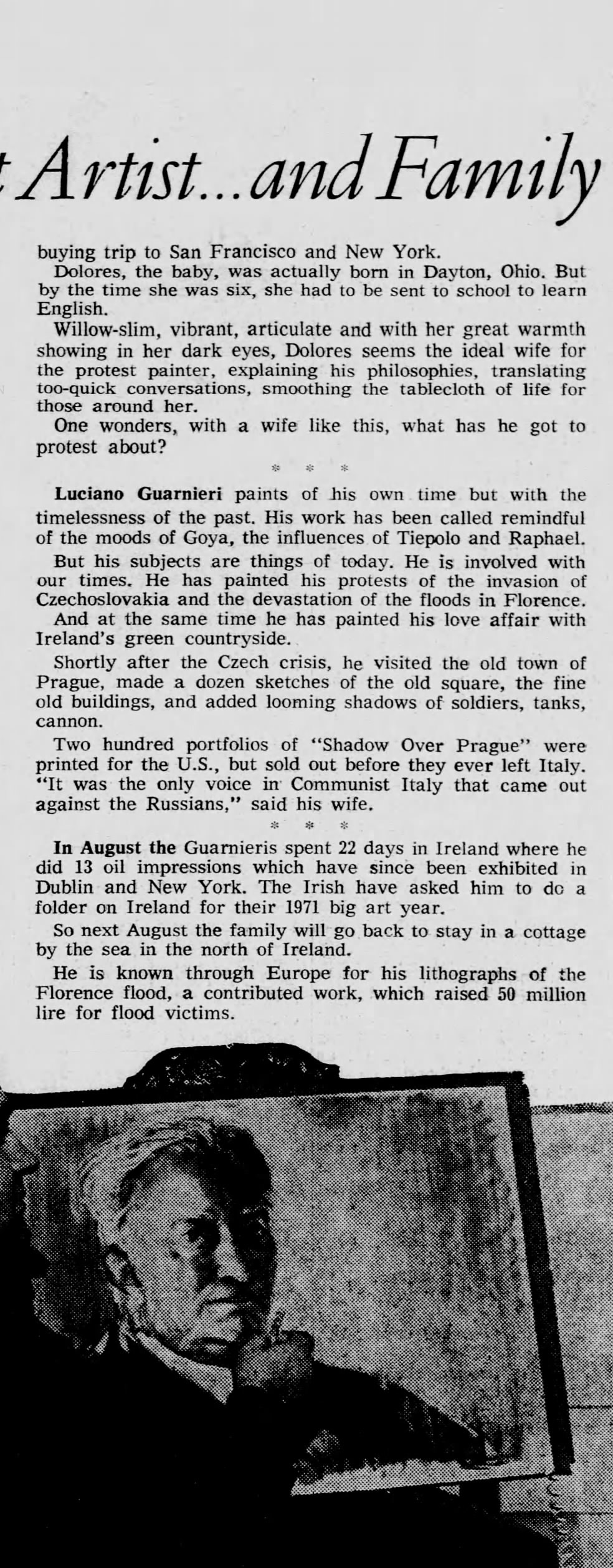
The Idaho Statesman newspaper, October 26, 1969. Column 3.
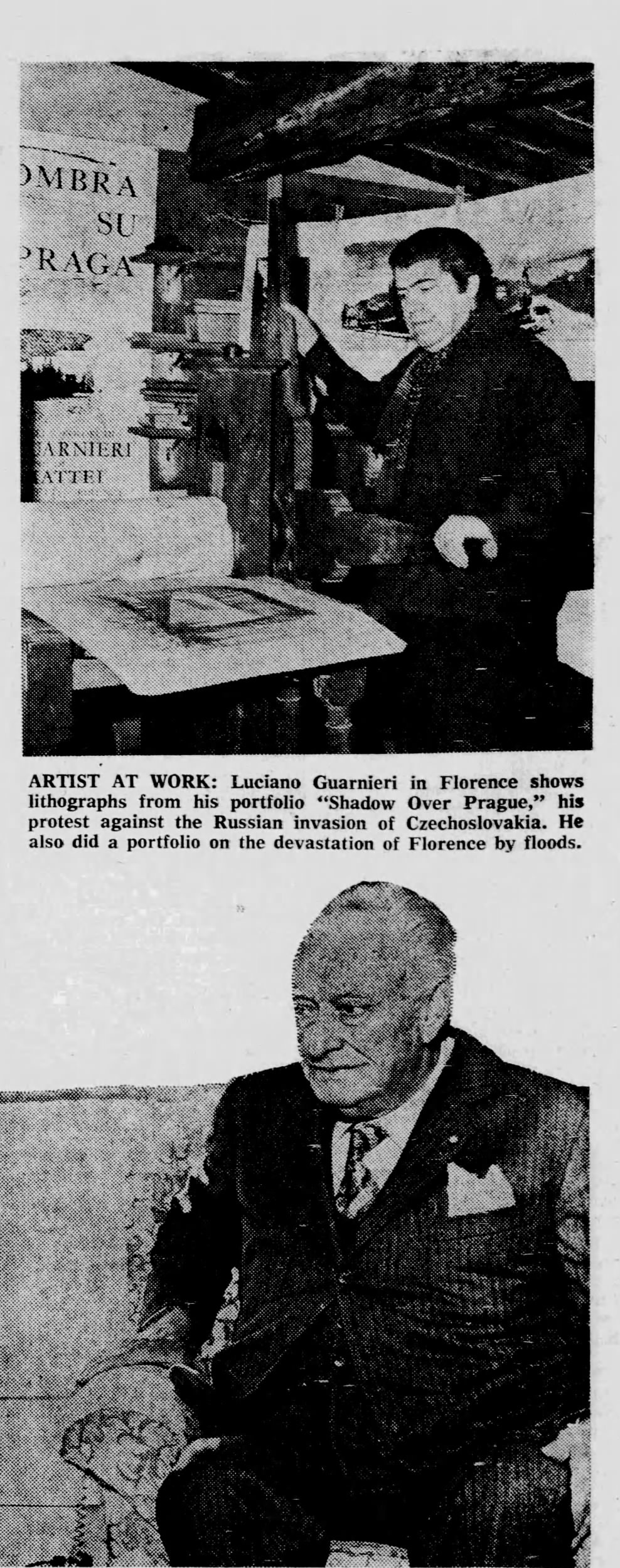
The Idaho Statesman newspaper, October 26, 1969. Column 4.
Here is one of Guarneiri’s “Shadow over Prague” lithographs:
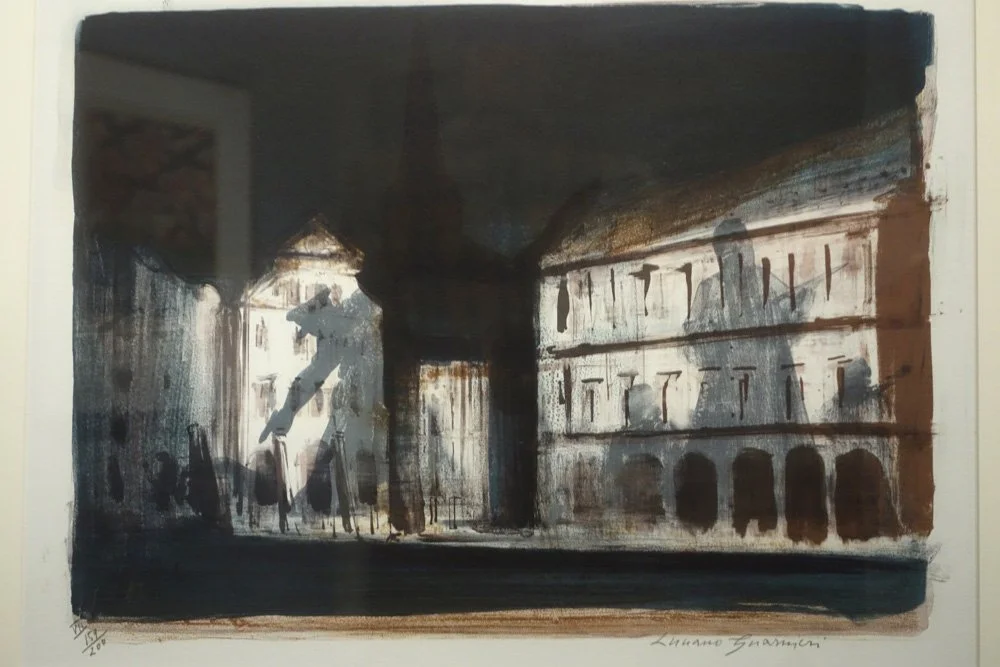
Luciano Guarnieri “The Lesser Town Square” 1969
One year later in 1970 Guarnieri also created lithographs celebrating the Apollo XII mission to the moon: “Luna 1969”. “HT WE CHOOSE TO GO”?
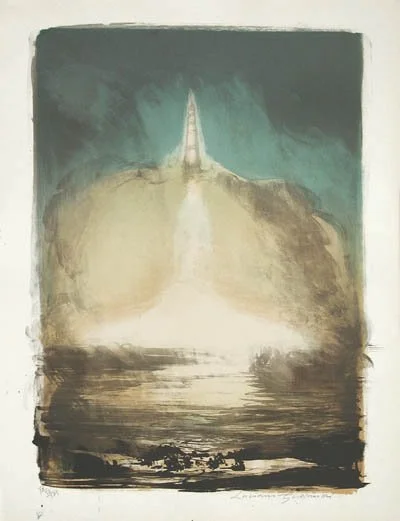
Apollo XII Towards the Moon (Apollo XII Verso la Luna), Guarneiri 1970.
Luciano Guarnieri's ninth original lithograph entitled, "Apollo XII Towards the Moon" (Apollo XII Verso la Luna) for the "Luna 1969" set depicts the lift off of Apollo XII for one of the historic manned mission to the moon. The immense amount of fuel required to lift the rocket through earth's atmosphere envelopes and illuminates the entire landscape. The artist has added extensive hand coloring to the composition. This original lithograph is printed on thick, pure rag paper as published in the sole, limited edition of 375 impressions in Florence in 1970. It is signed and numbered in pencil by the artist, Luciano Guarnieri. ArtofthePrint
Angleton’s team lost and I don’t believe many people have heard of Luciano Guarnieri today. In his time, he was an internationally respected artist. Here’s Art of the Print’s description of his career:
Luciano Guarnieri: A contemporary Italian painter and lithographer, Luciano Guarnieri studied art in his native Florence in the studio of Pietro Annigoni. A master of landscapes, architectural depictions, figures studies, portraits and nudes, Luciano Guarnieri has worked in Mexico, New York, Montreal and London. His art has also been the subject of one man exhibitions in Italy, Holland, Brazil, Argentina, the United States, Canada, England and Ireland. Public Collections which house his art include the Greenshields Foundation, Montreal, the Prentenkabinet der Rijksubiversiteit, Leyden, Holland, and the Galleria d'Arte Moderna and the Uffizi Gallery, Florence. Guarnieri has also illustrated a number of books and painted frescos for major churches in Italy.
Luciano Guarnieri's first experiments with lithography date from 1962. Since that time he has created a fine oeuvre of color lithographs (some with extra applications of hand coloring) depicting scenes throughout Europe and North America. Many of these have been published as sets, such as "Mexico" (12 lithographs, 1962), "New York" (14 lithographs, 1965), "Firenze" 'Florence' (12 lithographs, 1966), "Ombra su Praga" 'Shadow over Prague' (12 Lithographs, 1969) and "Luna 1969" 'Moon 1969' (14 lithographs, 1970).
So that’s how Angleton “secretly nourished the careers of too many square intellectuals, provided sustenance to thinkers in the Academy who influenced the intellectual tone of the West” in the words of Ginsberg. I don’t think too many working Americans would pillory Angleton for this and I’ll point out that nobody was ever grilled by Frank Church for the cultural violence of Pollock’s drippings.
I’m going to take issue with Angleton’s supposed “elitism” next because I have shared some of Angleton’s life experiences and can therefore put them in context where other biographers have failed. The Angleton family were lower-middle class people who chanced into money during James’s father’s lifetime. Prior to joining National Cash Register as a salesman, James Hugh Angleton was a sales rep for a local candy firm in Boise, Idaho. As boys, James Jesus and his playmates would cut horehound from a nearby meadow and bring it to Mr. Angleton’s workplace to be used as lozenge flavoring. [See Idaho Loners, p 267.] This characterized the first ten years of James Jesus’s life, the years when a child’s character is established.
Prior generations of Angletons were no less simple and industrious. Originating from Boone County, Kentucky, members of the Angleton family made the trek to Southern Illinois in the years following the Civil War. Their names suggest their values: “George Washington Angleton” (James’ great-great grandfather) and “William Penn Angleton” (James’ great-great-great grandfather). The Angletons were neither related to George Washington nor William Penn, but these were the names of famous, wealthy men to whose status they aspired. Like my ancestors and most Americans’ ancestors, the Kentucky and Illinois Angletons were farmers, probably tobacco farmers like so many of the Southern transplants who came to Illinois or Wisconsin. These families made Wisconsin an important tobacco growing region for a while. The politics of Southern Illinois were usually at loggerheads to the Kentucky Colony controlled north half of the state.
Angleton’s mother’s family were no less simple. According to a relative from the millionaire d’Autremont/Congdon side of James Angelton’s family, Carmen Moreno was from a “poor” Mexican family in Sonora, although contemporary press shows Carmen dressed in European clothes and describes her childhood home as “attractive.” Either way, Carmen married an invading soldier under General Pershing’s command. James Hugh Angleton was part of the punitive expedition to stop Pancho Villa attacking non-combatant US towns for supplies. (The Mexicans were very undisciplined and constantly shooting at innocent Americans across the northern border.) The entire Moreno household moved northward to the USA when Pershing returned home.
Who were the Morenos? I know of two photographs of Carmen in her youth; the most famous shows her in a glamorous black tulle dress, the type of glamor pre-code Hollywood beamed at the working classes for the first time in the 1910s and 20s.
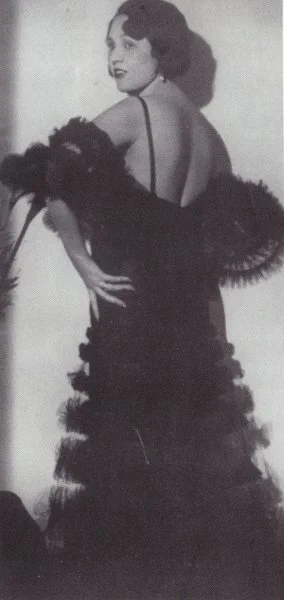
Carmen Moreno Angleton. A very different presentation of Mrs. Angleton than in 1969.
Both Moreno girls had a taste for fast men and both married spies: Carmen’s James Hugh began his espionage career spying on the Italian government while he worked as an expatriate businessman, while her sister married a German con-man who tried to sell what he claimed were Nazi secrets to the FBI during the 1940s. The psychology of a good salesman, a spy, or a con-artist can be quite similar. Certainly the Moreno girls were conditioned to be attracted to this type of man. Angelton’s regiment used the couple’s speedy marriage to promote the war effort, see below. In a similar vein, the Angeltons would contact The Idaho Statesman’s or the Evening Capital News’s social register if say, they took a motor trip or had a friend over for dinner: they were a couple who enjoyed public attention.
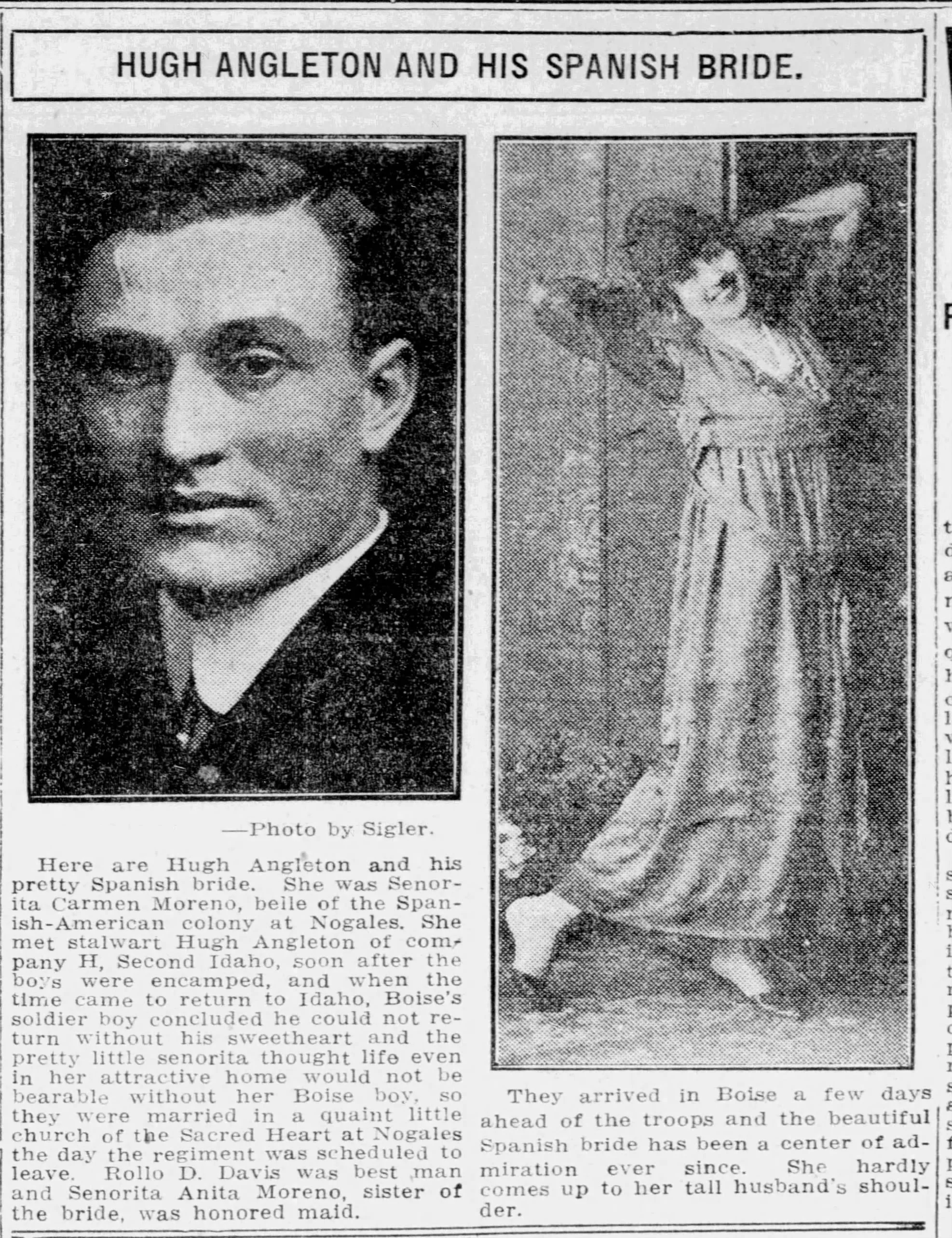
The Idaho Statesman, January 7, 1917. Hugh Angleton was one of two soldiers from Idaho to marry while fighting with Pershing. The marriage was used to promote the military undertaking.
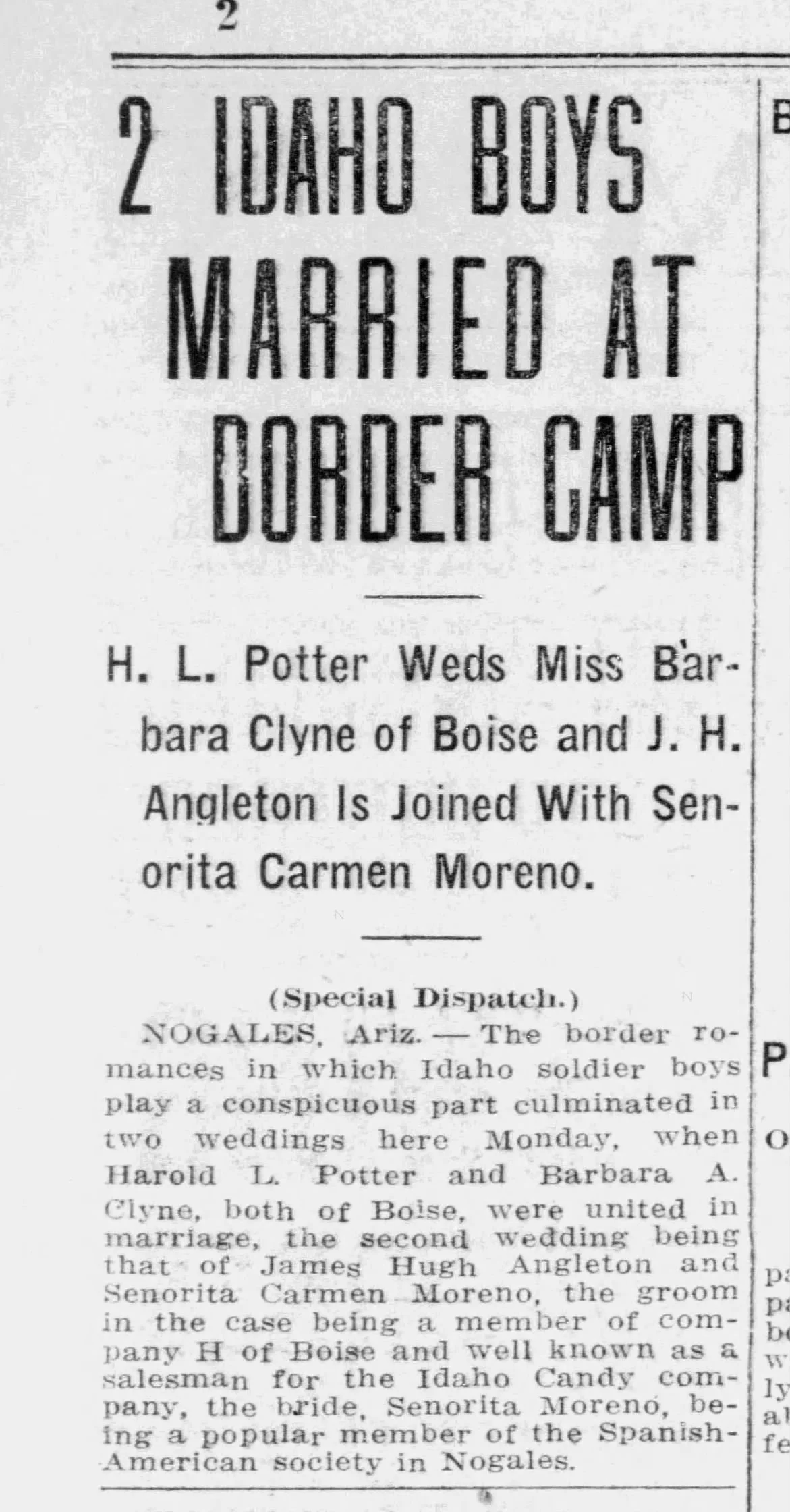
The Idaho Statesman, December 12, 1916. “Special Dispatch” from the front.
Accounts of Carmen’s ability to adjust from her Mexican culture vary: her great niece Antoinette Hart Wellman (a professional “storyteller” in NYC) claims Carmen “moved from the dirt streets of Nogales to the gilded palaces of European high society with great ease”, while James’ boyhood friend Dr. Richard Forney describes an eccentric, dislocated lady who celebrated her four children’s birthdays four times every year (16 birthday parties annually): “Presents and ice cream. She liked to have a party, and without a reason, a birthday party sounded good, so she had a lot of them. It was just practically a routine: a birthday party at Angletons.” Later in life, Hugh would counsel James against a “wartime marriage”.
Hugh Angleton came into money working for National Cash Register, the monopoly player in a growth-industry started by a pair of saloon keepers who wanted to prevent their employees stealing from the till. Angleton bought the Italian franchise to NCR when the company was about to close it down. Angleton turned the operation around and built its sales force in Milan. This business allowed his family to live well among the expatriate class in Milan, a class full of Brits. In the 1930s in England, Italy was known as a cheap place to live the good life. The Angletons rented quarters in the Palazzo Castiglioni from the Castiglioni family. It was from this expatriate milieu that Hugh decided to send James to a British Boarding School, one of the avenues for social advancement in Great Britain’s class-conscious society.
This is where I can provide some insight to readers. If you are an English-speaking person in a non-English speaking country, your life will be best if you do what the English expatriates are doing. The English have been professional expatriates for a long time and their schooling systems, housing compounds, and professional networks in foreign countries are generally the best. When Hugh got settled in Milan, he would have found the British schools better for his sons. The teachers and parents in the British schools would have quickly informed him that the best education to be had was at a tony boarding school in the mother country.
The “British Colonial” phenomenon is what made the British Boarding School system. Overburdened by obligations in backward host countries, British expatriates found that the most convenient way to educate their children was in the company of people from their own culture. Most colonials were middle or lower class Brits who saw foreign service as a route to social and economic advancement. Indigenous nannies were no more suitable for bringing up socially-aspiring Anglophile offspring than— and I say this with kindness and respect— a mother from Sonora, Mexico. Malvern College is and was one of the more respected of these institutions.
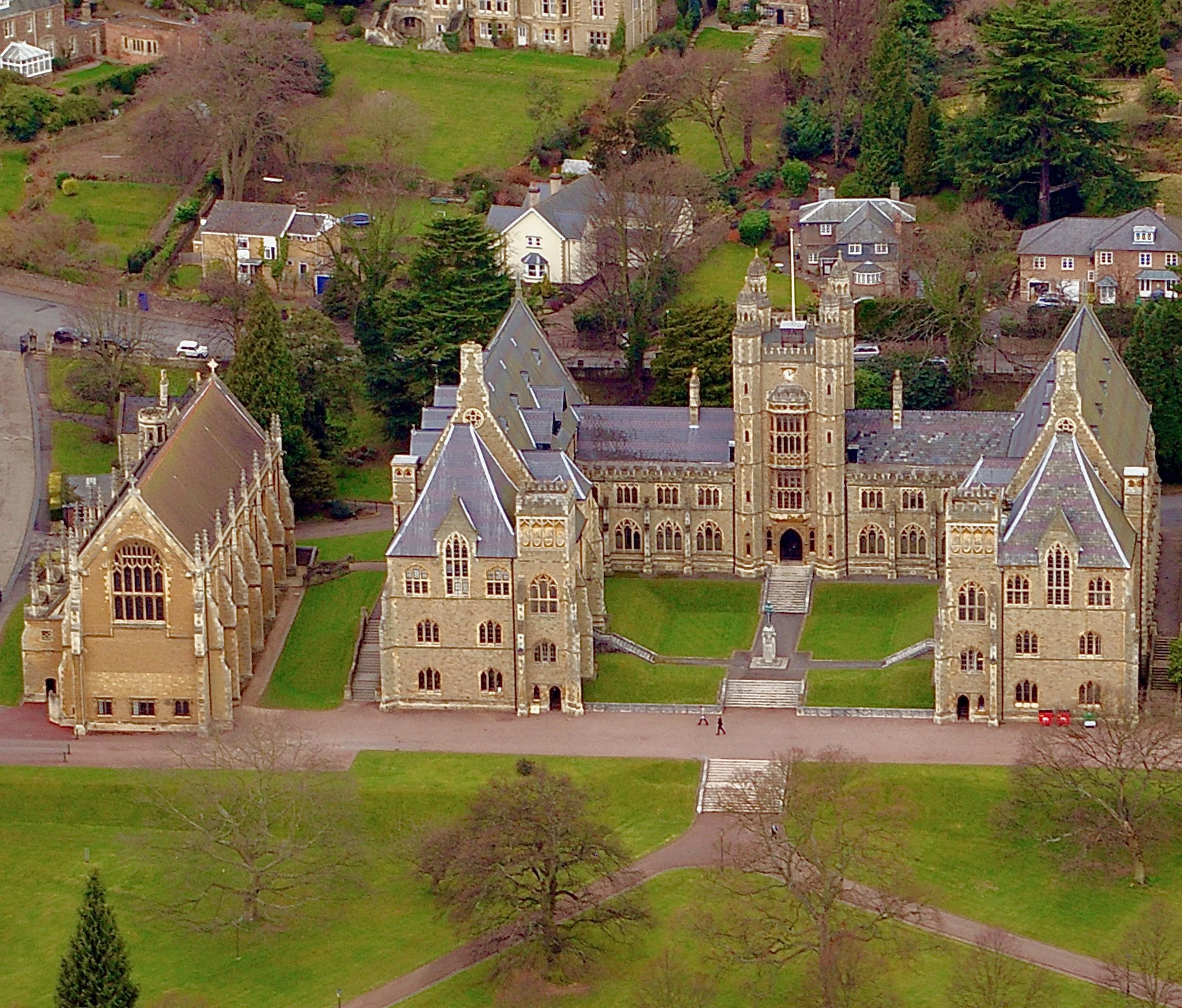
An aerial view of the Neo-Gothic (Victorian) buildings which house Angleton’s Malvern College. It’s co-ed these days.
The tricky thing is that prestigious boarding schools are a path to social advancement, they don’t equal social advancement. Aristocrats don’t send their children to them. They don’t need too. The result is that the higher-ranked of these institutions are usually filled with kids from families who are insecure about their social class. They’re middle class people— or lower-middle class people— who want to be “upper crust” and are willing to pay an obscene amount of money to climb that ladder (think $55,000 a year).
That’s what people misunderstand about James Angleton. His reserve and sometimes coldness are not ‘aristocratic’. I too went to one of these schools (for a lot longer than Angleton) and many of the children there are deeply insecure about social status. My school was called “Cheltenham Ladies’ College” and was highly regarded. When I attended in the 1990s, no aristocrats were there (except one princess from Thailand), but there were a lot of middle class girls whose parents worked in London. They were extremely sensitive to perceived class slights. For instance, being an American, I would thank someone who held open a door for me. (I’m from a family like the Illinois Angletons but in Wisconsin.) This irritated many of the Cheltenham girls, who felt I was treating them like a servant for acknowledging their help. I would also smile if I made eye contact with someone, say, walking down the corridor. They thought I was acting in an over-familiar manner. The easiest way to deal with people like this is to withdraw into that icy reserve which Angleton displayed, a tactic which both mimics and deflects insecure middle class behaviors.
In Britain, only the lower classes or those who are (or feel they are) of the highest social rank have the freedom to put unfamiliar people at ease with open graciousness. What you see with James Angleton’s retreat into iciness is not fine breeding, but learned survival behavior during what was probably a traumatic period in his life. British culture is very different to that in Italy or the United States, and children can be vicious. You conform to survive at boarding school.
Now the bright side. What Malvern would have given Angleton in spades was a classical education. In the 1930s even in the USA one could expect to learn Latin and probably Greek at a better school and Malvern would certainly have given James this opportunity. Back then, the British were also excellent at teaching children how to write: they produced stellar communicators. (Unfortunately, this tradition had fallen by the wayside by the time I was in the system. Now Britain too suffers from standardized state testing— the last glory days were in the 1970s.) When you pair this British education with the cultural knowledge Angleton would have gleaned from his life in Italy, you can see how James was in an excellent position to deeply love and value Western Culture and Art. Men like Angleton were worlds away from the scrappy mafioso who surrounded Allen Ginsberg.

Milan (Lombardy, Italy) – Milan Cathedral – view from the southwest over the Piazza del Duomo (Cathedral Square) with the triumphal arch of the historic shopping mall Galleria Vittorio Emanuele II
© Steffen Schmitz (Carschten) / Wikimedia Commons / CC BY-SA 4.0, CC BY-SA 4.0 <https://creativecommons.org/licenses/by-sa/4.0>, via Wikimedia Commons
I hope that I have given readers a better understanding of James Jesus Angleton in this post. If I have, then I’ve probably given them a better understanding of what the CIA and its custodians like Brennan are too. In defiance of Angelton’s detractors, I wish all readers a Happy Fourth of July.