Castle Bank & Trust and the Pritzker Family
Several months ago I wrote about Henry Crown, the Chicago mafioso who owned the largest known single stake of Swift & Co. shares when Swift & Co. gave “The Franklin Community Federal Credit Union” to Larry E. King (Jr). King would go on to use the FCFCU as a cover for trafficking children and collecting compromising material on (mostly Republican) Washington D.C.’ers. King was given FCFCU in 1970 and the abuse came to light in 1988.
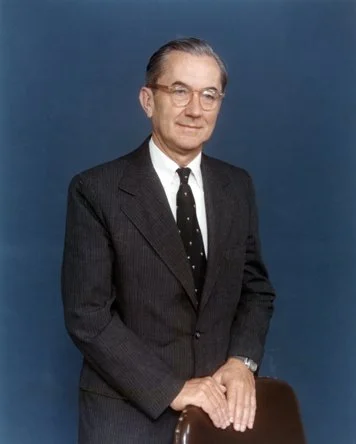
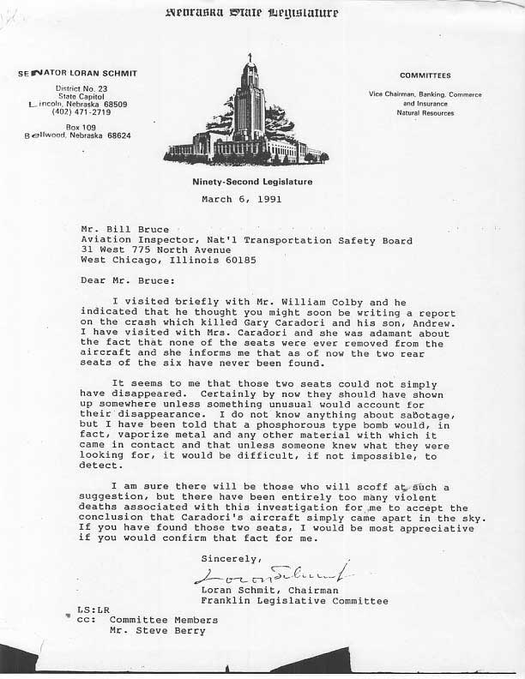
The trafficking investigation into King was derailed when lead investigator Gary Caradori died in a suspicious plane crash— after former CIA head William Egan Colby volunteered to ‘help’ the investigation. Colby involved himself in an inadequate investigation into the crash despite Nebraska Senator Loran Schmit’s efforts to ensure that a thorough inquiry be performed.
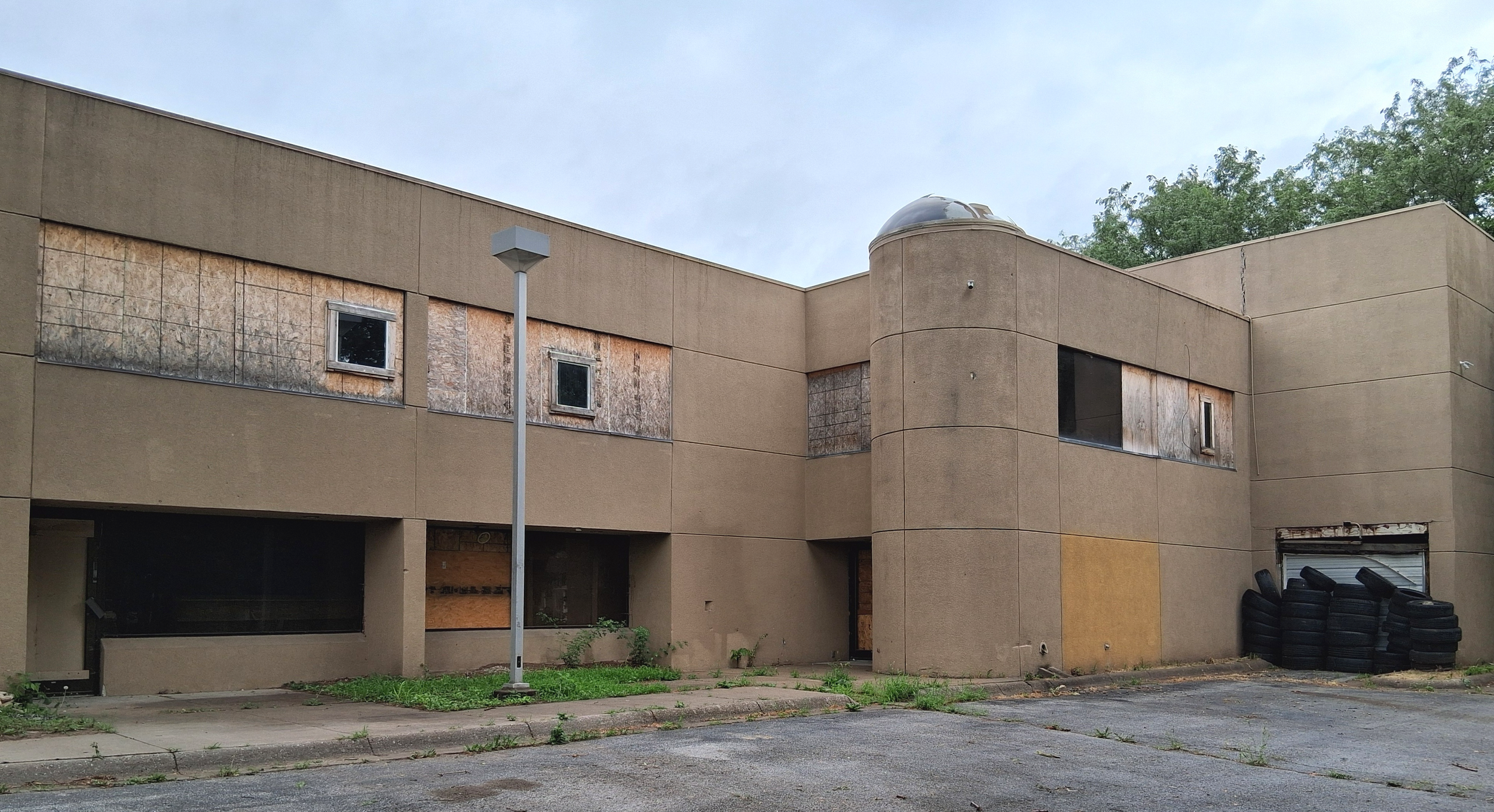
The former Franklin Credit Union in Omaha, Nebraska, in 2026. The basement of this place had a luxurious apartment where abuse took place. Staryu, Creative Commons CC0 1.0 Universal Public Domain Dedication.
So, as far as the public can discern, Henry Crown was the man in power when Larry King Jr. set up his twisted blackmail factory, a factory which appears to have been so successful among D.C. Republicans that it drew lifelong-Democrat Bill Colby’s attention. How’d Mr. Crown get there?
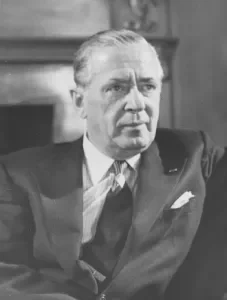
Henry Crown
In a December 12, 1976 interview with the NYT, six years after Crown’s company had empowered Larry King Jr., Henry Crown described himself as a “Chicago Democrat, as most big businessmen here are” but “his national politics are strongly Republican.” Interestingly, Crown’s interview spilled over into his family’s relationship with the Chicago Pritzkers, inheritors of the Windy City’s famous “Democratic Machine”, a political fraud system set up by Lincoln’s sponsors, the Kentucky Colony. Crown painted a picture of competition and conflict between his clan and the Pritzkers— let’s let the Gray Lady speak:
The Crown family achievements, interests, and problems parallel uncannily those of another powerful Chicago financial family, the Pritzkers, although parallels in this case have hardly spawned a close friendship.
The Pritzkers are headed by A. N. Pritzker, who is the same age as Henry Crown. The Pritzker family started and still controls the Hyatt hotel chain, which competes with the Crown's Hilton, it owns a building materials firm that competes with the Crowns' Material Services and Vulcan, and has vast real estate interests.
Like Henry Crown, A. N. Pritzker had three sons and lost one at an unusually early age to a heart attack-- but has one who is a brilliant businessman in his own right, Jay Pritzker. Both men are devoted to family and are intensely private persons. Both are also widowers who remarried. Both got their seed money from the First National Bank of Chicago.
And both have strong philanthropic leanings. The Pritzkers gave the University of Chicago $12 million to establish the Pritzker School of Medicine.
The Crowns have given away $75 million each to Stanford University, Northwestern University, and the University of Chicago.
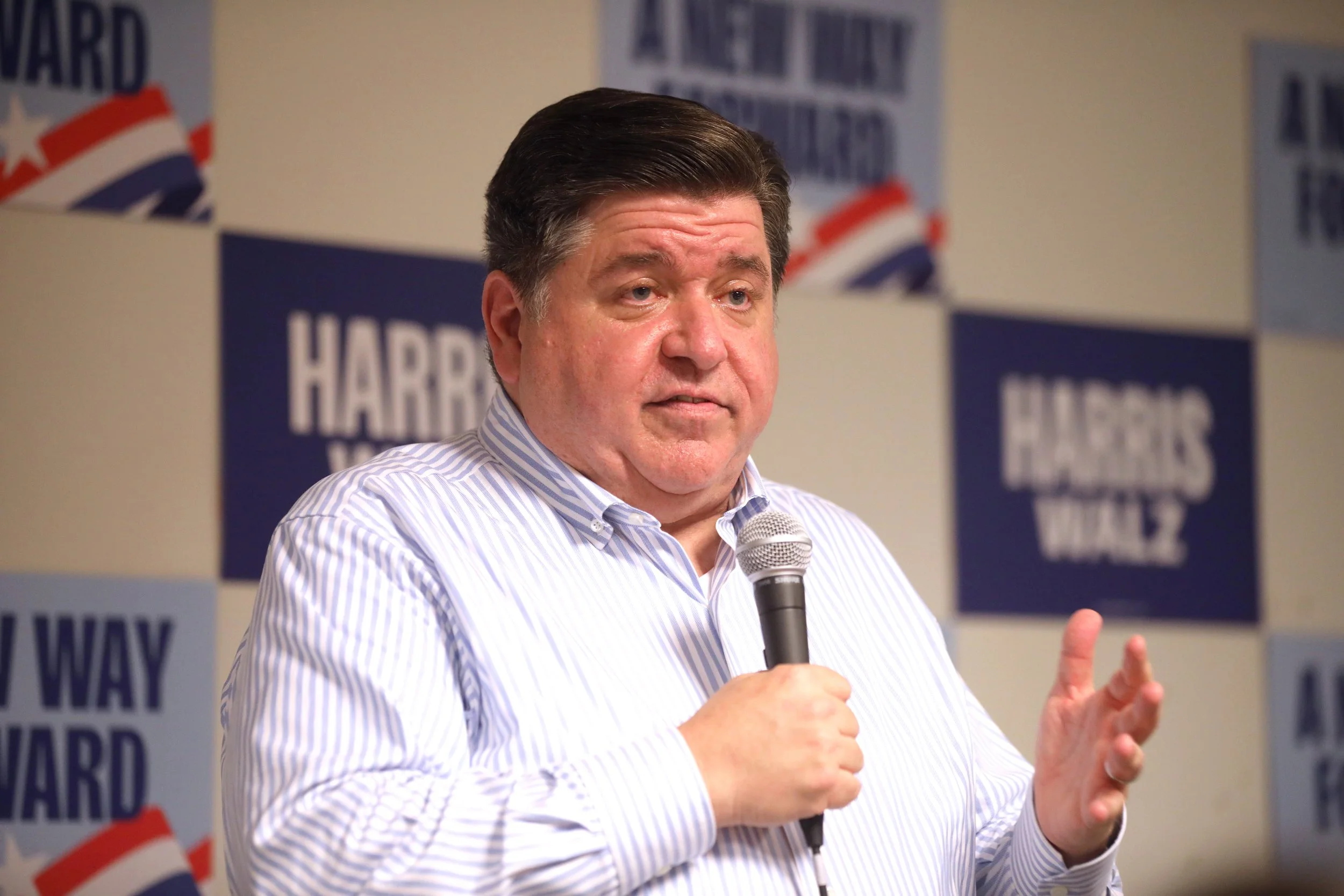
“JB” Jay Robert Pritzker, Illinois’s fat governor, preserves his grandfather’s legacy as a criminal lawyer. The Pritzkers were a well-educated Jewish family from Kiev (Imperial Russia) who became pharmacists in Chicago as designer drugs from Central Europe displaced counterfeiting as the white-collar crime of choice. Progressing up the gangland ladder, the original Pritzker brothers Abram and Nicholas hung out their shingles as mob lawyers for Capone crew like Joe Fusco, Jake Guzik and the Sidney Korshak clan. (Supermob, p 67.) Sidney Korshak would prevent strikes at Pritzker family hotels, while illegitimate union action put their competition out of business.
I’ll gently remind readers that the First National Bank of Chicago was a Lincoln-era creation and that Monroe, WI’s First National Bank, Arabut Ludlow’s bank, was FNB Chicago’s first client bank. Therefore, whomever controlled FNB Chicago in the 1920s and 30s were heirs to Lincoln’s counterfeiting empire.
NYT also points out the Pritzkers’ generous medical donations, which happened in the late 1960s, about the time the rest of the Galician Gang leadership was pouring money into hospitals. Both the Pritzkers and the Crowns won the “Andrew Carnegie Medal of Philanthropy” at the same time.
My point for bringing up this strange Prtizker/Crown duality is that it smells like a “Chinese wall”. If you’re unfamiliar with this term, a "Chinese wall” is an information barrier, an internal rule or system in a business designed to protect that business from legal action. If one family goes down, the Galician Gang still has access to each industry represented in that family’s portfolio: for example, the gang could still launder money through Hyatt if Hilton was drawing law enforcement ire. A “Chinese wall” is an insurance policy. There’s no other use for this staged redundancy and unfriendliness.
Henry Crown, an emotional man, prizes his honor in a way that would be familiar at Camelot. Only if his work, his actions or his family is challenged, does he permit himself, in Moses-like anger, to use even the mildest of swear words.
For decades rumors have been heard in Chicago that Mr. Crown got his start through improper political influence in the Chicago Democratic machine. He writhes under such accusations and denounces them angrily as indecent and untrue.— NYT, December 12, 1976.
While both the Crowns and the Pritzkers hate to be associated with the Galician Gang or “Supermob”, they are both at its heart. Here’s Gus Russo’s summary of the Pritzker patriarch Abram’s role, from Russo’s introduction to his famous book, “Supermob”:
Abe Prtizker (1896-1986) Chicago attorney (Pritzker, Pritzker and Clinton) and corporate mogul (Hyatt Hotel chain, the massive Marmon Group conglomerate [long controlled by Berkshire Hathaway, a.k.a. Warren Buffet]). His firm’s Standford Clinton was a trustee of the mob’s bank, aka the Teamsters Pension Fund, from which Hyatt made low-interest loans. [Stole from union-member contributors.] Often linked to Chicago’s Outfit, and L.A.’s “Capone,” Jack Dragna, Pritzker employed lifelong friend Sid Korshak to keep labor unions in line. His company paid penalties of $460 million for fraudulent bank failure and millions more to the IRS for tax evasion; the Pritzker empire was the largest depositor in the offshore Bahamian Castle Bank, which was developed by Pritzker’s tax attorney Burton Kanter as a vehicle for tax dodging. Noted philanthropist.
So we’ve come to the nut of this post: the Bahamian “Castle Bank and Trust”. The CB&T was a CIA front for channeling money to black ops against Cuba and other countries in South America and the Far East. Beyond its utility for the CIA, the Pritzkers were using CB&T to dodge taxes and develop entertainment properties in New Jersey and Louisiana. Quite the combo, no?
I’ve actually had the chance to talk with a CIA employee about the “Bahamian Castle Bank”. This employee was Cuba-focused, yet they point blank denied that the Castle Bank ever existed, and went on to opine that I was foolish for even believing that such a bank could exist.
The reason I had heard about “The Castle Bank & Trust” was because a rather strange University of Wisconsin professor named Alfred W. McCoy wrote about CIA head William Colby in his book The Politics of Heroin. Colby was implicated in heroin sales through an Australian cutout named “Nugan Hand Bank”, of which Colby was an officer. Why Australia? You’d better ask Colby’s Midwestern organized crime connections.
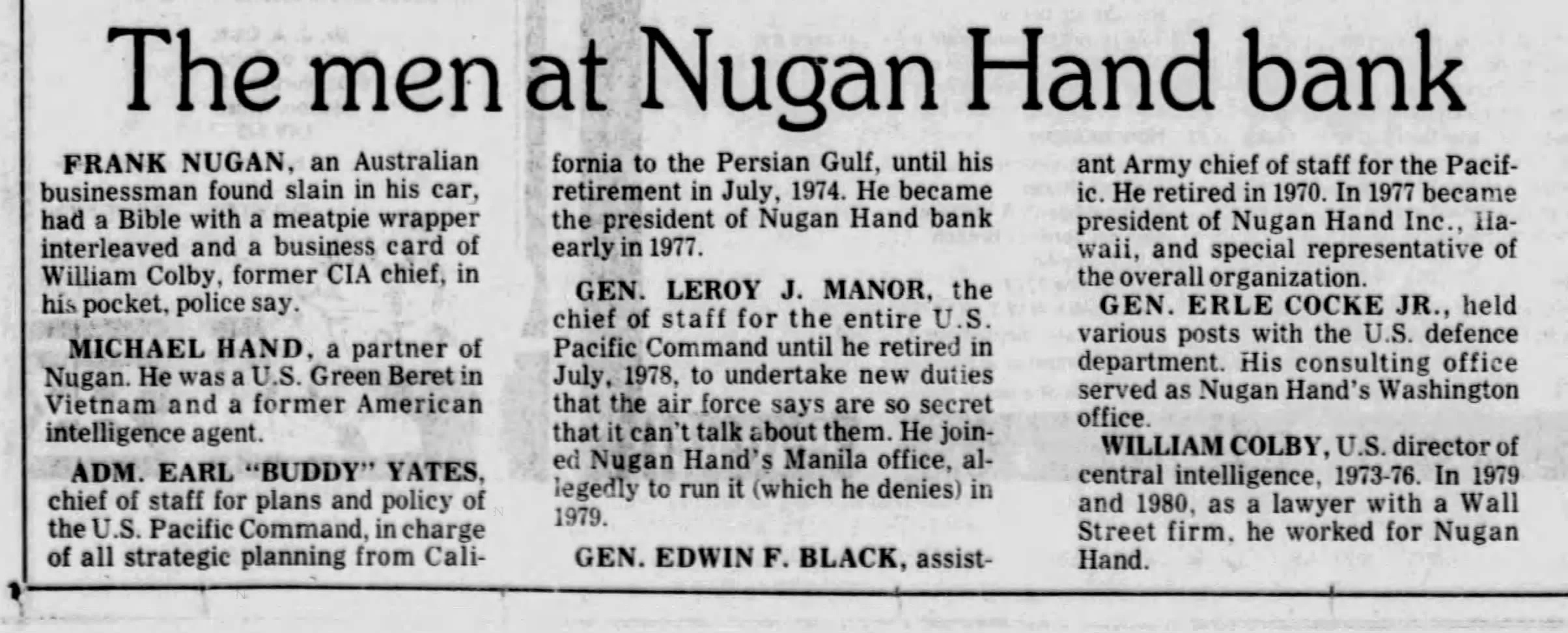
The Province (Vancouver, Canada), August 29, 1982.
Now this is amazing readers. You may remember my piece on “James Angleton and the Mobbing of the US Economy”, which was largely based on the investigative work of Jonathan Kwitny, who documented the mob’s infiltration of US food supply streams in his book Vicious Circles. Well, Kwitny was the guy who uncovered the nastiness around Colby and Nugan Hand Bank too, per The Politics of Heroin, p 469-70:
The pattern of events surrounding this expansion [of the Australian heroin smuggling bank Nugan Hand] indicates that Michael Hand may have realized his dream of becoming the “CIA’s banker.” both Sydney police and Wall Street Journal reporter Jonathan Kwitny came away from their long investigations of Nugan Hand convinced that there may well have been some connection between the bank’s sudden rise and the antecedent demise of a CIA proprietary, the Castle Bank & Trust of Nassau. After retiring from the CIA, Paul Helliwell, founder of such agency “proprietaries” as SEA Supply Inc. of Bangkok and Air America, opened a law office in Miami and formed Castle Bank offshore in nearby Nassau to cover the agency’s covert money movements. In 1973 agents of the Internal Revenue Service were able to photograph the Castle Bank’s customer list while a bank executive dined in a posh Key Biscayne restaurant with a woman described as an IRS “informant”. Reviewing the purloined documents, IRS investigators found that the 308 Castle Bank customers on the list had moved $250 million to foreign numbered accounts. Depositors included Playboy publisher Hugh Hefner, Penthouse magazine publisher Robert Guccione, and some major organized crime figures— Morris Dalitz, Morris Kleinman, and Samuel A. Tucker. Elated by the find, investigators formed Project Haven to make “the single biggest tax-evasion strike in IRS history.” Suddenly, the IRS announced that it was dropping the investigation because of “legal problems.” According to a later investigation by the Wall Street Journal, “pressure from the Central Intelligence Agency…. caused the Justice Department to drop what could have been the biggest tax evasion case of all time.” The CIA invoked “national security” since it was using the Castle Bank “for the funding of clandestine operations against Cuba and other covert intelligence operations directed at countries in Latin America and the Far East.” By the time Helliwell died from emphysema on Christmas Eve, 1976, Castle Bank had been liquidated.
Simultaneous with the closure of Castle Bank’s Nasau office, Nugan Hand Bank launched its formal “banking” operations in the nearby Cayman Islands. The opening of Caribbean branches, a new area for Nugan Hand, and recruitment of retired CIA officers gave it a corporate structure similar to the collapsed Castle Bank. Indeed, a former CIA agent named Kevin Mulcahy, a key witness in the Edwin Wilson case, gave details to the National Times of Sydney “about the Agency’s use of Nugan Hand for shifting money for various covert operations around the globe.”
What Prof. McCoy doesn’t mention, from his ivory tower just north of Chicago, is that one of the biggest clients of Castle Bank and Trust were the Pritzker Family. The Pritzker’s tax attorney, Burton Kanter, masterminded the tax-evasion dimension of Castle Bank. In fact, the Pritzker family is mentioned nowhere inside the good professor’s book.
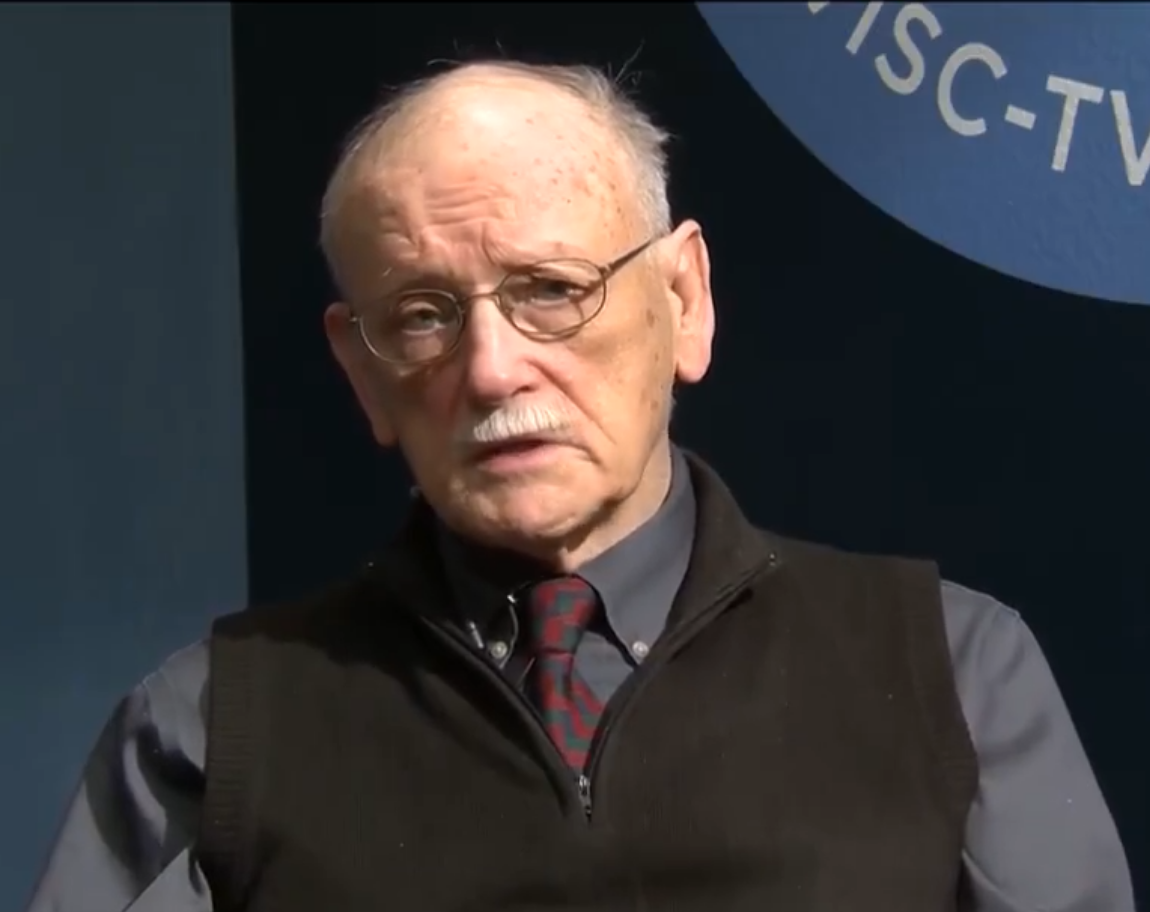
Prof. Alfred McCoy of the University of Wisconsin, Madison in 2026. This image was taken during the professor’s appearance at a “Democracy Now!” event with Amy Goodman.
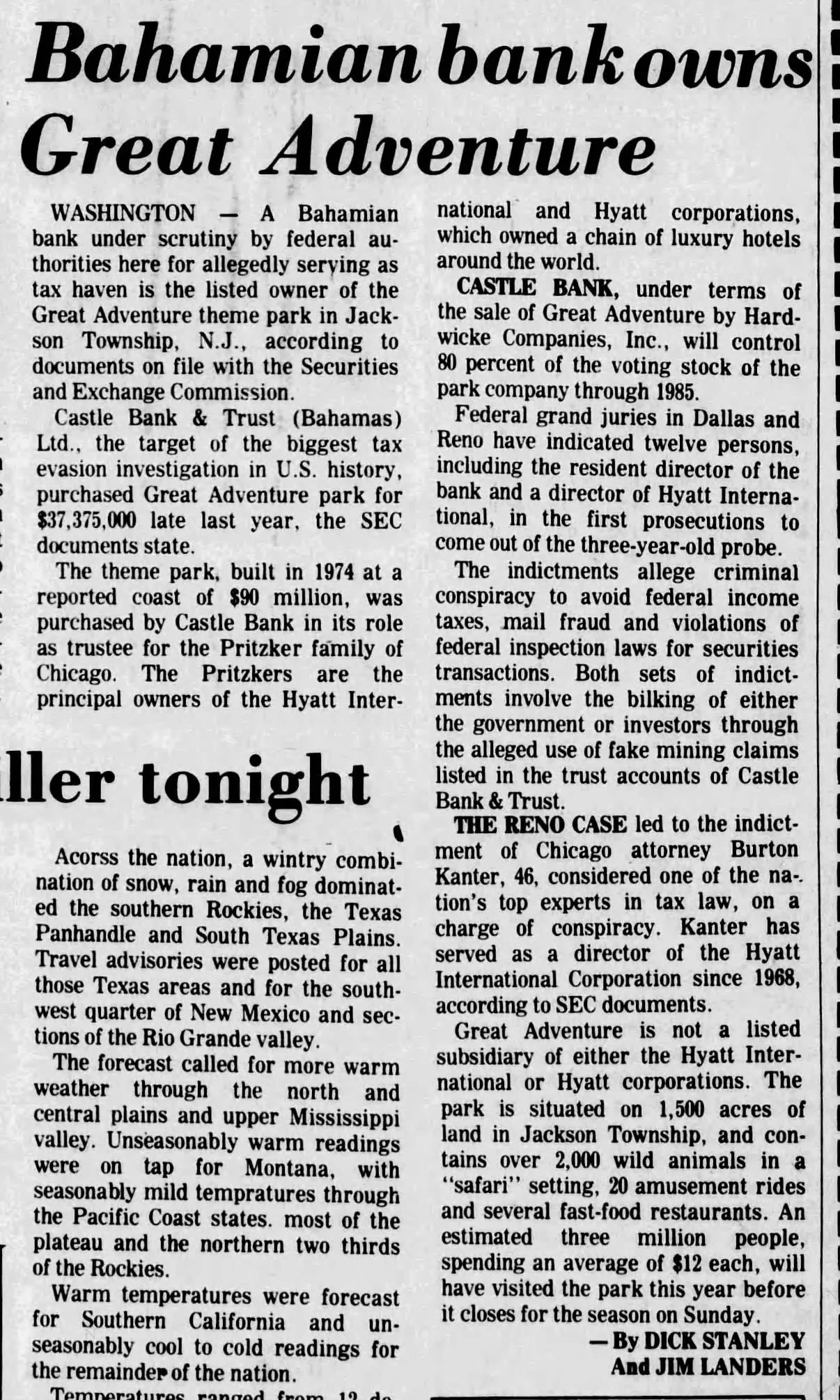
The Trenton Times (New Jersey), October 28, 1976
Spurred by the abrupt dismissal of the CIA’s ignorant Cuba-expert, I tried to get a hold of a copy of the WSJ article referenced by Prof. McCoy, only to find that the WJS’s online archives ‘could not locate that article’. Fortunately, the CIA declassified a redacted version of it many years later, with the client list blocked out:
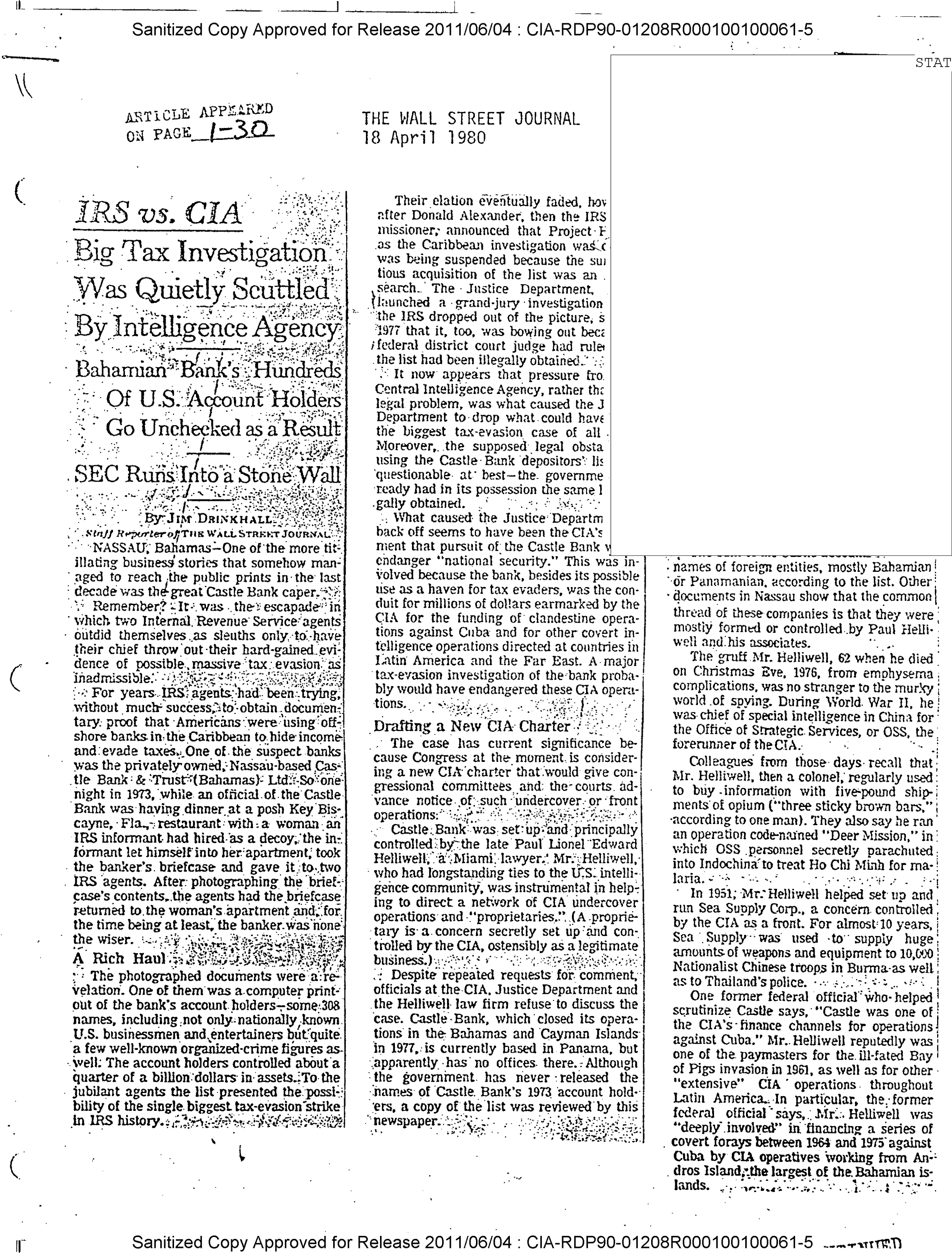
Jim Drinkhall was a San Fransisco-based correspondent for the WSJ who focused on the intersection of organized crime and high finance.
And even more fortunately, the CIA had released an unredacted version of the same WSJ article four years prior!
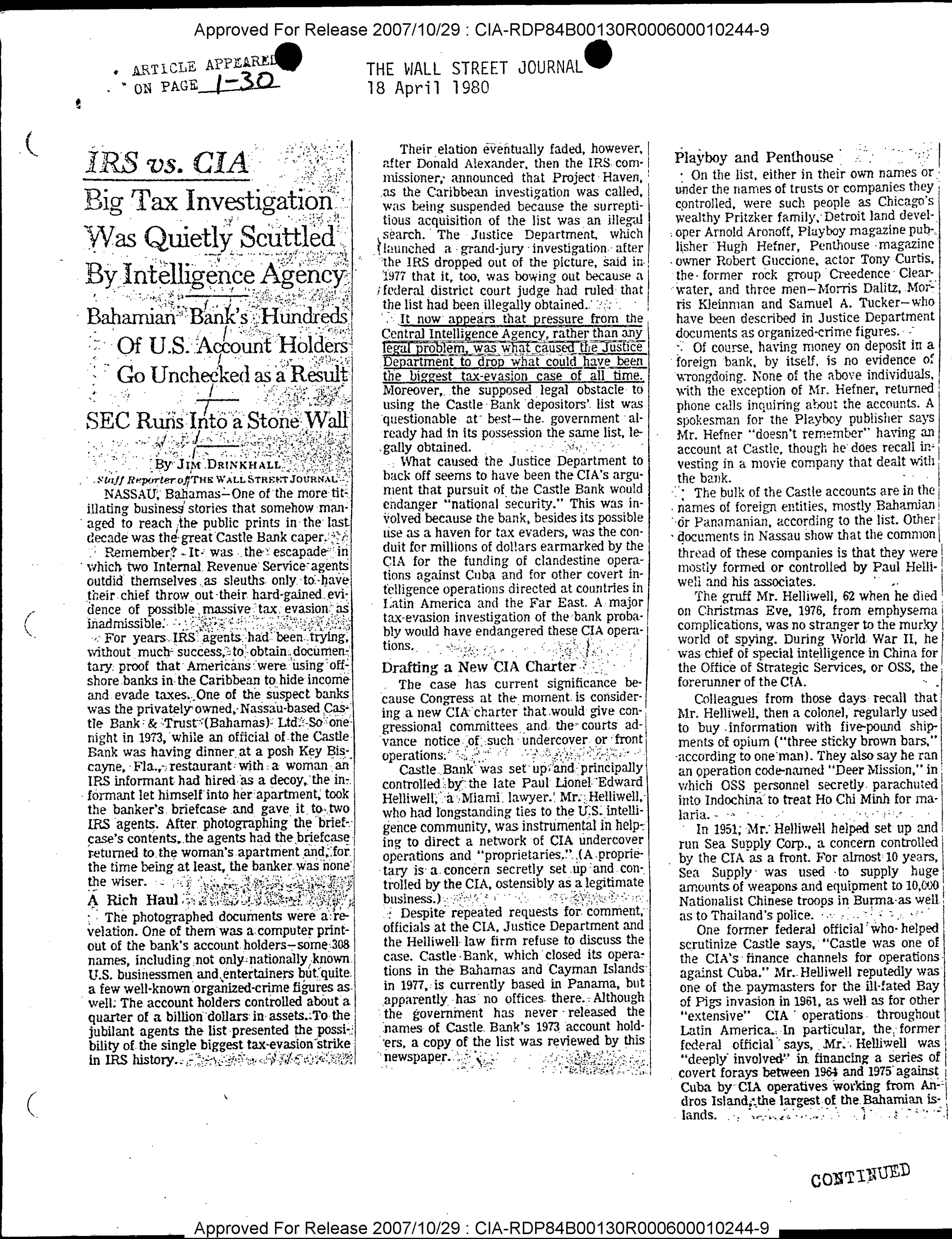
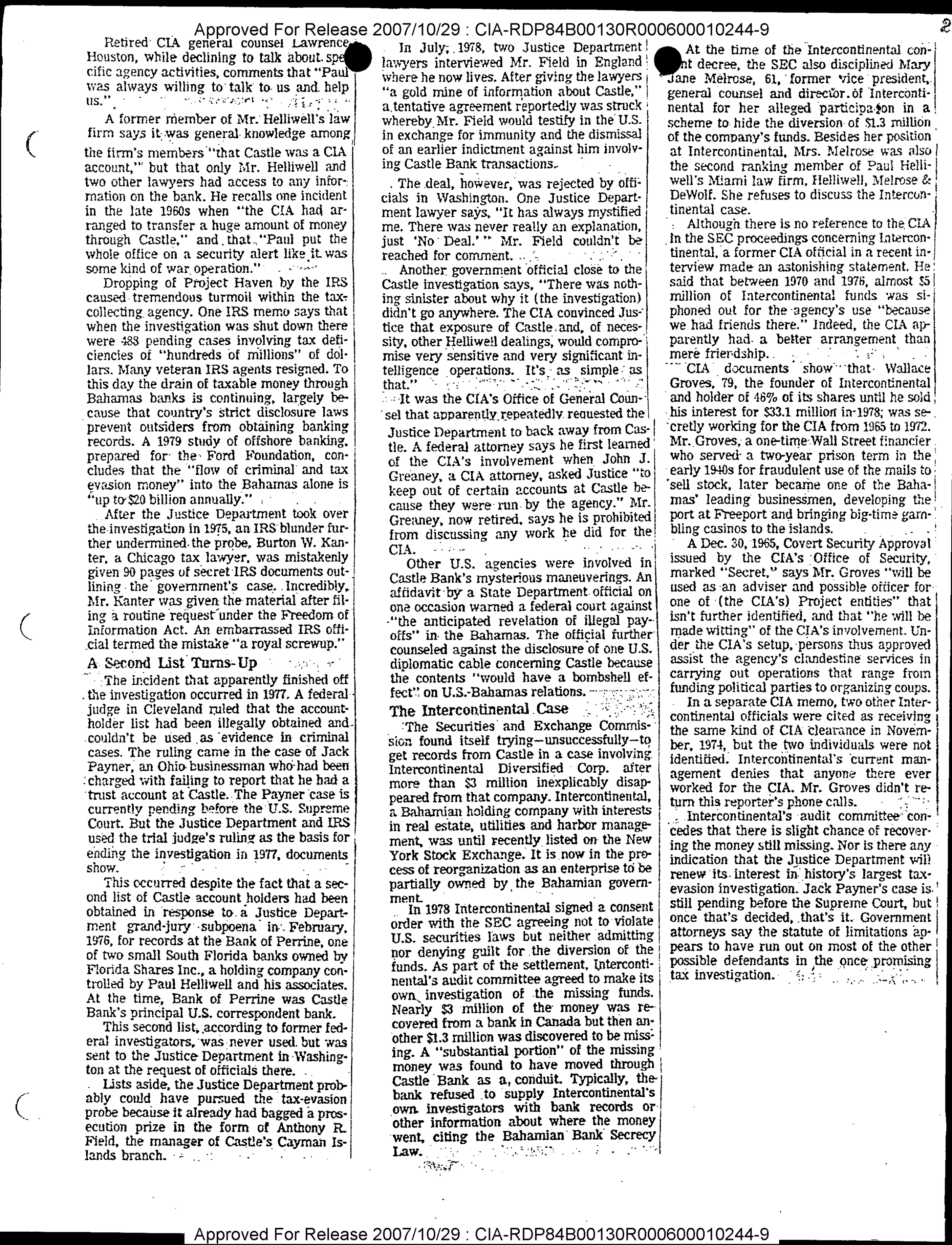
If you read column 3 on the first page, you’ll see that Paul Helliwell, identified by Prof.McCoy previously, was an old OSS man who was dealing opium out of China during WWII. Same sort of business Bill Colby, another old OSS man, was alleged to be in. Have I told you about Meyer Lansky?….
So I guess the Castle Bank and Trust was real enough to get a CIA staff meeting and an eventual redaction… Look, for any agency employee who may be reading this, the reason you’re not allowed to know about CB&T is the same reason you’re not allowed to think like James Jesus Angleton about Soviet penetration: both were threatening to Bill Colby.
Bill Colby, the Pritzkers and Burton Kanter were probably wishing they’d used a “Chinese wall” at CB&T when a partial client list was eventually given to the press in 1980: pornographers Hugh Hefner of Playboy and Bob Guccione of Penthouse Magazine; actor Tony Curtis; Michigan fraudster Arnold Aronoff; members of music band “Creedence Clearwater Revival”; mobsters Morris Dalitz, Mike Coppola, Yale Cohen (colleague of Anthony Spillotro), Morris Kleinman, and Nicholas Donolfo (colleague of Sam Giancana). All these people did their banking with the CIA.
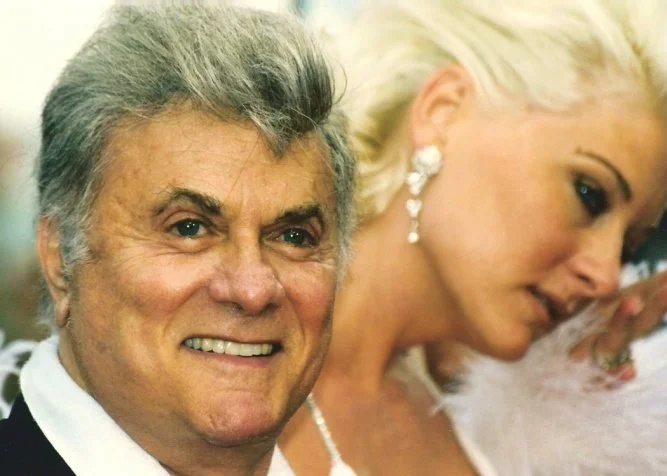
Tony Curtis in 1997.

The Miami Herald, July 1, 1980. 1/2

The Miami Herald, July 1, 1980. 2/2
Not only was the Castle Bank & Trust a real thing, but it was a real thing in front of the public’s eye for almost a decade. The longevity of the scandal was because the IRS took the client list as part of a sting involving a honey-trap, a female informant using sex to get evidence, therefore the IRS’s “Operation Haven” faced a battery of well-financed legal challenges from the Pritzkers.

The Miami Herald, July 1, 1980.
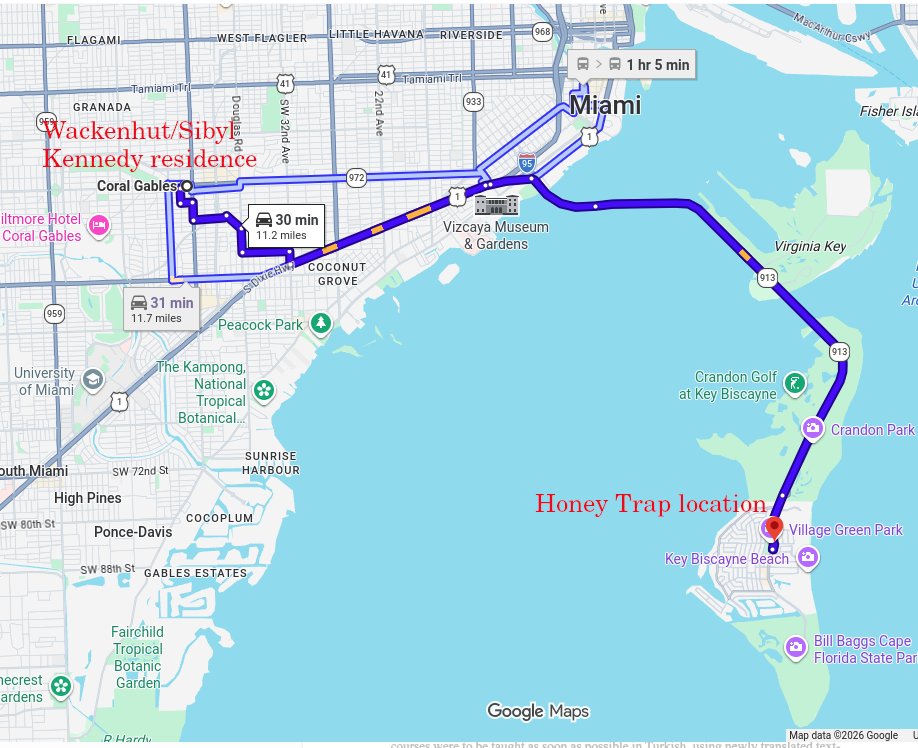
January 15th, 1973: The incriminating client list was left at the apartment of Ms. Sybil Kennedy, who then went with her target for dinner in Key Biscayne, so that IRS agents could rifle through his briefcase.
Who was this female informer who ran the honey trap which caught the Agency? A lady named Sybil Kennedy, fresh out of the police academy in 1973. Weirdly enough, this gal had a long resume prior to her enthusiasm for IRS work:
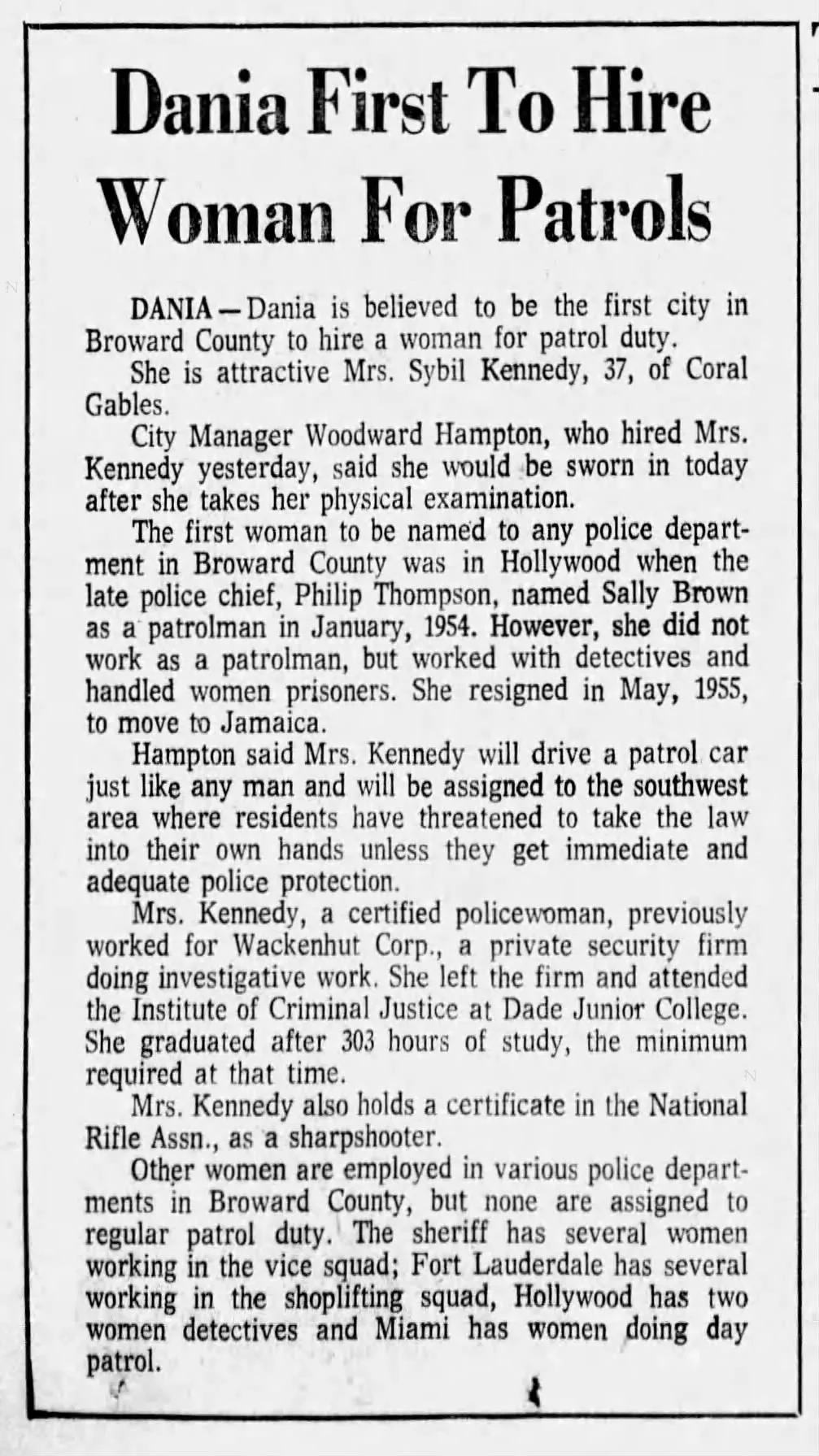
The Fort Lauderdale News, June 14 1973.

The Miami Herald, June 6, 1973.
I’m making the assumption here that there are not two policewomen named Sibyl Kennedy in sunny Coral Gables, FL who both just joined the force in 1973. Sibyl’s previous employment as a “Special Features writer in South Vietnam” during the war and then at Wackenhut Corp is quite the eye-opener. Wackenhut, now called “G4S”, is a private security form founded in Coral Gables by FBI agent George Wackenhut, a guy who also collected and sold information on American citizens (allegedly left-leaning “political dissidents”). Creepily close to what James Angleton has been accused of doing, no? Following the passage of the “Fair Credit Reporting Act” in 1970, keeping these files became a liability for Wackenhut, who transferred them to The Church League of America in Wheaton, IL. They are now housed at New York University, which says this about its collection:
The Church League of America, a right wing anti-communist research and advocacy group, collected these research files from other creators with a similar political outlook and professional activities: American Business Consultants Inc., the Wackenhut Corporation, and Karl Baarslag. All of these creators had connections to the intelligence agencies of the United States government, kept detailed research files on individuals and organizations, and were part of a right-wing research and information network that monitored Communists and other perceived threats to their interpretation of the American way of life.
By the 1950s, the Wheaton, Illinois-based Church League of America had become a major force in right-wing anti-communist activity, and as other similar organizations faced difficulty, the Church League obtained their research files. American Business Consultants, Inc. was founded in 1947 and was a major force in McCarthy-era investigations into suspected Communist activity. Their for-profit weekly publication Counterattack and special report Red Channels provided readers with specific names and information on allegedly subversive individuals and organizations. As a result of the financial difficulties caused by ensuing libel suits, ABC transferred their research files to the Church League. Additional files came from the Wackenhut Corporation, which was founded in 1954 by George R. Wackenhut and other former FBI employees. The company, which provided private security to industry and government agencies, also kept extensive files on individuals, ostensibly to run background checks. The Wackenhut Corporation received many research files from Karl Baarslag who worked for such prominent anti-communists as Senator Joseph McCarthy, Church League of America, and the American Legion.
Wackenhut’s activities were a lot like those of the Pinkerton Detective Agency, which had an unsavory role protecting Lincoln’s counterfeiters in Chicago. The Wackenhut Corporation was no less influential either, according to University of Florida historian Lauren Pearlman:
Founded in 1958 by Army veteran and former FBI agent George Wackenhut, the firm provided highly trained armed security forces for nuclear power plants, airports, and embassies before reinventing itself as a pioneer in the private prison industry. As this paper argues, its success was due, in part, to its paramilitary vision: Wackenhut recruited from military job fairs and publications; dressed its guards in helmets and paratrooper boots; and employed military veterans in management. Wackenhut’s business ventures and hiring strategies became characteristic of other private security companies that, together, drove the privatization and militarization of the 20th and 21st century American home front.
So Sybil Kennedy was a funny sort of lady to be busting wide the CIA’s anti-Castro initiatives, wasn’t she? The story gets weirder, readers. I’ll start by explaining that about a month after “Sybil Kennedy” wined-and-dined the IRS quarry, a “Sybil Kennedy” and a “Lee Kennedy” bought an apartment in expensive Venice, FL (Apartment 803 at 627 ALHAMBRA ROAD, VENICE, FL 34285-2504):
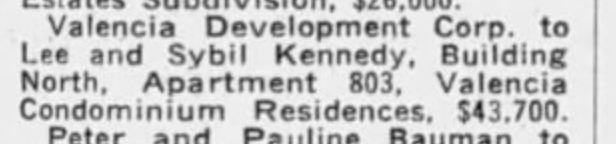
Sarasota Herald Tribune, February 18 1973.
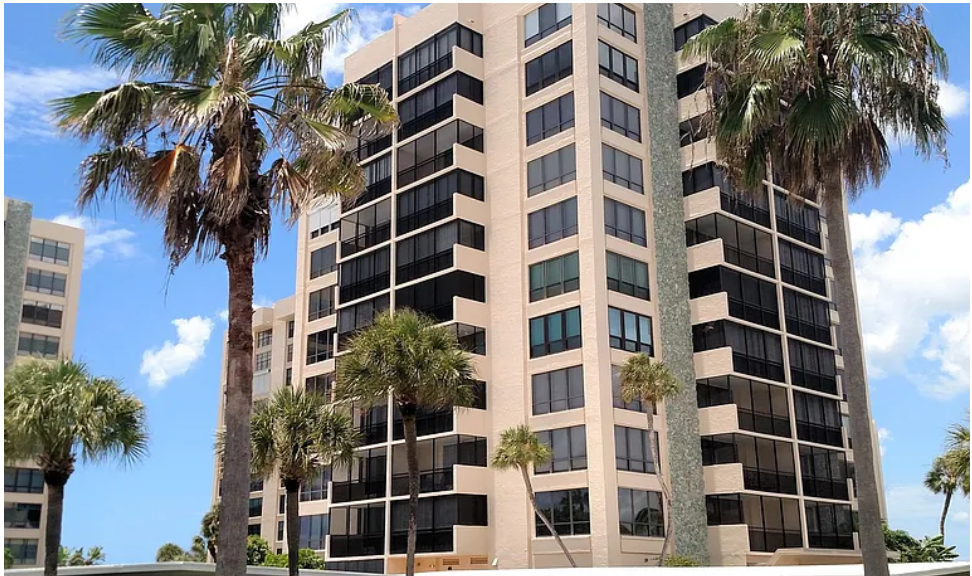
It’s “Miami Vice”! 627 Alhambra Road, Venice, FL.
Then, Lee and Sybil Kennedy started a company in Tarpon Springs, FL, two hours’ drive north of their new apartment in Venice. This company created pre-designed hotel suite furniture packages. Their star client was Robert F. Warner, whose flagship Bahamas hotel, the Emerald Beach Plantation and Hotel, had just been taken over by the Pritzkers two months before.

Fort Lauderdale News, May 19, 1973.
I wonder if this Bahamian takeover affected Robert F. Warner’s cash flow? The next month, June 1973, Lee and Sybil Kennedy sold a parcel of land in South Venice (“Section 5, Township 40 South, Range 19 East (T40S R19E)”:
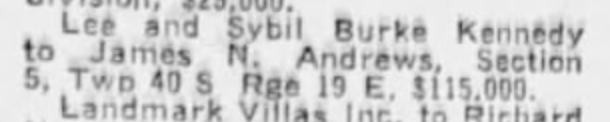
Sarasota Herald Tribune, June 17 1973
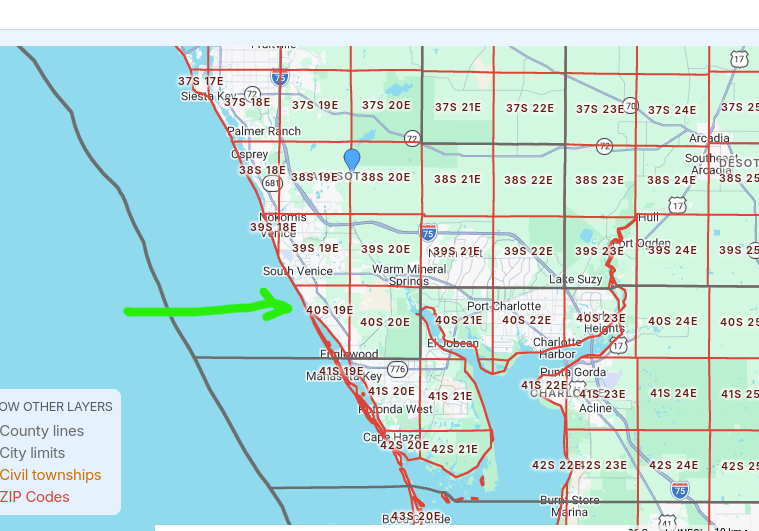
Lee and Sybil sold a parcel of land in the triangle marked “40S 19E”. “Palmer Ranch” as in Bertha Palmer.
A week before that Venice sale, “Sybil Kennedy” appeared as the first girl policeman in Broward County! Broward County includes Fort Lauderdale, which has kind of merged into the top half of Miami. So the police force got her a job near her Coral Gables apartment. For the next two years, Sybil was featured in The Miami Herald every four months or so, with feel-good puff pieces, for example: the time she saved a senile old man; recovered some fishing tackle from wayward teens; or this classic….

The Miami Herald, August 19, 1973. Officer Toots is on the case!
It’s weird as hell, readers. But Florida’s a weird place. While I am confident that “Sybil Kennedy” the policewoman is “Sybil Kennedy” the honey-trap, I cannot say with certainty that Venice’s “Sybil Kennedy” is the same person. The timing of that Pritzker Bahamas hotel takeover and the exposure of the Pritzker Bahamas banking scandal is odd though, isn’t it? And all this followed by Ms Kennedy’s sudden stardom in Miami, the denizens of which must have been endlessly entertained by her police-girl antics.
One last thing before I end this piece: the Prtizkers seemed to have looked to the OSS’s China operations as well as to New York to staff the Castle Bank and Trust. As you can see from the Albany, NY paper below, the president of the outfit was from Rochester, NY:

The Times Union, August 7, 1972.
In addition, Castle Bank and Company looked to New Jersey partners to finance their New Orleans Hyatt:
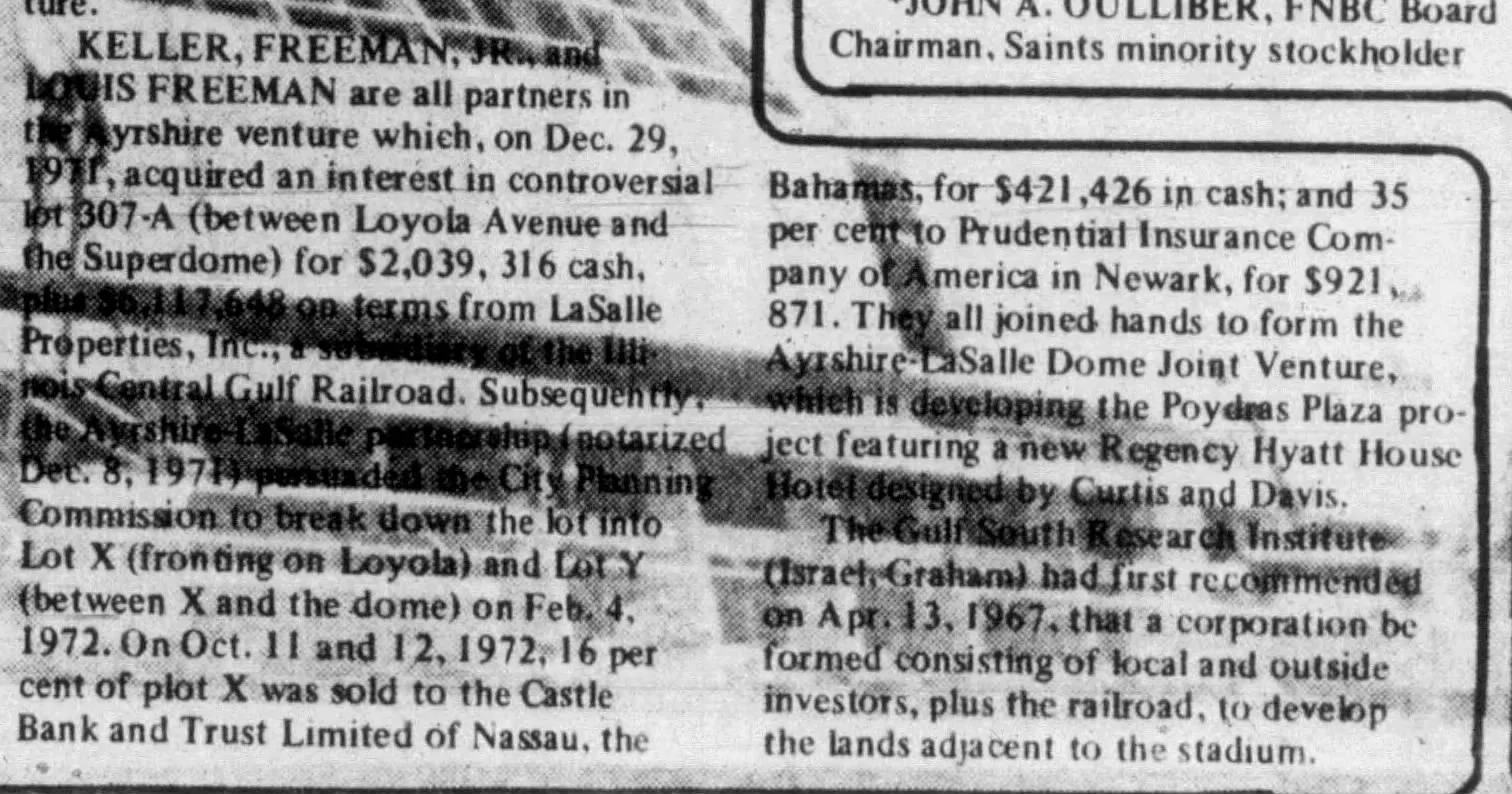
The Courier, August 31, 1972.
The more I uncover about the real history of the “Office of Strategic Services” and its successor, the CIA, the more confident I am that these outfits are simply vehicles for the state-sponsorship of the Galician drug trade. Dealing drugs is the only thing they do consistently well.