OSS in Turkey: Alfred Redl and The Kentucky Colony
Let’s start August with some Chicago-Crime-meets-International-Intrigue!
Readers, today I’m going to show you how the Office of Strategic Services (OSS) fell into the “Redl Trap” when they tried to commandeer Chicago Organized Crime for their war effort. There are three parts to today’s puzzle, which we will fit together seamlessly:
1) Colonel Alfred Redl, head of military counterintelligence for Austria-Hungary before May 25, 1913. Redl was forced to commit suicide when it was discovered that he was a double agent for multiple countries. His stellar career was most likely based on contacts with the Galician Gang and their international sex trafficking network. (Short of this historians have no reasonable explanation for his meteoric rise on the General Staff.)
2) “The Kentucky Colony” were Chicago’s pre-1910 leading crime families. These families financed Lincoln and assisted his counterfeiting efforts, which carried on long after the US Civil War. By 1890 their political power came from the prostitution business (supplied by Galician Gang trafficking), the proceeds from which bankrolled their corrupt politicians. (You can read all about it in my book, Lincoln’s Counterfeiters.)
3) The “Office of Strategic Services” was, in 1939, the latest incarnation of the Roosevelt Family’s industrial espionage network. This network was bloated with Galician Gangsters, sleazy Brits, and Quaker/British Loyalist-derived business partners. The OSS Istanbul office would have been an important source for information on the Nazis because many connected German Jews were emigrating via Istanbul, where there was a long-standing Jewish community.
So how do these puzzle pieces fit together? Let’s start with the most recent piece: the OSS operation in Turkey during WWII was a fiasco. The mess was mostly due to their original Istanbul head, Lanning “Packy” MacFarland, who was an incompetent playboy. MacFarland’s agents relied on one “Czech” [Hapsburg] contact, code-named “Dogwood”, who put them in touch with a “Cereus” spy network that was thoroughly controlled by the Germans. For most of the war the Americans were receiving deceptive intelligence, “chicken feed”, from this preexisting German intelligence network in Turkey’s capital. All four British intelligence bureaus acting in Istanbul cut ties with the OSS there thanks to MacFarland and “Dogwood”. Norman Holmes Pearson, a British spy, was complicit with MacFarland’s Istanbul failure and would go on to train James Jesus Angleton, who would in turn try to milk information on the USSR out of Jewish emigrants in Israel, a.k.a “the Israeli Desk”.
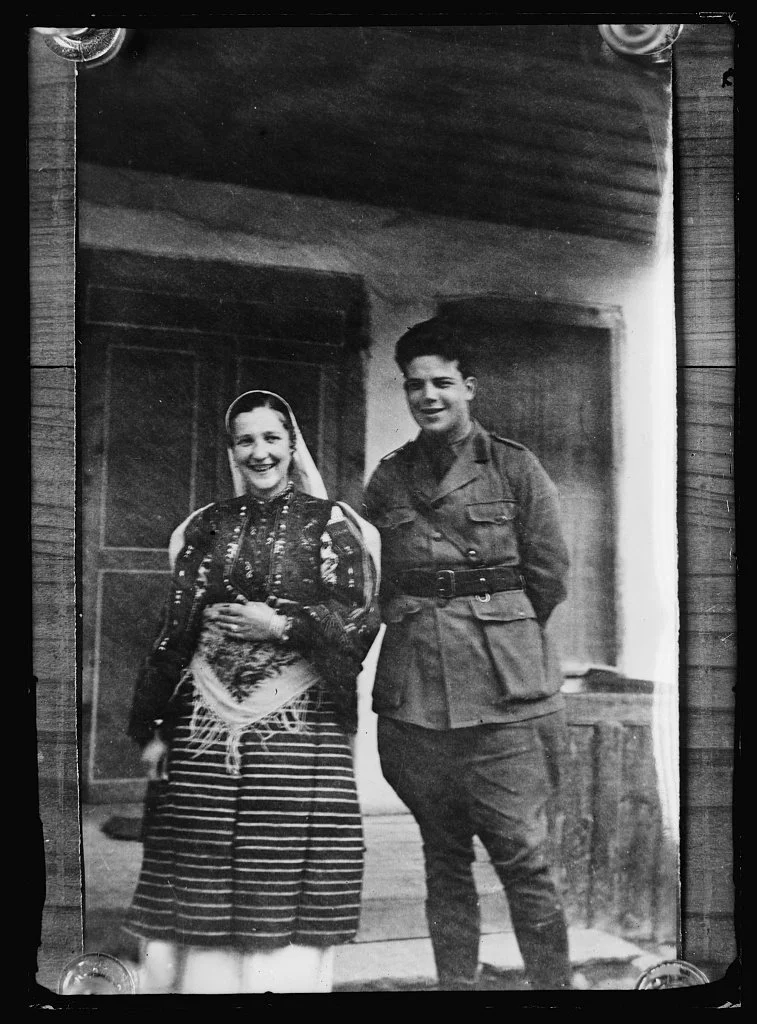
“Capt. Lanning Macfarland, A.R.C. [American Red Cross] Jewish refugee woman”. Image captured in Serbia, sometime before February 1919. Library of Congress. MacFarland was in Serbia after Bill Colby’s dad, Elbridge, did a fact- finding mission for the Ringstrasse-affiliated Columbia University there at the start of the Great War.
Why was Packy given the Istanbul position by Allen Dulles? In the decades prior and on the back of mining money, Theodore Roosevelt’s industrial spies like John Greenway became social peers of powerful Kentucky Colony families around Chicago like the Harrisons. They would hunt, fish and do other “strenuous life” hobbies together, with the added benefit that they could exchange information away from unwanted ears.
Packy was banker to the Kentucky Colony: in 1921, shortly after the photograph above was taken, MacFarland joined the Northern Trust Corporation, an investment bank in Chicago which services high net worth individuals. Northern Trust’s original 27 shareholders included Kentucky Colony protege Marshall Field (a business face for Potter Palmer) and “Beef Trust” czar Philip D. Armour. Northern Trust is where Chicago’s dirty money went to be laundered.
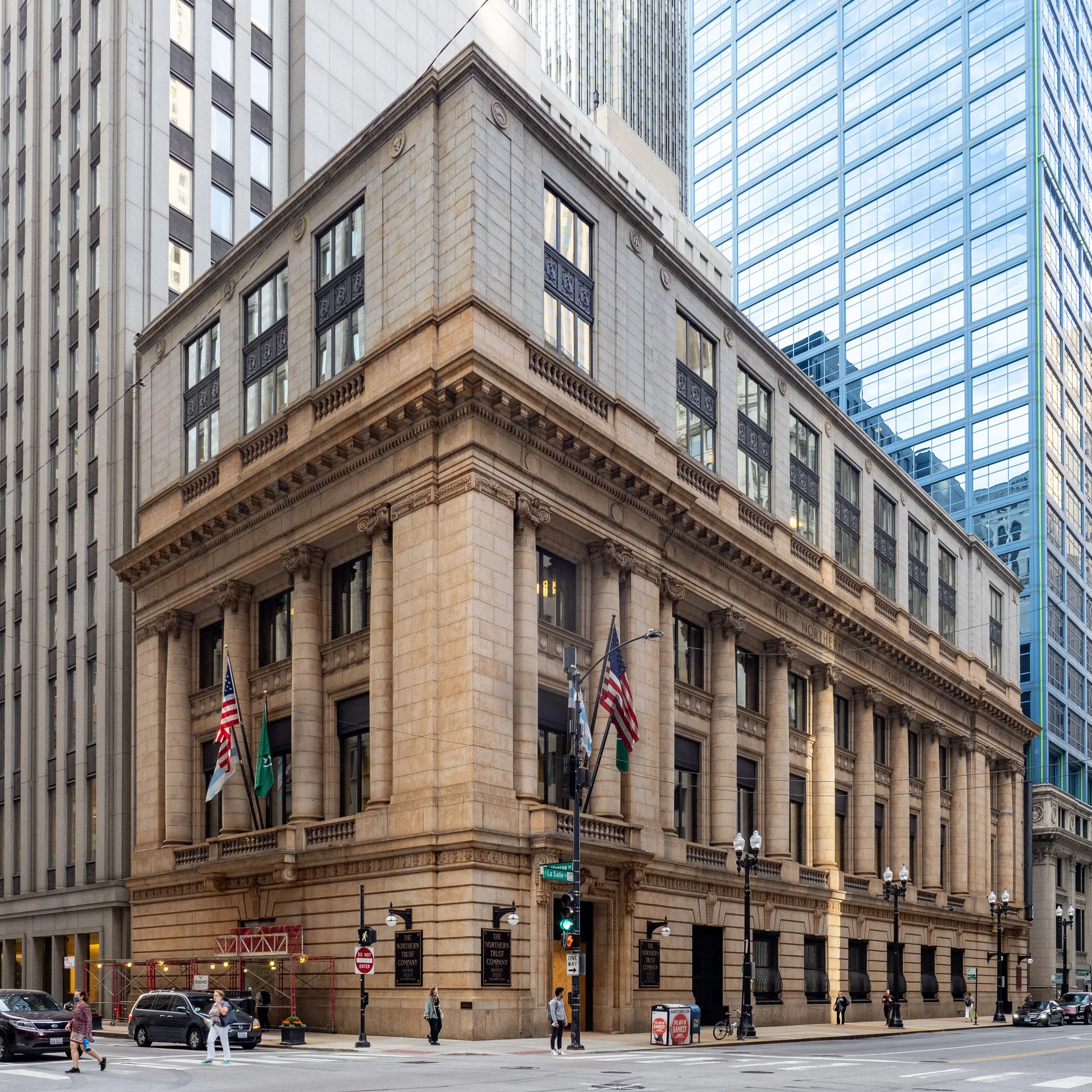
Northern Trust’s company headquarters in downtown Chicago.
The Kentucky Colony had a long history with German Europe and the nefarious secret police partnerships undertaken by both the Hapsburgs and the Hohenzollerns. In fact, the Colony’s most famous mayor, Carter Harrison III, spent time in Europe learning just how these rulers worked with organized crime to manipulate political movements. Harrison proved just how well he’d learned these tricks when he instigated the Haymarket Riot and undermined the Chicago’s Socialist movement, which was lead by 1848-hardened German immigrants and wealthy Jewish intellectuals back home, though by 1886 they’d been co-opted by German secret services.
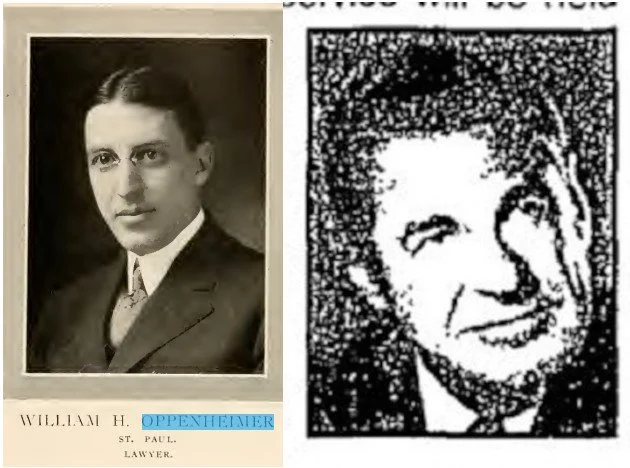
Within months of joining Northern, MacFarland also became a director of the Chicago Daily Law Bulletin, which was a legal intelligence publication of the type important to Galician Gang leadership, such as William Oppenheimer out of Minneapolis. With the Kentucky Colony’s long-standing Galician partnerships, as well as Roosevelt’s OSS making Galician Gang friends left and right (Meyer Lansky and the old Arthur Rothstein drug dealing network out of German Europe), Packy was a natural choice to interface with Galician Gang networks in Asia Minor.
What would the Galician Gang networks in Asia Minor have looked like? Following the 1848 Revolutions, the Hapsburgs gave Eastern European Jewish organized crime families special economic privileges. Among the most lucrative was control of the newspaper press in Vienna and the freedom to pump-and-dump stocks from those newspaper pages. In exchange, the editors were supposed to support Franz Joseph and Hapsburg/Ringstrasse-aligned economic policies, like imperialist expansion into Ottoman lands.
Newspaper editors set up the empire’s most sophisticated espionage networks under the cover of journalistic deployments. These “journalists,” who were almost exclusively Jewish, would solicit information from cash-strapped army officers, or use Ringstrasse-connected diplomats, to stay ahead of the international situation. They often wore dual-hats as “students” in the cities they targeted. Because of these weaponized social networks, Austro-Hungarian newspaper magnates like Mortiz Szeps knew the outcome of military engagements, international treaties, and social scandals before the Hapsburg government did. Even Crown Prince Rudolf was one of Szeps’ informers.
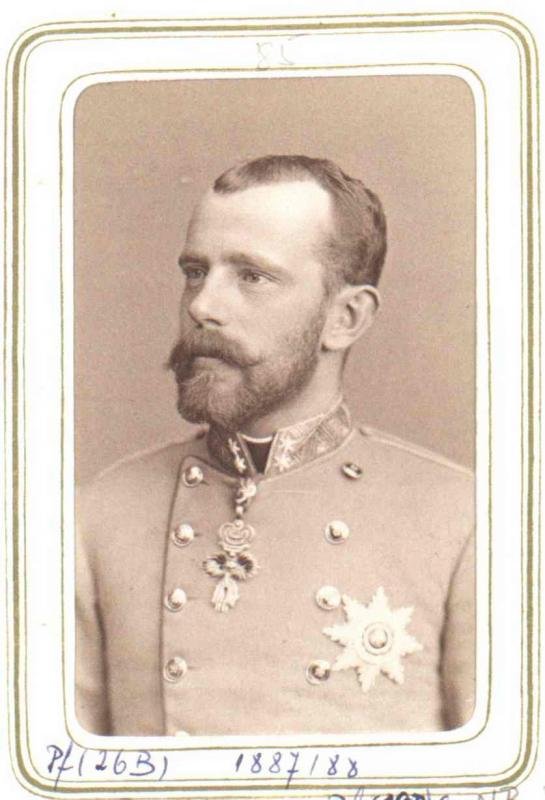
Crown Prince Rudolf of Austria. The only son of witchy Sisi, Rudolf was always jockeying for political influence which he didn’t have the intellect to wield. Moritz Szeps flattered the prince into a guru/disciple relationship and milked him for state secrets.
Who were the Ringstrasse? They were the “intercessor” or shadlanut class which protected the lower-level Galician Gang traffickers from any local government or nationalist political party which might seek to reinstate law and order. Famous among them are the Rothschilds, Gomperzes, von Pappenheims, Epsteins, Szepses, Waerndorfers and Wittgensteins most of whom were cousins of some description and interrelated by marriage through a variety of channels. These are the wealthy families Sigmund Freud is famous for ‘treating’.
When Colonel Alfred Redl was uncovered as a traitor, it terrified the Ringstrasse community. He had been their information point-man with Berlin during the annexation of the Balkans, from which they derived heavy economic benefit. There was also the specter of Redl being Jewish— “Redl” is the Yiddish spelling of an Ashkenazi name— and that was a nightmare for a community who were already being criticized for exploitative economic behavior.
How do we know what the Ringstrasse’s feelings toward Redl were? We can look at the press coverage of him in their German-language newspapers. This coverage avoided printing photographs of Redl— out of weeks-long coverage by thousands of newspapers, only one photo of him was ever printed and it appeared only twice. The first (June 1, 1913) of these was in a low-brow newspaper from Vienna titled Wiener Bilder, the second appearance was in Berlin on June 8, in the Sunday insert of the esteemed Berliner Tagblatt. Berlin Tagblatt was published by Berlin’s answer to Vienna’s advertising/espionage magnate Moritz Szeps, Rudolf Mosse. Mosse was born to a wealthy Jewish family in Greater Poland, but found privledge and power in Berlin under the Hohenzollerns.
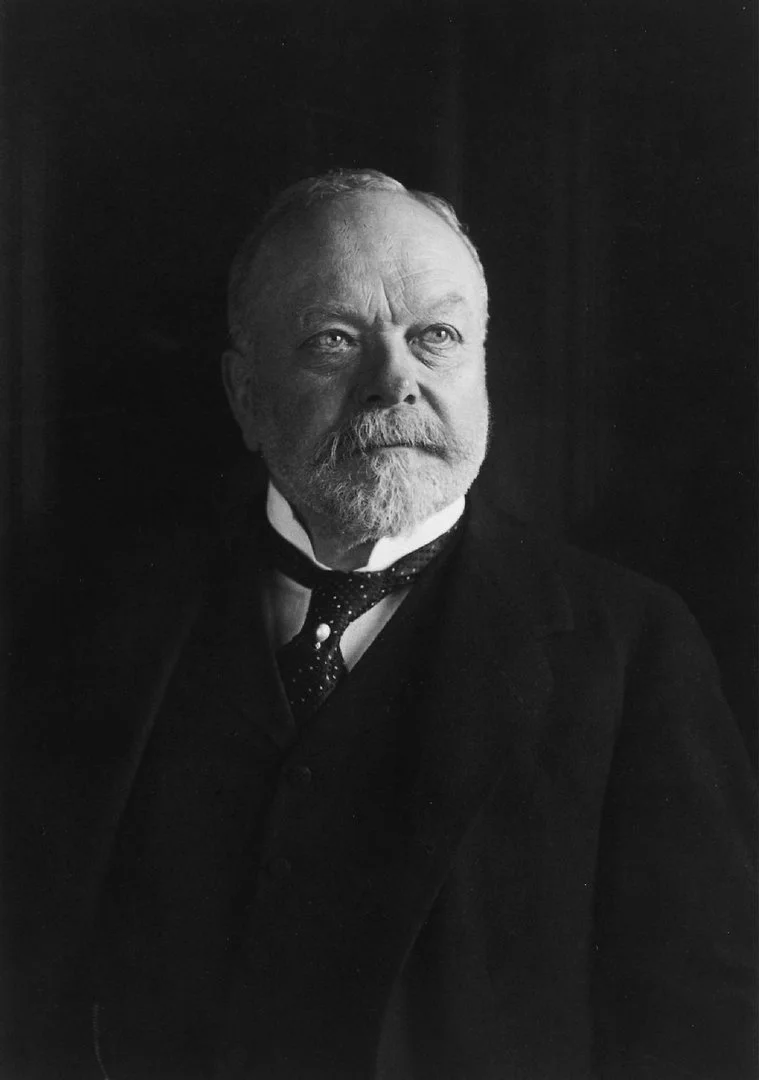
Rudolf Mosse, Berlin’s advertising kingpin in an age where newspapers doubled as espionage networks. Mosse’s father was a doctor in Greater Poland.
Berliner Tagblatt was one of the first papers to break the Redl Scandal (not that liar Egon Kisch) and its reproduction of Redl’s photograph was done in a very unusual way. Rather than illustrating a description of scandal and suicide, the photograph was couched in the middle of a literary fiction piece— a retelling of the Narcissus story by Anders Oesterling, the Nobel Prize gatekeeper and minder for Herman Hesse, another one of Freud’s ‘patients’. Narcissus was a sixteen-year-old sex-symbol in Ancient Greece, whose self-centeredness caused him to be transformed into an ephemeral flower.

Image from the Jun 8, 1913 Berliner Tagblatt supplement that printed Redl’s photograph (Top, RHS). The top LHS image is of a soldier who betrayed his country to enlist with a foreign army. The text of Oesterling’s Narcissus piece is printed in Fraktur between the two images.
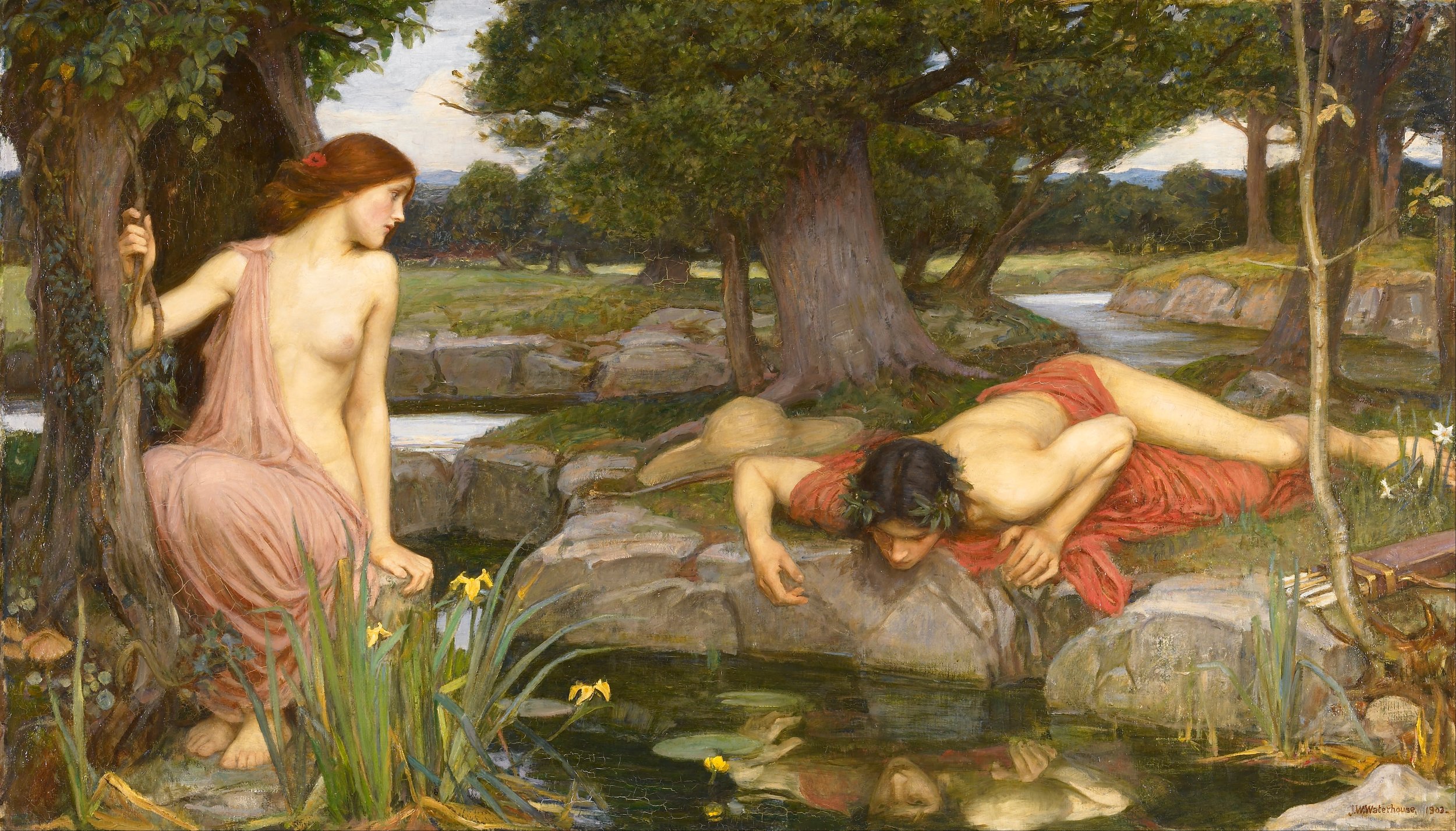
The famous John William Waterhouse painting of Echo and Narcissus. To understand the role that narcissism plays in child grooming and high-control groups, please see “Does Alcibiades Hurt? Narcissistic 'Love', Child Abuse and High-Control Groups in Plato's Symposium”.
The Swedish-German translator of Oesterling’s work for Berliner Tagblatt was "Marie Franzos" which is probably a pen name for Marie Herzfeld (she took many pen names). Herzfeld was likely helped by her colleague Karl Emil Franzos (who was married to the daughter of the publisher of Vienna's top broadsheet, Neue Freie Presse). Both Herzfeld and Franzos were part of the Ringstrasse’s literary wing— the “Young Vienna” crowd— whose work was promoted in a trioka of establishment literary papers: Die Wage, Die Zeit (which actually broke the Redl Scandal) and Wiener Rundschau. Herzfeld was the Scandinavian correspondent for Die Wage, making her one of Redl’s peers and the logical person to translate Oesterling into German for Mosse. You can read Oesterling’s story in English here, and you will probably agree that it shows how personally the "Young Vienna" literary milieu took what happened with Redl.
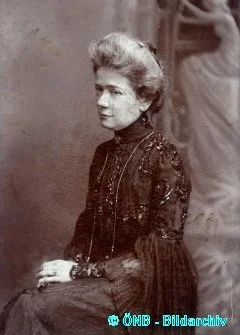
Marie Herzfeld. Like Mosse, she was the child of a Jewish doctor, but in Hungary, the original headquarters of the Galician Gang. Hungarian Revolutionaries would come to dominate the Austrian Foreign Office under Franz Joseph, and were the original patrons of Colonel Alfred Redl.
How does Berliner Tagblatt’s setting of Oesterling/Herzfeld relate Redl to Narcissus? Redl was an informant network building expert, a collector of people, at a time when informant networks thrived among a specific cultural subgroup. Redl’s networks spanned the Ringstrasse world, a world obsessed with the Narcissus story and pedophilia. It wasn’t an accident that Sigmund Freud linked his concept of “narcissism” with child sexual abuse among these wealthy families. Celebrating pedophilia and Narcissus became a badge of honor for the Ringstrasse crowd, the social leaders of whom bought Secessionist style art, as described by art historian Elana Shapira in Style and Seduction, 2006, p 122-27:
One of [Fritz] Waerndorfer’s early purchases at the exhibitions was George Minne’s Kneeling Boy, a sculpture of an Aryan-looking kneeling boy. This kneeling boy can be seen as symbolic of the transformation of Jewish identity (here in the frame of the secessionist club) that was apparent in the plastic surgery of Die Zeit’s newsboy, derisively named “Kohn” by [Karl] Kraus… The secessionist community fashioned itself as a religious group with the conscious choice of religious icons such as Minne’s kneeling boy, who could be seen as a communal symbol…
...Waerndorfer’s star attraction in his room was the narcissistic Kneeling Boy. Epstein had decorated his ceiling to show his relation to Greek culture and his historicist credentials; likewise, Waerndorfer chose Minne’s Kneeling Boy to show his membership in the secessionist club.

Kneeling Boy, by Minne. Copies of this statue were held in the homes of Ringstrasse notables and their social inferiors who wished to ape them.
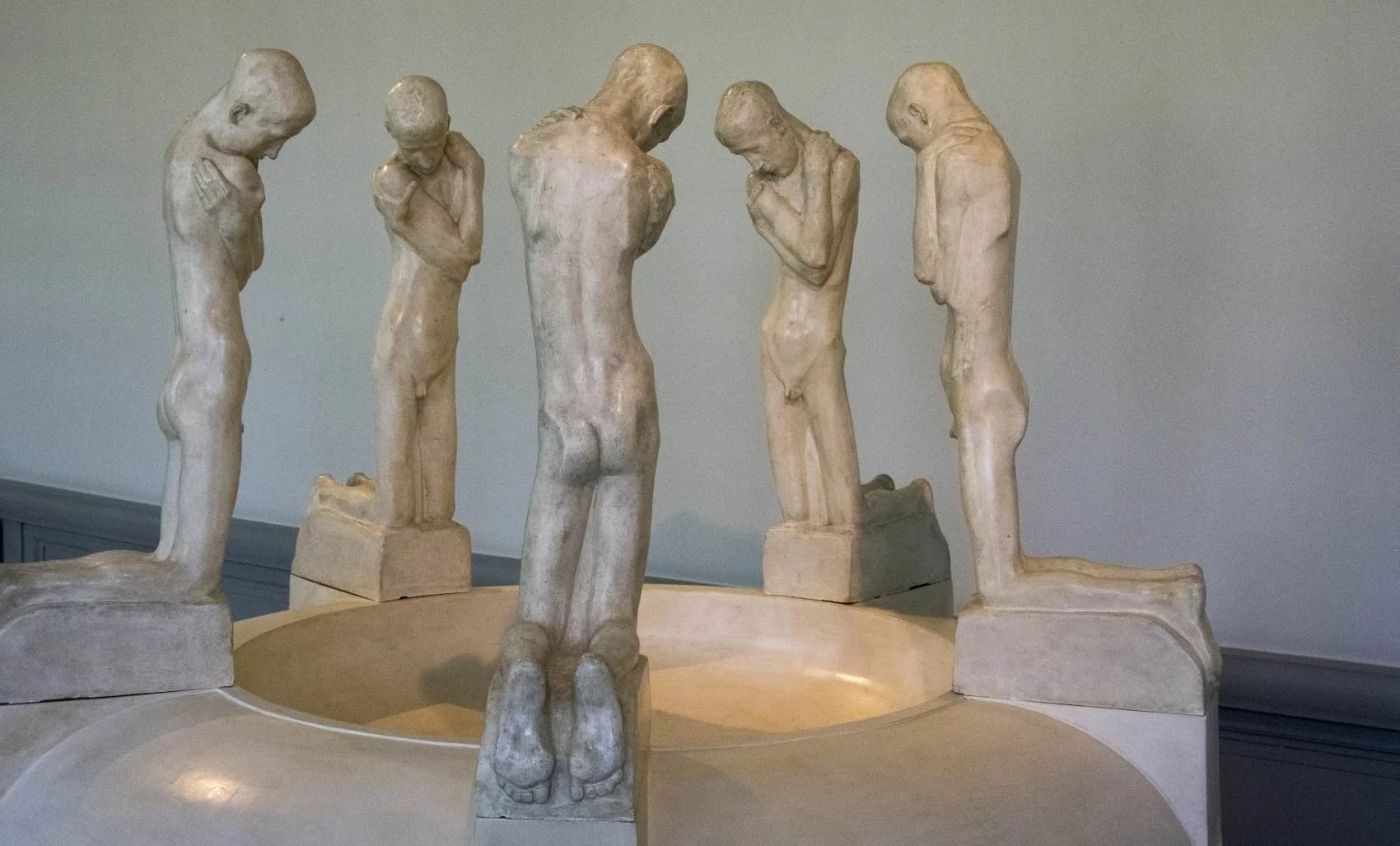
The original “Kneeling Boy” installment had five copies of the statue peering down into a pond, a direct reference to the Narcissus Myth which the Ringstrasse felt resonated with their sense of self.
The pedophilia angle was particularly important to Marie Herzfeld’s “Young Vienna” crowd. Shapira goes on to describe Kneeling Boy in relation to Herzfeld’s “Young Vienna” colleague Peter Altenberg’s paraphilia:
Born Richard Englander, he [Altenberg] adopted the name [Peter] Altenberg from the small Austrian town on the Danube. Peter was the nickname of a girl he knew and liked who was harassed by her brothers and forced to play the role of their servant boy. The fact that he adopted a boy’s name given to a girl as a taunt suggests that he chose to repeat the inner experience of being taunted for supposedly belonging to another gender (instead of being taunted for belonging to another ethnicity)...
Altenberg's lifestyle, represented in his room, has been regarded as a “critique of, and resistance to, bourgeois society and culture.” His ideal model for identification was the “child-woman” Gronberg notes: “Altenberg presented himself not only as the friend and protector of childish femininity, but also as its masculine equivalent: naively innocent, receptive, capable of unerotic love...”
Altenberg further grafted a postmodern virtual socializing network onto his interior. He created his own type of Facebook world in his room to rehearse, master, and demonstrate his art of sociability with women—specifically young girls—and to eternalize his act of flirtation as a failed gesture of taking possession.
In his room in the Hotel London, where he stayed from 1904 to 1910, Altenberg positioned at the corner of his bed a collage-like arrangement of postcards and photographs of young women’s faces together with drawings and photos of himself ... and a photo of an Ashanti woman with exposed breasts. Here the young women served a similar purpose as the Minne sculpture placed in front of the mirror in Waerndorfer’s studio: they were an artistic attempt to exchange and unite Altenberg’s physical reflection with the image of his ideal.
Oesterling’s “Narcissus” character, ‘Jonas Askeberg’, was a collector of flowers, not Narcissus-informants. Between the photograph of Redl and a less famous military traitor, Berliner Tagblatt lists all the different kinds of flower Askeberg collects:
He [Askeberg] surrounded the henbane, hemlock, foxglove, belladonna, the doping oleanders and others who had the curse of the poison in their body with the guard of violets, mignonettes, carnations and other lovely children of Flora. Yes, it was a very peculiar system.
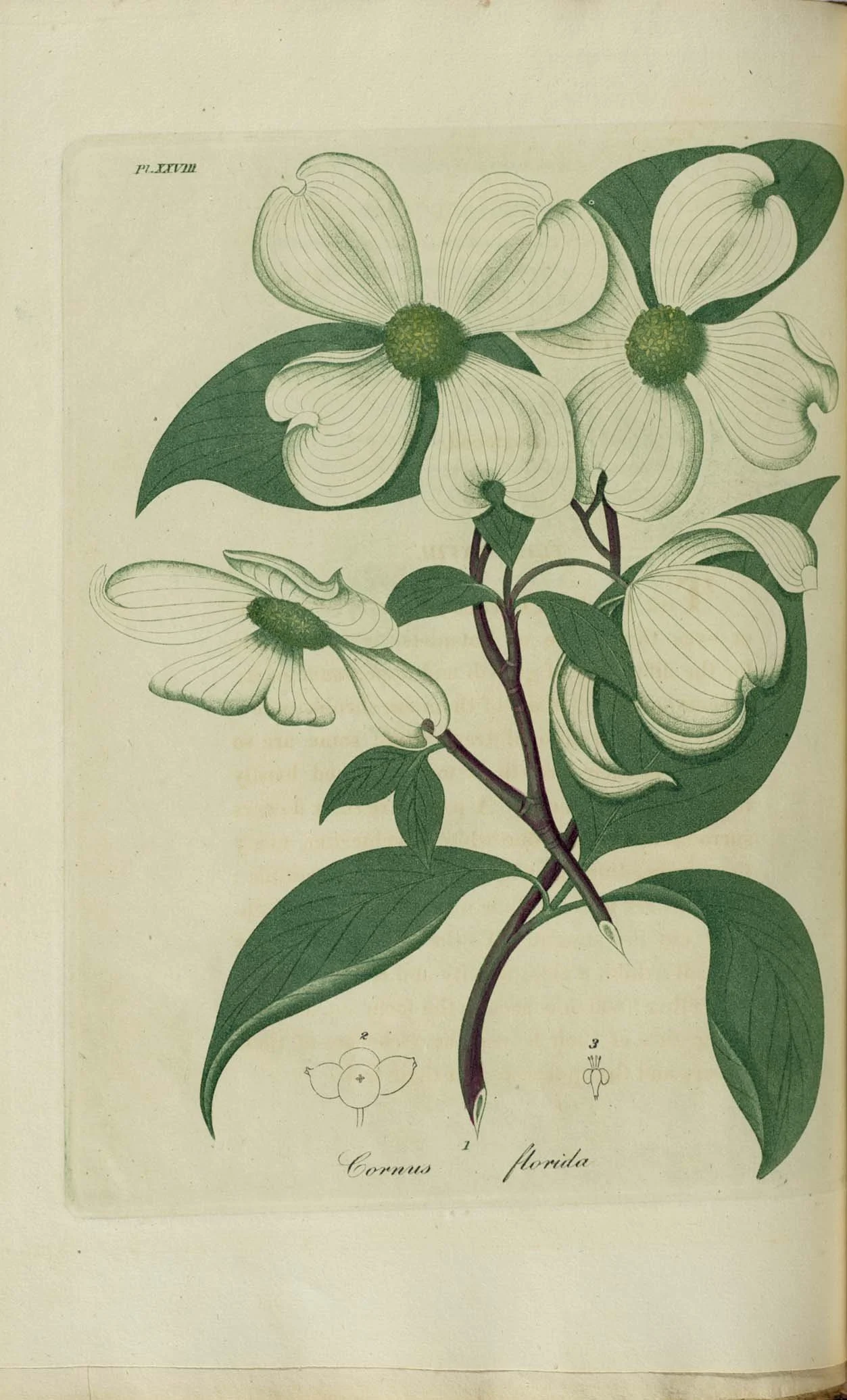
Guess what, readers! The OSS in Istanbul had a ‘peculiar system’ for assigning names to the agents of “Dogwood’s” ‘Cereus’ (a type of cactus) network, too.
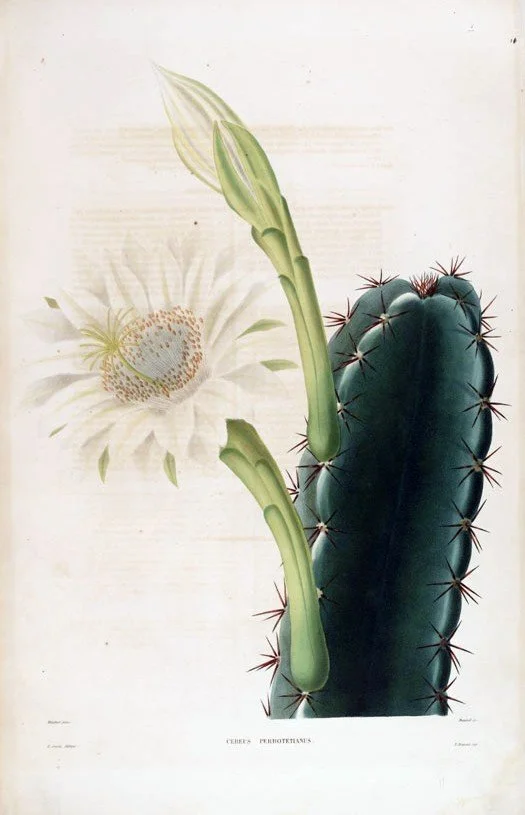
Botanical sketch of Cereus Hexagonus by Charles Antoine Lemaire (1800-1871)
The OSS naming convention gave each Istanbul informer the name of a flower, starting with the Czech “Dogwood”. The following excerpt is from Esra Cengal’s PhD thesis, “THE PRE-COLD WAR ORIGINS OF US STRATEGIC ENGAGEMENT WITH TURKEY, 1920-1945”, using information from “Office of Strategic Services, Supplements to Lists of Code Names Used in Written Reports from Istanbul, Turkey, October 30, 1943, Istanbul, WN 21243–21244, CIA Declassified Records.” I’ve provided the highlights to help.
Another OSS report details the code names of US informants in Istanbul. The list is noticeable in terms of revealing the intricate networks. Accordingly, OSS had explicit cooperation with Turkish Secret Intelligence Service through high-ranking Turkish officers. The following informants, especially those named Paprika, Thyme, and Savory, are noteworthy to show the cooperation with high-raking intelligence officers.
CARNATION: This individual is Chief of Official Rumanian News Agency “Ardor.” The Germans did all possible to have him dismissed. He was saved by Mihai Antonescu, who changed his views of the war when the U.S. entered. Antonescu has made Carnation his roving press agent; this job is in addition to his work as Director of “Ardor.” As Antonescu’s roving agent, Carnation has made repeated trips to Rome, Berlin, Stockholm, and lately to Istanbul and Ankara, where he will spend much of his time in the future. He is of an honorable family and a trained diplomat. Both he and the new Romanian Minister to Turkey, Cretzeanu, are strong supporters of Maniu.
ASTER: Due to some confusion reported from Cairo, we are dropping the name Aster and substituting for it the name Gander. Contrary to the statement made in the Istanbul Supplementary List of 9 October, reports emanating from this source are no longer given regularly to British ISLD in Istanbul (as reported from Cairo); the British are satisfied with distribution of this material in Cairo.
GANDER: This name will henceforth be used by Istanbul in the same way that it is being used by the Cairo office.
VIOLET: This informant has been proved by Cactus to be thoroughly unreliable and even intentionally deceptive, and may be dropped from the list because he will not be used again.
POINSETTIA: Information from this source has proved to be either exaggeration or misstatement on many occasions. Istanbul informant Paprika considers Poinsettia fairly poor as a possible source of intelligence.
COWSLIP: An informant used by Oleander. Cowslip is a South German, 37 years old, SS Gruppenführer, employed in the Foreign Service of the SS, and travelling abroad as an engineer representing the Nuremberg pencil factory of Staedtler, carrying a government service passport. His field is the smaller neutral countries — Switzerland, Sweden, Spain, Portugal — and Turkey and semi-occupied countries like Bulgaria and Rumania. He reports OSS heads on German foreign opinion about Germany’s situation and chances, worth of German representatives, and activities of the German Foreign Office and diplomatic representatives.
PAPRIKA: Hereafter the name Paprika will be used for the entire Turkish SI (Secret Intelligence) service, but only for the Colonel in Istanbul who is second in command. He has been designated by Savory to review and censor reports of the Turkish SI, but reports only Turkish SI. but also maintains perhaps as frequent contact with the British as with us.
CROCUS: A member of the Board of Directors of the Aussiger Chemical Works in the Sudetenland; in touch with leading industrialists, lawyers, officials, and Party functionaries. His last stay in Istanbul was in August, when he visited Aussig and Reichenberg.
GINGER: Employee of the Greek Consulate in Istanbul; used for information on personnel and politics. Intelligent and energetic; unaffected by diplomatic pressure.
CITRON: Italian newspaperman with an American wife. Publicly took political positions contrary to his own beliefs.
THYME: Third in command of Turkish SI in Istanbul. Former Turkish Military Attaché in Iran. Well-connected with military attachés and enjoys special privileges in Iran.
SAVORY: Head of Istanbul branch of Turkish Secret Service. Controls intelligence, counter-espionage, and other matters. Rank equivalent to colonel. Sixteen years’ experience in intelligence. Speaks only Turkish. Maintains occasional contacts with Germans (directly or indirectly unknown). Has contacts with the British perhaps as frequently as with us. Well-known to Captain Trammel, U.S. Naval Attaché, and has cooperated well.
CARNATION: Theodor Solecolu, Romanian press agent in Istanbul
LICORICE: Representative of Romanian Secret Service in Bucharest
LOBELIA: Representative of Romanian Secret Service in Istanbul
VERVAINE: Representative of OWI (Office of War Information) in Istanbul.
That’s who the OSS thought comprised ‘Cereus’. Nearly a century later, Cengal can flush things out a little bit more. Readers will notice a preponderance of the type of person who benefited from Hapsburg economic largess:
Furthermore, operations in Europe were conducted through an agent known as “Dogwood.” “Dogwood” was a Czech engineer who had previously been employed by British services in Istanbul and was subsequently transferred to the OSS by them. He assumed the role of chief agent for the CEREUS circle, a group of influential elderly individuals residing in Istanbul, and was responsible for managing all subsequent communications provided by the American Military Attache office and other units. CEREUS was composed of the president of an Istanbul-based firm, an Austrian businessman involved in radio, a wealthy Austrian with extensive social connections in Austria, a German economics professor who was a friend of Franz von Papen, another German professor with significant ties to German Junker families, and a Hungarian nobleman who managed an American oil company in Istanbul. It established connections in influential circles.
Sounds pretty ‘Ringstrasse’ to me.
What this little episode does explain is Allen Dulles’ obsession with Alfred Redl and why the information which got back to Dulles about Redl was so poor. It would not be flattering to Norman Holmes Pearson’s nor Angleton’s endeavors to look too closely at who was lying to MacFarland. The unfortunate thing about avoiding the truth is that the American “intelligence community” is doomed to repeat the same failures, over and over again…
”Don’t merge the military…..”