Jim Thompson and the Nugan Hand Bank
Jim Thompson is not famous. Except perhaps in CIA and Chinese Communist circles. Therefore, readers should know that he was an American man, a former Office of Strategic Services officer, who went missing in Malaysia on Easter, 1967. At the time of his disappearance Thompson was vacationing with a Singaporean chemist at a British Colonial golf course in a Malayan Communist battlefield. He wasn’t declared dead until 1974.
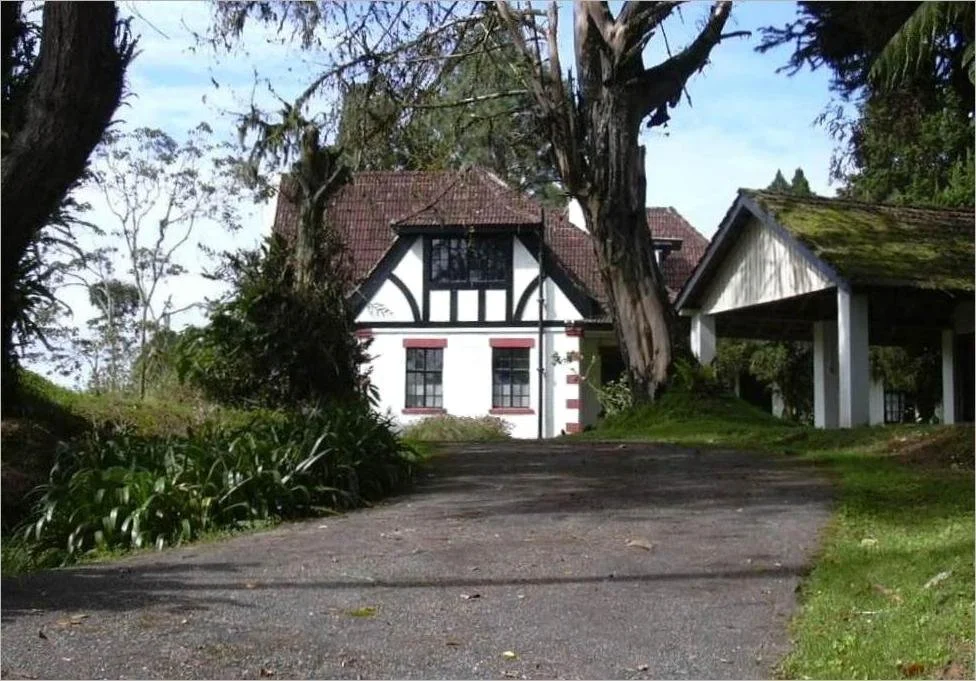
Moonlight Bungalow, Cameron Highlands, Malaysia. This house is where James Harrison Wilson Thompson spent his last holiday with US-trained chemist Dr. T. G. Ling and his American wife Helen. Prior to the Dr. Lings’ purchase, the house was a headquarters and torture chamber for the Malayan Communist Party. Apparently, bodies were buried between the bungalow’s English rose beds— an indication of the begrudging respect that many post-Colonial subjects felt toward their British masters. The Cameron Highlands were the flashpoint of MCP guerrilla fighting from 1966-69.
There are aspects of this story which are close to my heart as I lived in Singapore with my family for about five years in my late teens. We did all the expat things: hung out at the American Club and spent more than our fair share of time with weathered Brits who were renting jungle “Black and Whites”— high-ceilinged Tudoresque colonial mansions— from the Chinese Singaporeans who now own them. Nobody remembers Jim Thompson, not even the Brits.
The memory hole isn’t for lack of trying. Shortly after Thompson’s disappearance, his intelligence community colleagues in Bangkok began lionizing him. In 1970 William Warren, a journalist from the “conservative and fundamentalist state of Alabama” who was “friends” with bachelor Thompson, was first off the mark when he wrote Jim Thompson: The Legendary American of Thailand. Warren dedicated this biography to Charles Sheffield, the business manager of Thompson’s firm “The Thai Silk Company”. Warren wrote the same book again in 1998 and this time titled it Jim Thompson: The Unsolved Mystery.
That 1998 title is very important because Warren’s book appears to have been re-released in order to head off exactly the type of inquiry featured in Barry Broman’s 2017 documentary on Thompson’s disappearance. “Former CIA officer Barry Broman” claims with some justification to have solved the mystery: Jim was murdered by the Malay-Chinese Commies who he was trying to cultivate… for some reason.
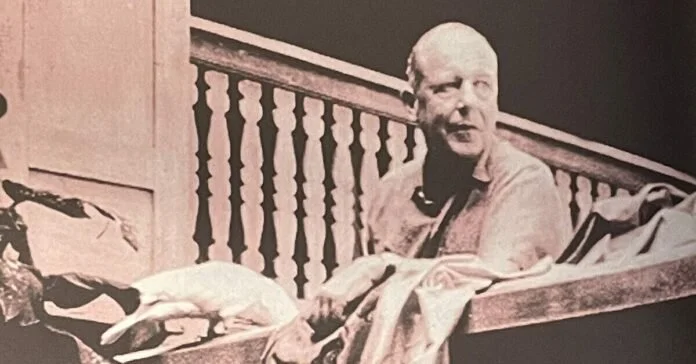
Jim Thompson in the elegant colonial surroundings he loved. While a twenty-year resident in Thailand and a self-styled ambassador to its culture, Jim never learned to speak Thai.
Please watch Broman’s documentary film (embedded below), which the Foreign Correspondents Club of Thailand uploaded along with an informative Q&A session featuring Broman’s sources. The documentary itself is a short 45 minutes and reminds me of the Friday afternoon educational reels we used to get in elementary school in the ‘80s. Broman was a photographer for the Associated Press in Bangkok from 1962; then became an infantry officer in Cambodia and Vietnam. When his CIA association began is unclear.
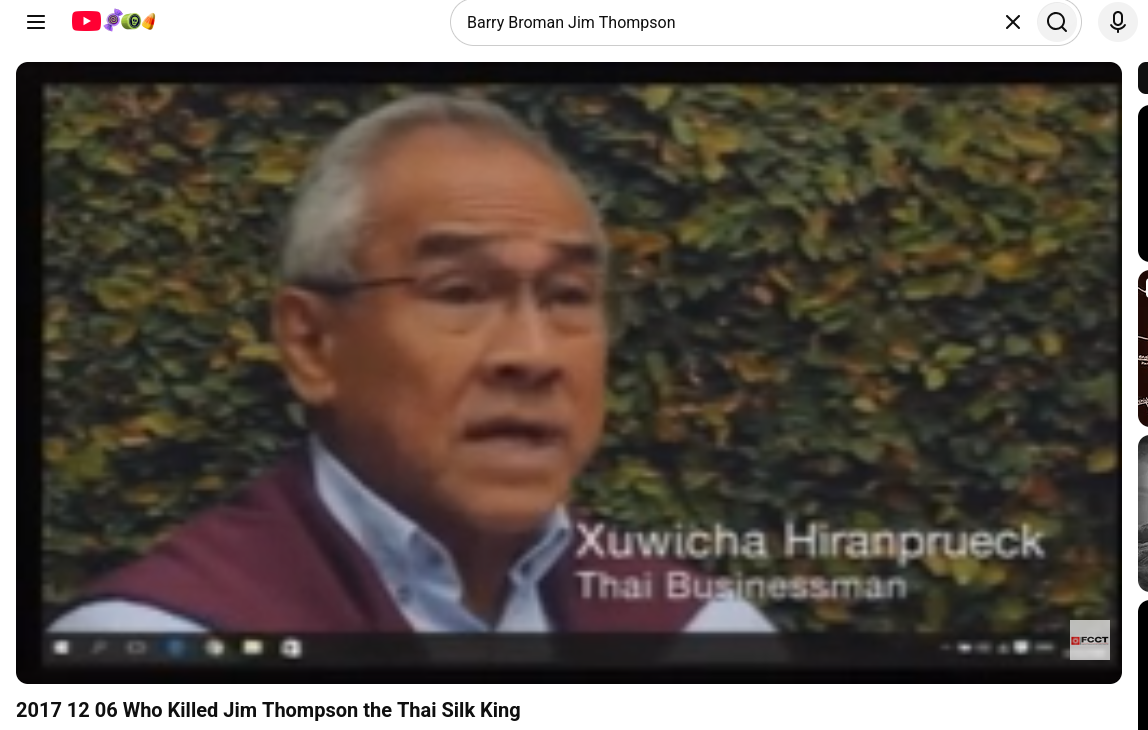
Broman’s chief sources are men who I recognize as having Communist Chinese ties: Xuwicha Hiranprueck and “Teo Pin” (an unusually short name for a Chinese person) who now identifies as a Singaporean Chinese businessman.
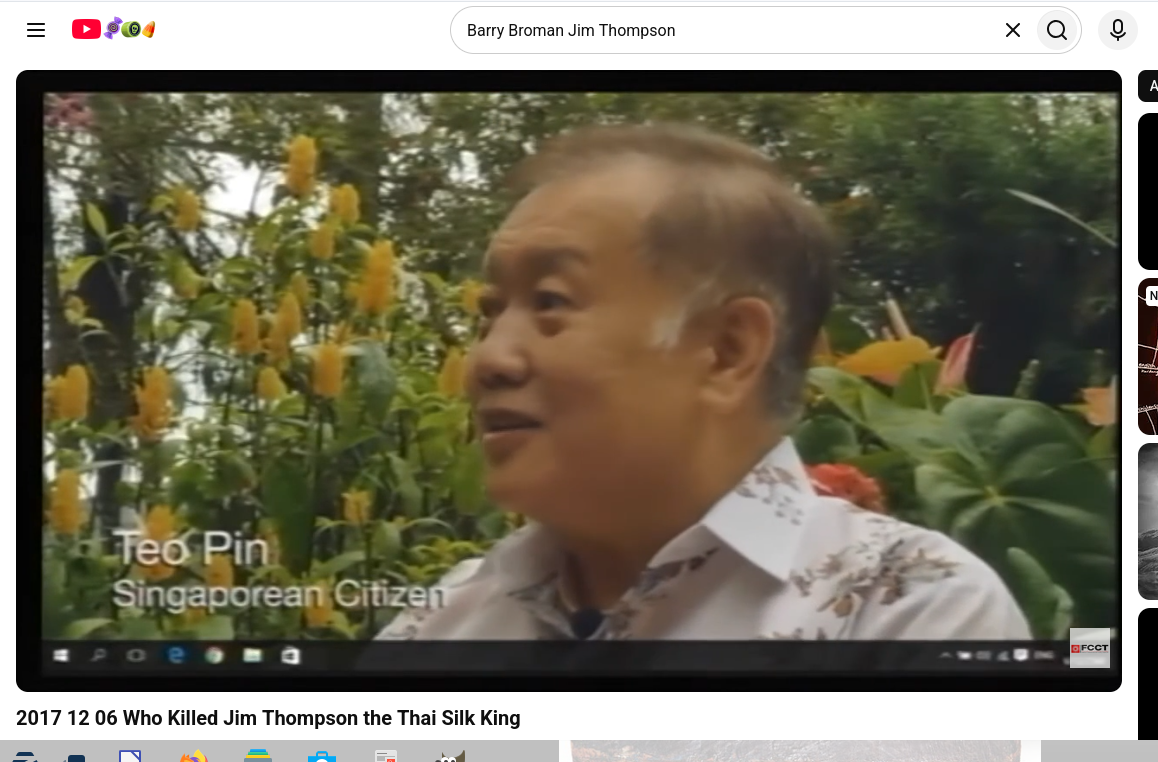
Teo Pin is a surveyor who is “highly decorated” by the Singaporean government. He now lives in Shanghai, the commercial capital of the PRC, where as of 2017 he held a cushy consulting job with a Malaysian construction firm.
Broman isn’t honest about his sources in the documentary, “Thai Businessman” Hiranprueck was actually a CIA operative, according the National Lao-Hmong Memorial Foundation (in the United States):
Xuwicha “Noi” Hiranprueck was born in Thailand and served in Long Cheng, Laos as an attaché to the U.S. Central Intelligence Agency, USAID, and Hmong General Vang Pao. His responsibilities included serving as the Chief Procurement Officer for the Special Guerilla Units in Laos. Since 1975 Noy has served pro-bono in the Foreign Ministry and the National Security Council of the country of Thailand, as a refugee and security consultant to the Supreme Command, Royal Thai Armed Forces, and The UN Refugee Agency (UNHCR). In addition to experience managing a variety of businesses in Thailand, Noy is currently the representative to Thailand for Gulfstream Aerospace Corp. Noy has homes in Minnesota, California, Colorado, and Thailand.
[Hiranprueck confirms some of this information himself in the Q&A of the documentary embedded above.]
Readers, please note Mr. Hiranprueck’s connections with the aerospace industry in Thailand, his concern for refugees, as well as his choice to buy a home in Minnesota, governor Tim Walz’s state.
In addition to helping the UN resettle refugees, Xuwicha Hiranprueck has also helped Myanmar’s “State Law and Order Restoration Council” or SLORC, contain ethnic Mon refugees along Myanmar’s border with Thailand. SLORC was the military junta that seized power in Myanmar (then called Burma) in September 1988 after crushing a pro-democracy uprising. From “Mon on the Thai-Burma Border”, No.24 Thai-Yunnan Project Newsletter March 1994 published by the Australian National University:
Also, in recent years, the [“pro-democracy”] ethnic opposition/s have become dependent on Thailand for refuge, communications and humanitarian assistance. In this light, Thai authorities want to achieve conditions for the major ethnic opposition groups to come to SLORC's 'peace talks' table. In addition to the NSCีs [Thai National Security Council’s] strong influence in this scenario, a certain Thai businessman, Mr Xuwicha Hiranprueck, is also crucially involved in his capacity as personal advisor to the Chairman of the NSC. Sources, which must remain unnamed, state that he is pushing the agenda of events regarding Burma very vigorously. This advisor has also had a business and personal relationship with the Burmese military since the 1960s and was the agent for the US $1 million Thai fishing trawler which was blown up by dissident Burmese students in January 1991. Sources indicate that this businessman's exertion translates into control over events on the ground.
His [Hiranprueck’s] agenda includes the following: that the New Mon State Party will sign a 'gentlemanีs agreement' with SLORC by April 13; that all refugees will be required to move back to the cease fire zone before the rainy season in May; that then the refugees will be entitled to 4 monthsี supply of rice; and following this, the Karen will be the next target for 'peace talks' under overwhelming pressure. Previous requests by the Karen to hold talks in Thailand have been rejected. This agenda is currently secret. Implications for monitoring safety and security upon return and are incontrovertibly perturbing. If return is forced and access impeded the implications could be catastrophic.
Forgot to mention that, eh Barry? I gently remind readers that Bill Colby’s Nugan Hand Bank was also concerned with resettling SE Asian refugees at economic development sites in the West Indies.
“Teo Pin”, Broman’s second source, made friends with Xuwicha Hiranprueck some time previous to 2007 due to the fact that both men, Hiranprueck and Teo, were close to the Singaporean Chief of Intelligence resident in Thailand who had died a few years prior to Broman’s documentary project. (Again, by Hiranprueck’s own admission in the Q&A.) Teo Pin had an uncle who was high up in the Malaya Communist Party in the 1960s: this uncle made a death-bed confession that he was part of the crew that “eliminated” Thompson. Why does Teo Pin care now?
Teo Pin was motivated to investigate the Thompson story by his dying uncle and a desire to record “the romance of the revolution of the Chinese overseas," according to his talkative partner Hiranprueck. Hiranprueck says he just wants to help Teo Pin write that “romance” of a persecuted, idealistic minority in Malaysia. (Q&A) In reality, as Communist China expands its power in Southeast Asia, it needs to rewrite its history in the region, where Overseas Chinese communities are typically seen as extractive, supremacist, and prone to allying with foreign enemies. Singapore itself was founded by Christian Chinese (i.e. European-allied) and its aggressive leadership under Lee Kuan Yew was the political catalyst for the Malaysian race riots of the 1960s.
In 2017 Xuwicha Hiranprueck, a man who built his career serving American intelligence interests in Southeast Asia, probably figured it was time to diversify his sponsorship. So let him tell you about the “Thai Silk King” Jim Thompson [0:18:06] :
“The rich, the powerful, the famous, the infamous all sat at his [Thompson’s] table. Also businessmen, arms dealers, journalists and diplomats. Needless to say, it could have been the ideal setting for the gathering of intelligence. A point that did not pass unnoticed especially after his disappearance."
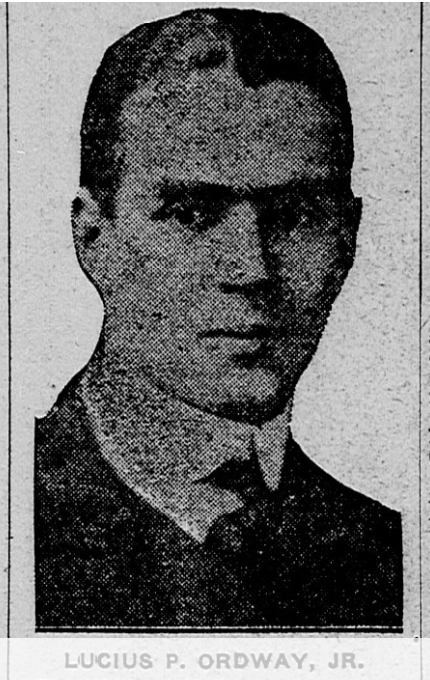
Hiranprueck lists the following people as Jim Thompson’s guest at his art-home in Bangkok: Robert Kennedy, Truman Capote, Ethel Murman, Lyndon Johnson, Kathryn Hepburn, Benny Goodman, Marlene Dietrich, Tennessee Williams. A very liberal, Galician Gang-friendly bunch. AndreaNolen.com readers know that before he entertained any of these people, Thompson partied with Lou Ordway Jr. at the Oriental Hotel. Ordway sold a massive rash of Russian bonds to Midwestern investors, bonds which would eventually be by serviced by Western European taxpayers, thanks to Rothschild family and other bankers’ intervention. This act saved political goodwill (and credit lines) for the struggling Bolsheviks.
Not everyone shares Barry Broman’s views on Jim Thompson’s disappearance. Coming from a different perspective are the 1960s/70s era CIA leadership in the region, as exemplified by my ole buddy Bill Colby. These people don’t want to admit that Jim Thompson associated with communists. It seems to me that the Jim Thompson Foundation, created to shepherd Thompson’s art collection after The Siam Society cut ties with Thompson when he was caught looting Thai cultural treasures, speaks for the Colby crew.
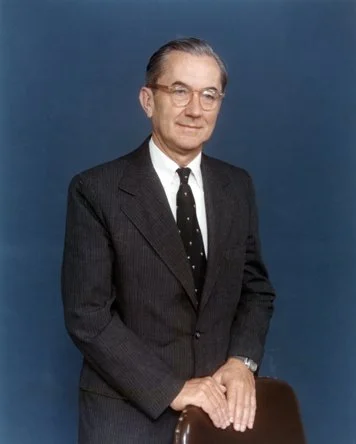
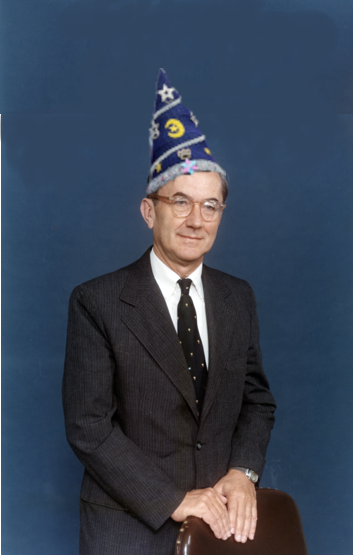
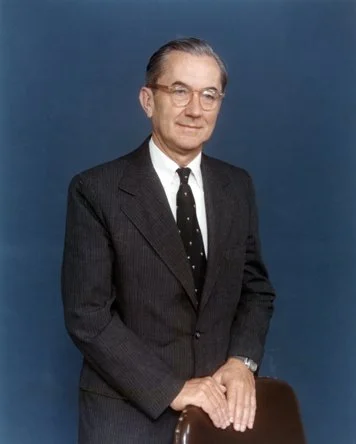
William Egan Colby. CIA Saigon Station head (1959–1962); Far East Division Chief (1962–1967); head CORDS and Pacification (late 1960s–1971). These roles prepared Colby well for his post-CIA career as a tax lawyer for the heroin trade.
Prior to making his documentary, Broman was hired by the Jim Thompson Foundation to document the Jim Thompson House on film. The Foundation curates the colonial-style mansion which Thompson built out of the carcasses of six traditional Thai houses by turning them inside out and stretching them to fit the dimensions of a Black-and-White jungle xanadu. (See the walk through below.)
The Foundation wanted Broman to make archival footage about the house and not touch on the disappearance. According to Broman, he insisted on asking about the disappearance during interviews. Although key CIA and Foundation representatives agreed to interview with Broman, he presents them as adversarial— a false dichotomy— but let’s let the horse speak.
William Warren (now sadly passed), as well as the trustees of Thompson’s home/museum in Bangkok, insist that Thompson’s disappearance is and will remain a perpetual mystery… and also, for some reason, that Jim Thompson wasn’t gay. [Warren, 2017. P. 126] Got that? Jim wasn’t in Thailand for the “kathoey”. These protestations are probably more for the benefit of Thompson’s Thai allies [Muslims, communists, Thai royal family, military contractors] than Langley, where rainbow nail polish is cool.
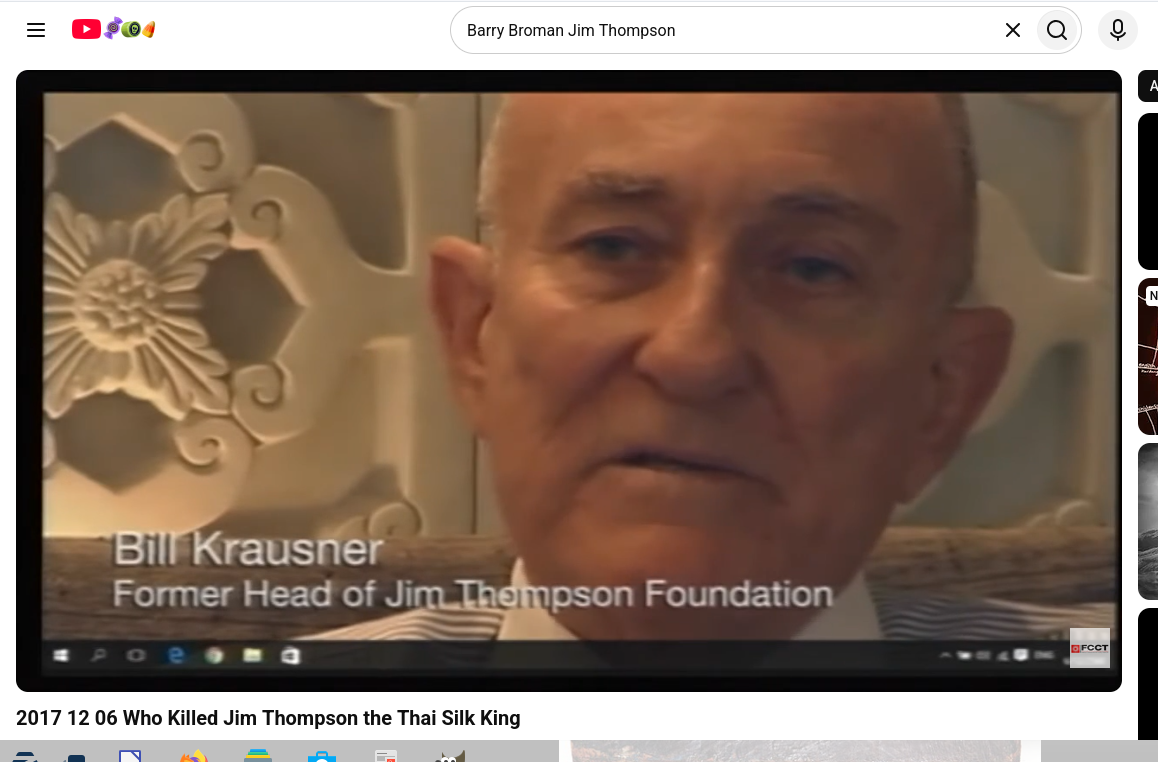
Bill Krausner speaking in Broman’s documentary: “"Many of the theories, the conspiracy theories that have been advanced have no factual basis to provide proof. So as I say, both the foundation and myself feel very strongly that his disappearance was a mystery and remains a mystery today."
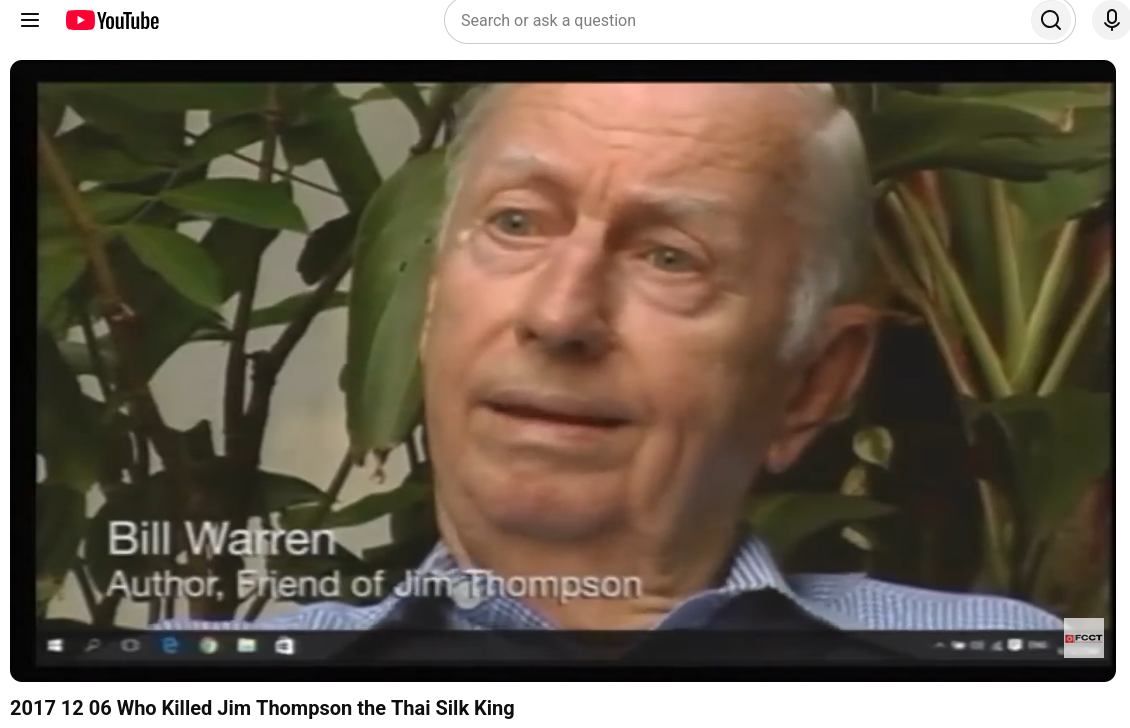
William Warren, in his genteel Southern drawl: “No matter what anybody says, none of them have one piece of proof of evidence. There's only evidence of what did not happen."
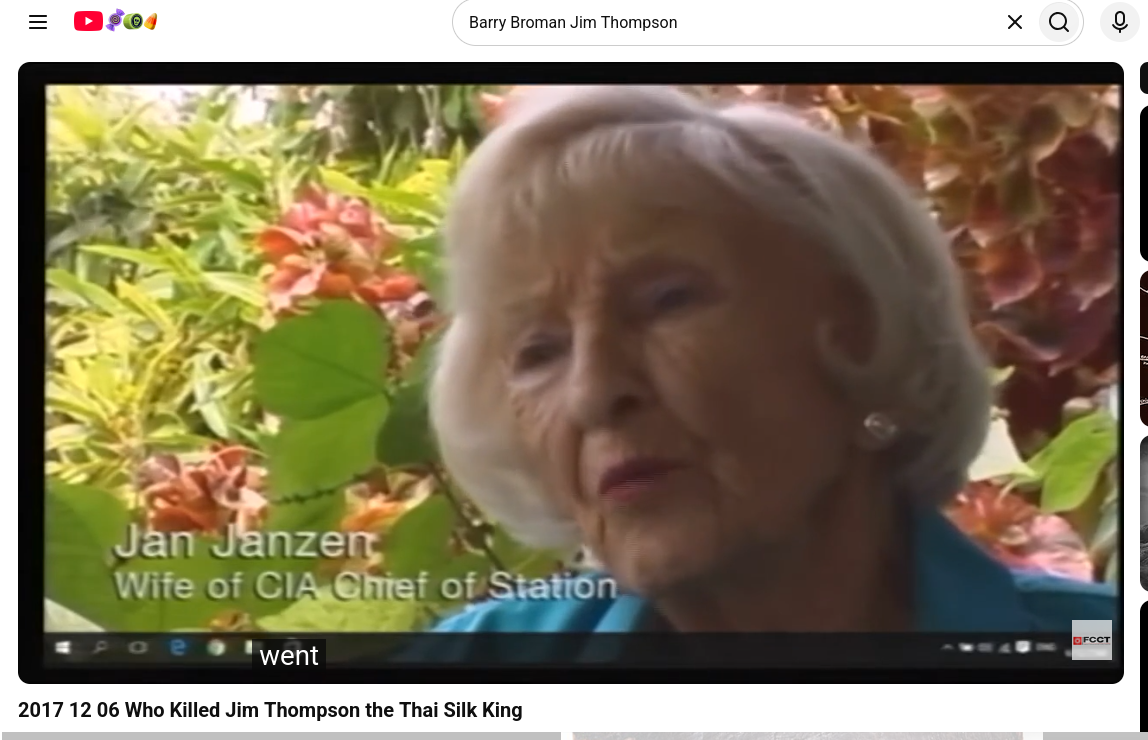
Jan Janzen (usually “Jantzen”, Barry admits he was rushing) was the wife of Robert “Red” Jantzen, who was CIA station chief in Bangkok until 1966, i.e. the last years of Jim Thompson’s life. In 1967 Jantzen would be replaced by Peer de Silva, a long time friend of Bill Colby.
Jan Janzen in Broman’s documentary: "There were lots of rumors that Jim had been kidnapped by the communists and taken away. Well those were all followed up and nothing. Absolutely no truth to it whatsoever." [0:26:00]
Here’s where the false dichotomy comes in: none of these people ever suggest that Jim Thompson might have died arranging a drug deal. Jan Jantzen’s husband has been accused by CIA officer Anthony Poshepny of running drugs through Thailand with that same Vang Pao from Xuwicha Hiranprueck’s past:
Poshepny continued: “Through his underlings, Vang Pao [Hmong leader in Laos] was selling guns to [Burmese] drug trafficker Khun Sa and his boss Li. We [the CIA] were penetrated by crooks.”
Poshepny noted further that, when he tried to discipline one of the underlings, Vang Pao promoted him. “And the bastards in Bangkok” (meaning the commander of the U.S. Military Advisory Group, Major General Richard G. Stilwell, CIA Station Chief Robert “Red” Jantzen, and Ambassador Graham Martin) “didn’t back me.”[3]
According to Poshepny, Vang Pao “made millions dealing drugs,” drove a Mercedes-Benz and “enjoyed the high life at his villa in Vientiane, where he a made illicit deals under the gaze of CIA officers. The CIA even gave him his own D-3 with a crew of KMT [Chinese Guomindang] mercenaries that flew narcotics to cash customers around Southeast Asia.”
Poshepny’s accusations ring true, as Red Jantzen was the US Ambassador U. Alexis Johnson’s point-man on “stemming” the drug flow out of Thailand. Chinese combatants, including the Guomindang and Communists, had been funding themselves via the drug trade since the 1920s at least. Chinese triads were world-leaders in drug and human trafficking— part of the reason that the Overseas Chinese community was so despised. Of course, Jantzen’s “stemming” efforts made not a dent, which is probably just the way both CIA’s communist sympathizers such as Colby and Thai leadership liked it. See, Ambassador Johnson on the “opium problem”:
[522. Letter From the Ambassador in Thailand (Johnson) to the Director of the Office of Southeast Asian Affairs (Kocher)1]
Bangkok, June 29, 1959.
Dear Eric [Kocher]: I have received and carefully studied your letter of June 11 on the Thai opium problem.2
As you know from our previous correspondence I have been extremely interested in looking for ways in which we would at least be able to make a start in doing something about this repellent business. I am particularly disappointed that the arrangements for the stationing [Page 1079] of a US Customs Service man in Bangkok, that I discussed with Mr. Strubinger,3 have not yet worked out. I and other members of the staff, particularly Bob Jantzen,4 always take advantage of the opportunities we have in conversations with Praphat and others to give them to understand that we are aware of the opium traffic and regard it with much disfavor. However, it has not been possible for us to utilize the very extensive and valuable information [less than 1 line of source text not declassified] developed in this field because of the sensitivity of the sources.
While, as Chang Lan-chen claimed, I believe that there is a certain amount of sincerity on Sarit’s part in suppressing opium consumption in Thailand, I do not believe that it necessarily follows that there is a corresponding interest in suppressing the very lucrative traffic from and through Thailand to other countries. In fact, I am inclined to believe that with the present reduction of revenue from other sources resulting from his anti-corruption campaign, he and the military group are now more dependent than ever on the profits from opium exports.
Thus we must separate the opium problem in Thailand into two aspects which are somewhat separate from each other. The first is the question of the growing and consumption within Thailand and the second is the traffic through Thailand of opium grown in the Burma–Laos–Communist China triangle for which Thailand is the natural export route…
In a country like Thailand the only reliable export routes were (perhaps are still) rivers and airports. Whomever controlled Thai airspace controlled the drug trade into the Western world, for both the Communists and Hmong alike.
But why would Jim Thompson go out of his way to arrange drug deals for Malay-Chinese Communists? Jim Thompson was a bitter OSS veteran and communist sympathizer. The man was a classic commie trust-fund baby. Although biographers like Bill Warren go out of their way never to use the ‘c’ word, Thompson’s silk industry was a direct funding conduit for “Free Lao” revolutionaries (Laotian nationalists with a strong communist bent) organizing in Thailand. [Warren, 2017. P 81] (He also empowered Bangkok’s Cambodian Muslim minority weavers, a dangerous game given what has happened to Malaysia.) Thompson openly spoke out against US involvement in the Vietnam War. He was investigated by the FBI for “potentially Unamerican activities” according to Hiranprueck. Thompson’s business partner in the Oriental Hotel, Germaine Krull, was a Ringstrasse hanger-on and communist activist (Bolshevik side) from Central Europe. However, Thompsons most powerful connection to Chinese communists in the the region came from the Regent of Thailand, Pridi Banomyong.
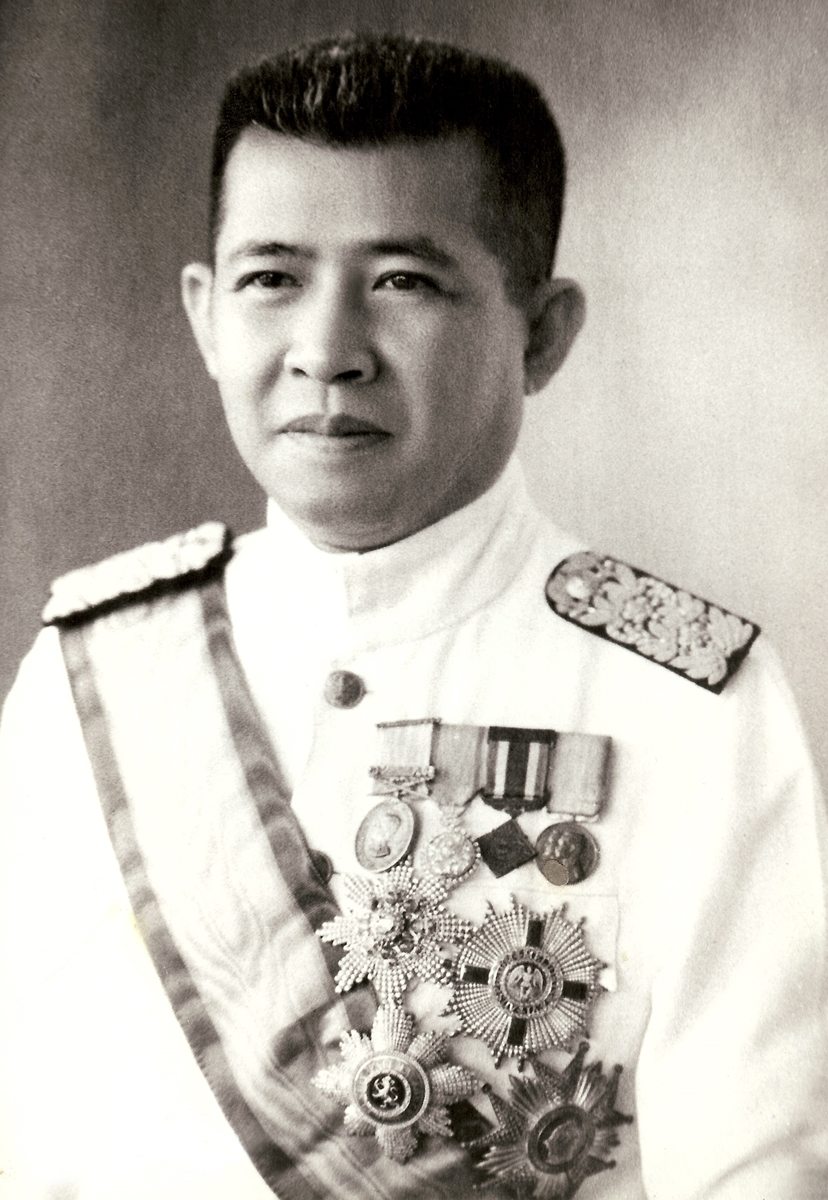
Pridi Banomyong in his royal regalia. Much like the “peasants party” activists from Archduke Franz Ferdinand’s old circle of advisors in Romania, Thailand was lead by French-trained aristocrats who were champions of “democratic socialism”… maybe we should call it ‘atheistic neo-feudalism’?
After his deposition Pridi ran for succor to Communist China. In 1970, when he finally gave up on reclaiming power in Thailand, Pridi immigrated to Paris where he would hob-nob with Barry Broman at the Thai Embassy Christmas Party. Broman’s documentary production company is in Paris, too.
Thompson was bitter that his ticket to power and riches, the “democratic socialist” Prime Minister Pridi Banomyong, a Paris-trained revolutionary of Chinese ancestry, had been ousted and that the US government had recognized a conservative military junta in Pridi’s place. (In 1949 Pridi, still in exile, had tried to forcibly take back the Thai government in what has been termed a failed “Palace Coup”.) Thompson spent the rest of his life agitating in Bangkok trying to recapture the power he had tasted during WWII alongside the communists. You need money for such provokatsiya.
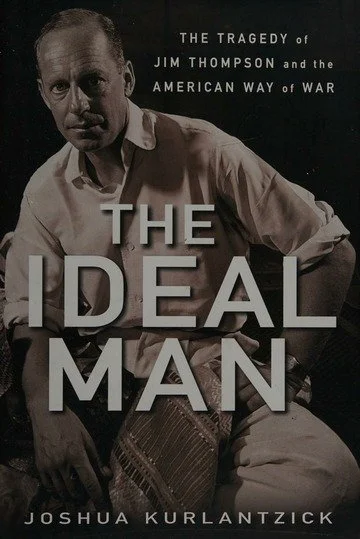
One of Broman’s Foreign Correspondents Club of Thailand Q&A participants describes Kurlantzick as “ a good Washington man”. Such hagiographies as the one above overlook the fact that Thompson was a corrupt power-seeker prone to fits of narcissistic rage when he had to follow the law like common people. But yes, ideal in Washington D.C..
And let me tell you, Thompson wasn’t the only bitter ex-OSS red with an axe to grind. Wow, were there a lot of them. Donald Downes. Julia and her husband Paul Cushing Child. Ernest Hemingway. Irving Goff, William Aalto, Milton Wolff— many people associated with the “Abraham Lincoln Brigade” fighting in the Spanish Civil War alongside (or under the direction of!) the Bolshevik NKVD. Duncan Lee. Maurice Halperin. Julius and Bella Jospeph. Carl Marzani. These are just some we know about: power-hungry individuals who felt they’d been cheated when US politics took a right turn after WWII. These OSS’ers were fighting to implement their political stratagems, not serve the will of a democracy.
It was actually William Donovan’s policy to recruit communists to the OSS simply because he wanted violent ‘anti-fascists’ for his spying network. Donovan’s recruiters would comb European and North African prisons looking for useful communists— irrespective of the other crimes they may have committed. Xuwicha Hiranprueck remembers shaking ‘Wild Bill’ Donovan’s hand as a child back in 1953-54 when Donovan was made the US Ambassador to Thailand shortly after Lou Ordway Jr. visited Thompson.
Another one of these OSS sympathizers was the father Barry Broman’s third source for his claim that communists killed Thompson. Willis Bird Sr. shared his views on Thompson’s disappearance with his son, Willis Bird Jr.
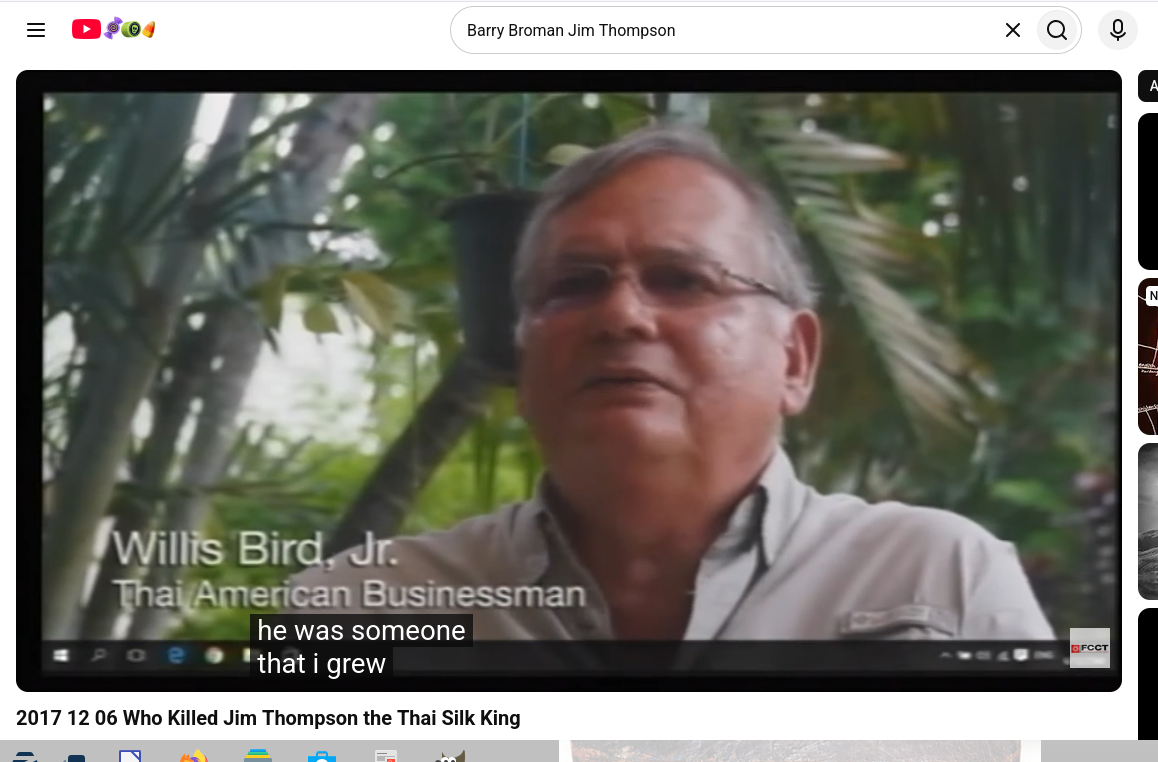
Willis Bird Sr. served in the OSS alongside Thompson, fighting with Pridi and other assorted communists under the auspices of the “Free Thai Movement”— almost exactly like what Donald Downes was doing for the OSS in North Africa. The Nation Thailand gives this short bio for Bird Sr.: “Willis Bird Sr, a top OSS officer who had known Mao in China during the war, and who set up businesses in Thailand, including airlines and selling weapons to the Thai government.”
Willis Bird Sr. ran an airline company that operated parallel to the CIA’s infamous “Air America”.
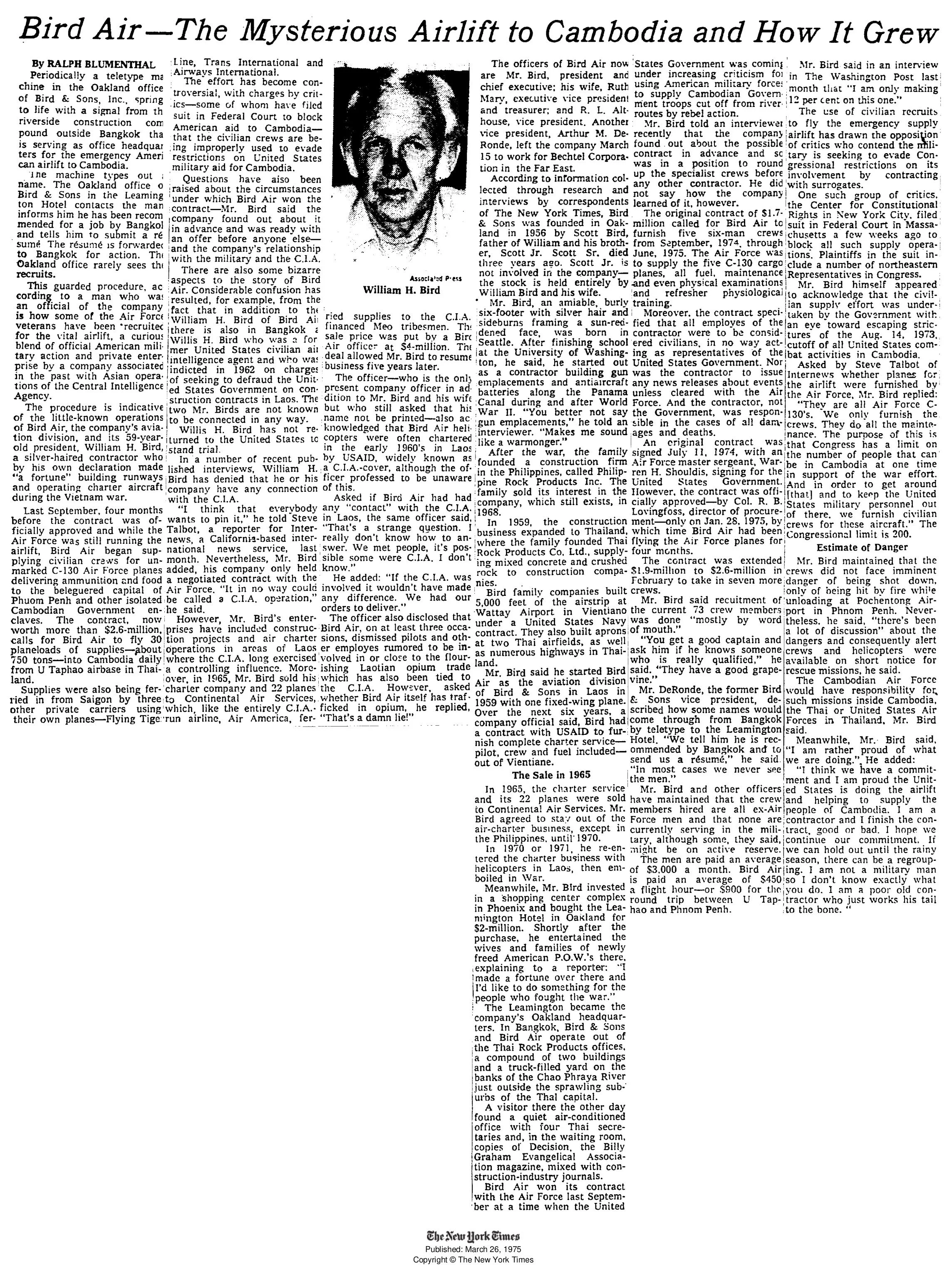
New York Times, March 26 1975. Image scales up.
In SE Asian countries like Thailand, not just anybody gets the chance to start up an airline business. One has to have connections to do this, and the tacit support of the ruling junta. This is true even in a place like Singapore. At least one aviation company from Thailand’s charmed circle would reach out to the Nugan Hand Bank in 1974.
The charmed circle of Thailand’s airline industry got a dose of sunshine in 1980 when one of its members, “Wings Travel Pty Ltd” was implicated in drug money laundering via Bill Colby’s Nugan Hand Bank.
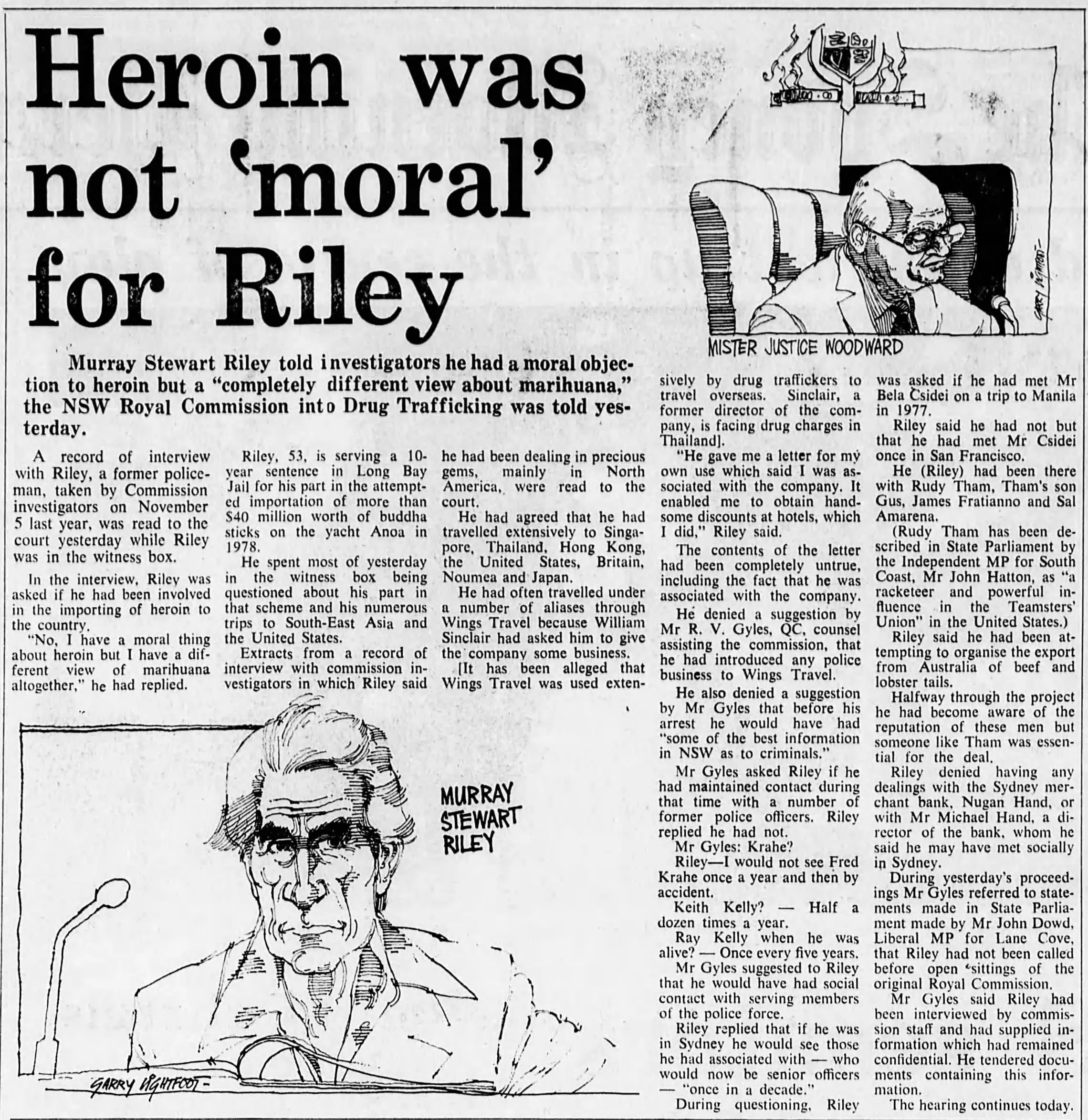
Sidney Morning Herald, March 23 1980.
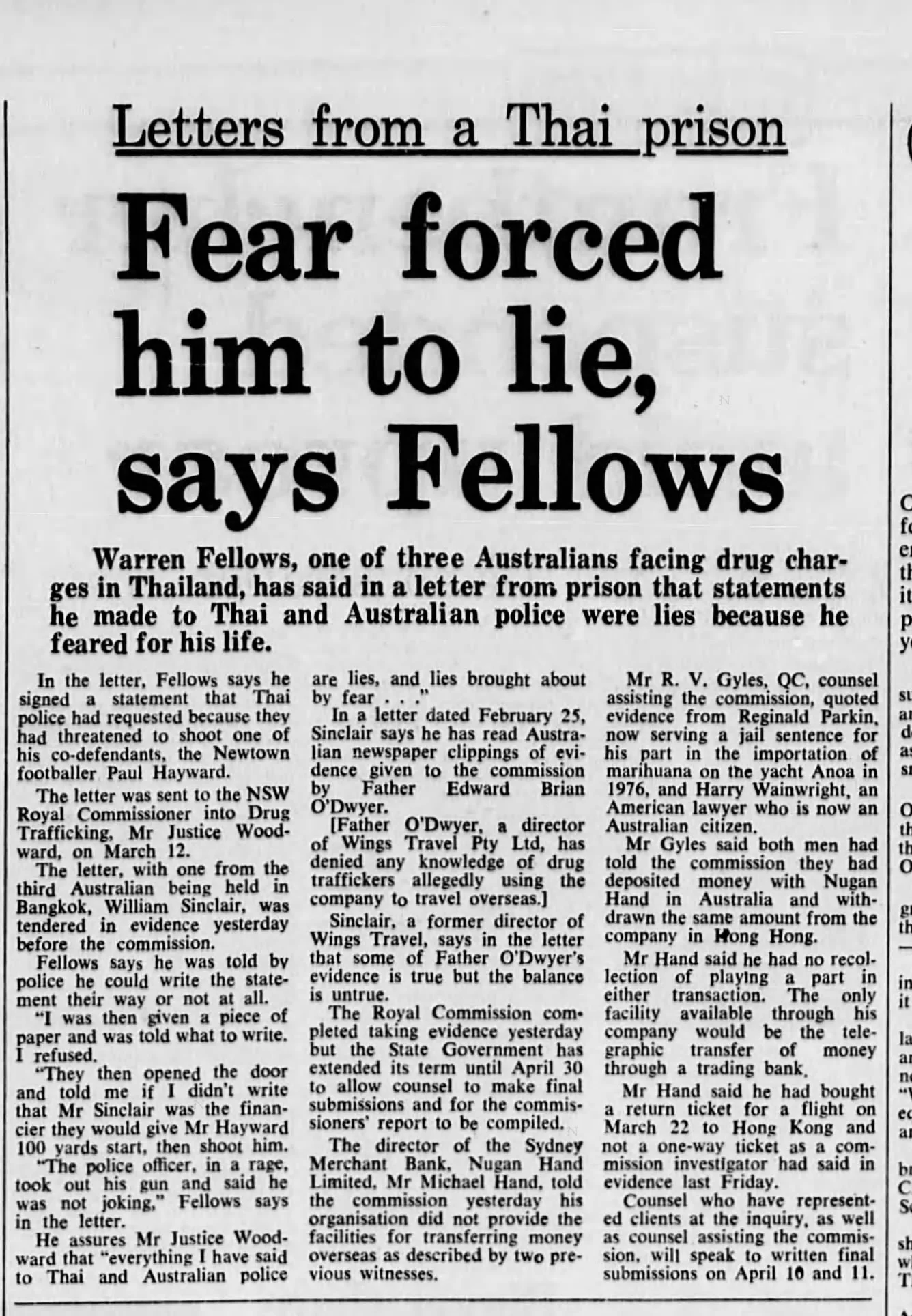
Here is where things get really interesting, readers. According to Bird Jr., Bird Sr. was contacted by Pridi during Pridi’s time being protected by Communist China. Pridi wanted to arrange the meeting which lead Jim Thompson to Moonlight Bungalow in 1967. Since their days fighting with the OSS, Thompson and the Birds were close— to the point where Thompson would come over to raid the family fridge, Bird Jr. says. Bird Sr. turned Pridi’s meeting invitation down but and sent Thompson in his place. Why? Bird Jr. says Thompson agreed to meet with Pridi just because they were old comrades in arms.
Why would Bird even entertain the idea of Thompson meeting with the politically toxic Pridi? Well, Bill Colby had just placed a close personal friend in charge of the CIA’s Bangkok station, a man named Peer de Silva. De Silva replaced Red Jantzen some time in 1966. Who was de Silva?
Before that Bangkok appointment, De Silva had been working with Colby “overseeing” the CIA’s struggling intelligence apparatus in South Vietnam for three years. What made De Silva qualified for this? During the war De Silva served with the US Army providing security for the Manhattan Project. After WWII, De Silva caught James Murphy’s attention. Murphy was the leader of Franklin Delano Roosevelt’s “Twelve Apostles”— a branch of the Roosevelt family spying network working out of the State Department and in parallel to the OSS in North Africa and Europe. Murphy’s daughter Rosemary played a lead role in the macabre true-to-life horror film shot in Angleton’s ancestral home in Duluth, MN. Here’s the West Point Graduates Association on De Silva:
James Murphy, the internationally-known lawyer and key figure in the wartime Office of Strategic Services (OSS), requested his [De Silva’s] assignment to the Strategic Services Unit (SSU) which inherited the vestiges of OSS Later the SSU was absorbed within the newly created Central Intelligence Agency, and Peer found his permanent niche in the intelligence community.
From 1946-9 De Silva studied in the USSR and fraternized with Soviet soldiers, which in turn lead to his 1951 appointment as head of the CIA’s notoriously ineffectual “Soviet Russia Division”. From these dubious beginnings De Silva continued to fail upwards and earn Colby’s respect.
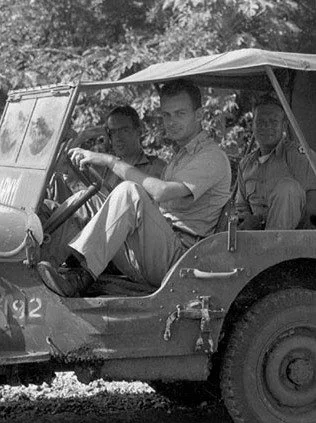
Colby’s bestie Peer de Silva in 1945.
What Bill Colby may not have realized at the time was that he was in an increasingly perilous position thanks to James Jesus Angleton, who thought the whole “ex-OSS” cocktail socialist crew in Southeast Asia smelled fishy. According to biographer Tom Mangold, in 1965 Angleton chose to do something about the CIA’s penetration problems in Saigon [Cold Warrior, p 310]:
In the summer 1965, Colby was chief of the CIA’s Far East Division, with special responsibility for developing and running the covert war in Vietnam. Angleton believed, with a passion, that Communist agents had permeated the entire infrastructure of South Vietnam. to combat these penetrations, he was determined to introduce his concepts of counterintelligence operations into the conflict. But Vietnam field operations were an area dominated by the U.S. military, and neither Colby nor Army Intelligence saw any reason for allowing Angleton’s small unit to set up shop in Saigon.
Frustrated but unbowed, Angleton decided to run his own covert action to implant counterintelligence officers from Washington into Vietnam. He summoned John Mertz (the future chief of station in South Africa) and instructed him to organize this secret project, which was reminiscent of Angleton’s old X-2 operations in Italy.
Of course, because this Angleton group would have bypassed Colby’s underling Gordon Jorgenson, the CIA’s chief of station in Saigon at the time, Angleton’s efforts were torpedoed. Colby, Jorgenson and Angleton took the matter to the CIA’s deputy director of operations Desmond FitzGerald (a WWII vet in China), who sided with Colby and prevented counterintelligence action in Saigon. Mangold:
Angleton held Colby personally responsible for the failure, and criticized him bitterly for his alleged refusal to take counterintelligence seriously in Vietnam. How many Americans had died, Angleton later asked, because the Communists were warned of impending operations by their legions of spies in Saigon. Angleton charged that because of this there was blood on Colby’s hands.
During the Vietnam era, Angleton even went so far as to harbor doubts about Colby’s loyalty, suspicions that were raised after Colby had become the subject of an Angleton-directed security investigation.
What were Angleton’s reasons for such an investigation? Colby had been meeting with a French medical doctor in Saigon who was a GRU (Soviet overseas military intelligence) agent. Contrary to the protocols he was responsible for enforcing, Colby did not report these meetings. Angleton had Colby formally interviewed about the GRU meetings, which were conducted by Newton ‘Scotty’ Miler in 1971. Mangold concluded that Miler found “nothing suspicious”, but notes that Angleton’s file on Colby’s GRU meetings was leaked to the press during Colby’s hemorrhaging period in 1974, the hemorrhaging which would eventually get Colby fired. Miler, like Angleton, was culled by Colby in ‘74. [p 312]
Hey, check who got to report the Colby specials to the NYT! Seymour Hersh from the My Lai Massacre!!

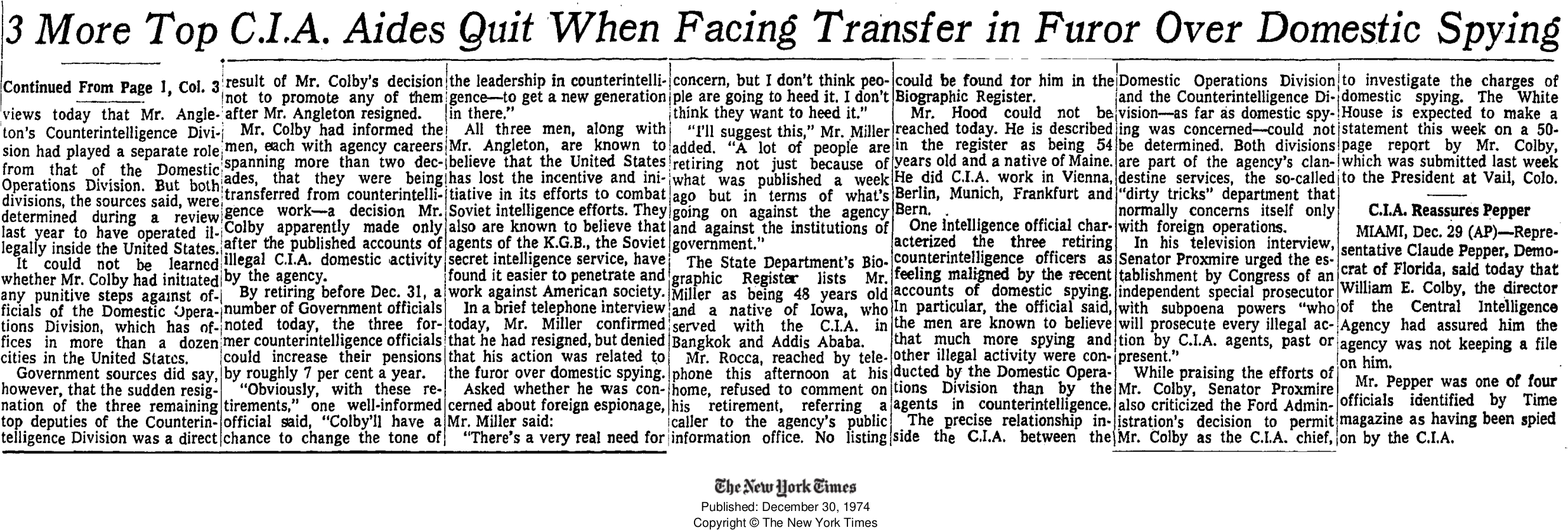
So let’s take stock of where we are at with Jim Thompson. A bitter, pro-communist US intelligence asset working (at least) in parallel to official intelligence organs disappears after making contact with drug-funded communist guerillas. CIA and Military Intelligence support this drug trade as long as it keeps the Thai military junta in power, the junta which dashed Thompson’s glittering Siamese power-dream. By 1967 a fifth column of other bitter OSS’ers has taken over the CIA’s SE Asian operations, but they are sweating under scrutiny from counterintelligence in Washington D.C. Ergo, the CIA SE Asia Leadership’s position becomes: Jim Thompson sure as hell wasn’t meeting with any communists in 1967, and erm, we’re not even sure he’s dead. Ya can’t prove nuffin.
Unfortunately for Bill Colby, time marched on and we can prove that he was an officer of the Nugan Hand Bank, which laundered drug money for smugglers working out of Thailand via the nation’s charmed circle of airlines. Doubly unfortunately for Colby, Col. Edwin Fahey Black served with Colby on the board of this bank (which was set up by refugees from Franco’s Spain. N.B. “Abraham Lincoln Brigade”.)
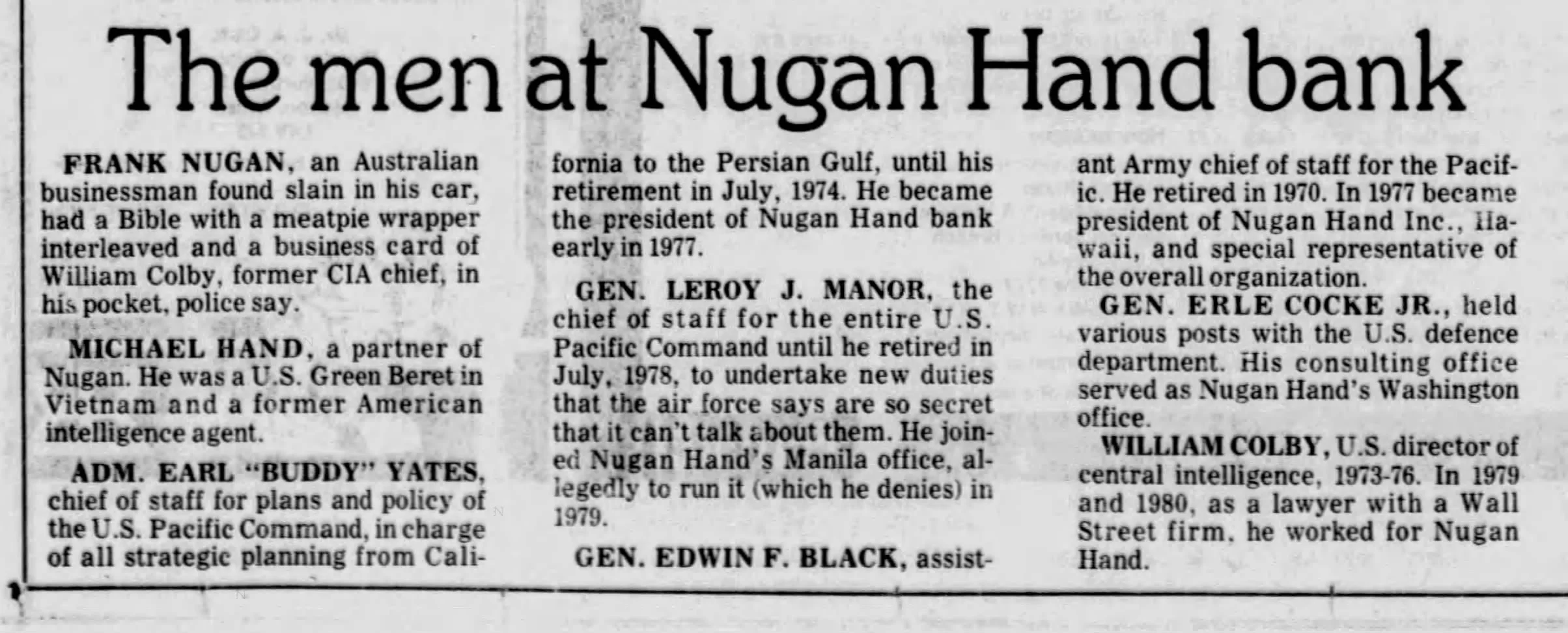
The Province (Vancouver, Canada), August 29, 1982.
Triply unfortunately for Colby, we know that Jim Thompson was recruited by Col. Edwin Fahey Black for the OSS [Warren, 2017. P. 43], as part of Donovan’s commie-hoovering maneuver to find people who wanted to “kill Germans”. [Winks, 1987,p 196] Warren tells us that when Thompson’s business manager for the Thai Silk Company Charles Sheffield learned of Thompson’s disappearance, the first thing Sheffield did was report to Col. Black. [Warren, 2017. P. 150] Clearly, Black, the future Nugan Hand president, had more than a little to do with Thompson’s altruistic silk dyeing enterprise.
Here’s one more tie. Jim Thompson did very little for the Thai silk industry save give it Hollywood exposure and introduce new chemical dyes (which ended up in the waterways of Bangkok). Does that ring a bell, readers? Because the dominant drug cartel in the USA from WWI, the network overseen by Galician honcho Arnold Rothstein and his Belgian moneybags Captain Alfred Loewenstein, and protected by Levi Gamble Nutt of the Treasusry’s Narcotics Division, involved what is now know as the Louis-Dreyfus Chemical company, creators of chemical dyes for the cloth industry. Loewenstein controlled the Dreyfus company. This opioid/chemical dye synergy exists because the dyes are often alkaloids like the drugs, which make the chemical production of both types of substance possible through a similar processes. If you want to engineer these compounds en masse, you need an industrial-scale factory and industrial-scale know-how. Jim Thompson, so knowledgeable about dyes, met his drug-funded communist friends in a former communist headquarters building owned by a US-trained Singaporean chemist. What sort of person wants to buy a vacation home with such a recent and grisly history?
Singapore, while currently famous for being hard on small-time or foreign drug criminals, was well-recognized as a key heroin trade center until 1978. As a former resident I can attest that it is widely believed in Singapore that the current regime protects powerful drug barons and human traffickers among its post-independence ruling class— sex and drugs are still available for purchase from the right people. Singapore is the place Teo Pin made his fame as well as the city-state to which his high-ranking communist uncle ran.
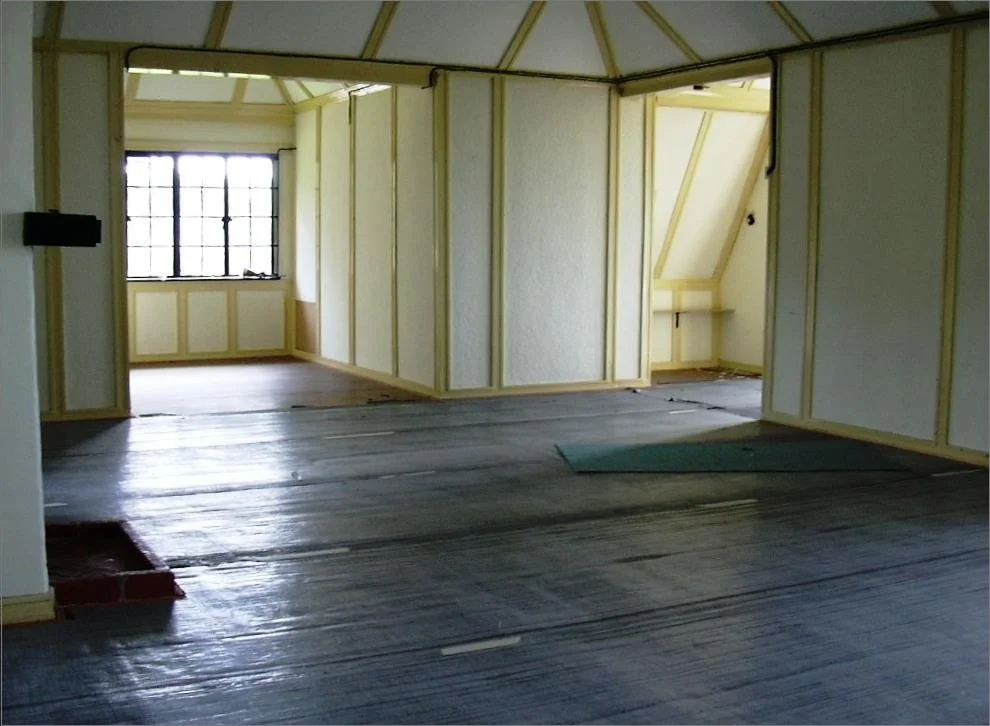
A partial view of one of the three rooms at “Moonlight” bungalow. The cottage is located at No. A47, Jalan Kamunting, 39000, Tanah Rata, Cameron Highlands, Pahang, West Malaysia. Photo taken by User:Roysouza. Licensed under the Creative Commons Attribution-Share Alike 3.0 Unported, 2.5 Generic, 2.0 Generic and 1.0 Generic license.
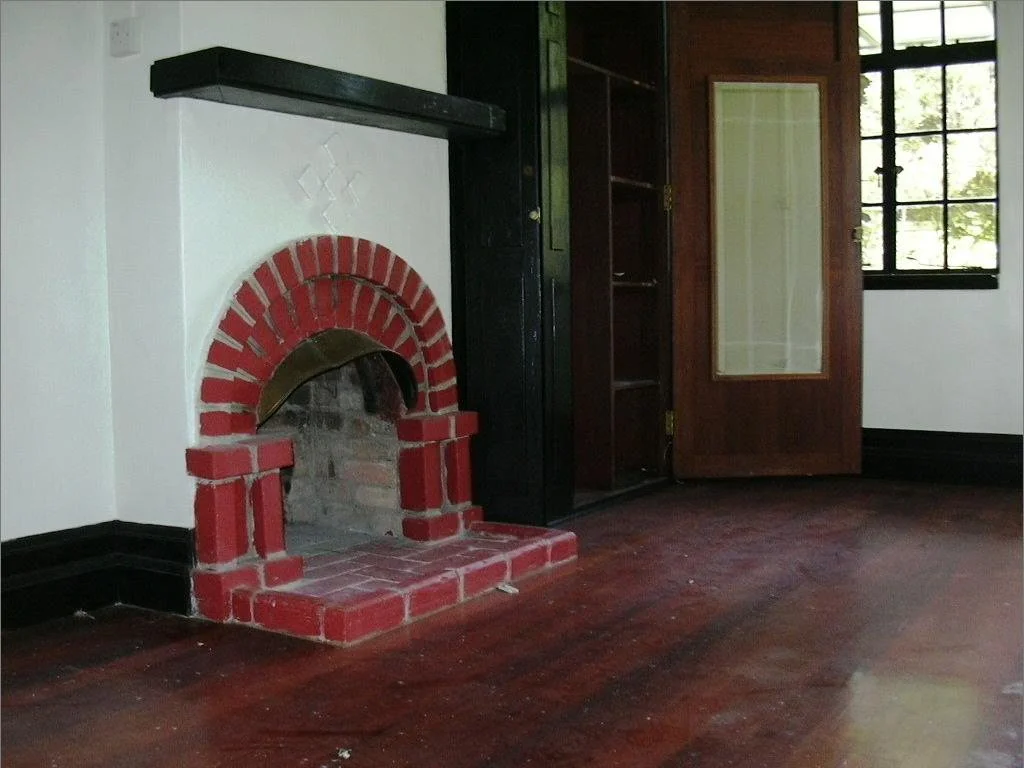
A partial view of one of the three rooms at “Moonlight” bungalow. The cottage is located at No. A47, Jalan Kamunting, 39000, Tanah Rata, Cameron Highlands, Pahang, West Malaysia. Photo taken by User:Roysouza. Licensed under the Creative Commons Attribution-Share Alike 3.0 Unported, 2.5 Generic, 2.0 Generic and 1.0 Generic license.
Readers have probably already surmised that I believe that the 1974 legal recognition of Jim Thompson’s death has something to do with setting up the Nugan Hand Bank and parlaying Jim’s contacts into its service. Please bear in mind that the Castle Bank and Trust, Nugan Hand’s likely predecessor, was staffed by OSS men who dealt in opiates in China, according the famous April 18, 1980 expose in the Wall Street Journal by Jim Drinkhall. These China OSS men, like opium dealer Paul Lionel Edward Helliwell, would have served alongside WWII China-theater veteran Desmond FitzGerald, the man who as the CIA’s DDO frustrated Angleton’s counterintelligence efforts on behalf of Colby. (Helliwell was instrumental setting up “Air America”, the CIA proprietary company, too!)
Who was Jim Thompson and why was he on Col. Edwin F. Black’s radar for the OSS? Thompson’s mother’s family was part of Theodore Roosevelt’s personal espionage network, which I wrote about with respect to the Congdon family and James Jesus Angleton here. Jim’s mother was the daughter of Union Army Major General James Harrison Wilson. Wilson was a minder for General Ulysses S. Grant: it was Wilson’s job to keep Grant off the sauce long enough to perform his wartime military duties. Wilson achieved this by supplying Grant with enough sugar to curb the commander’s alcohol cravings. [Warren, 2017. P. 37] After the Civil War, Wilson assisted with the suppression of the Boxer Rebellion in China (which had caught up Herbert Hoover while he was looting China); then Wilson served with Theodore Roosevelt during his invasion of Cuba— Rough Riders! Shortly after Cuba, Roosevelt appointed Wilson as his personal representative at the coronation Edward VII of the United Kingdom. In the USA, it’s hard to be better connected than Jim Thompson was. These connections would not have been lost on Black, who besides recruiting Thompson for the OSS, set up Thompson’s disastrous and short marriage to an American model and oversaw the search for Thompson after the disappearance.
One may ask: “Why was an independently wealthy man attracted to communism?” I’ll point out to readers that a number of trust fund babies, even in our day and age, become zealots for this style of government. Maybe it’s because they’re sheltered and materialistic. I think with the Lincoln crowd we have to search for other answers, though. Please remember that Lincoln maintained correspondence with Karl Marx and Marx saw Lincoln’s war in class struggle terms. Lincoln was a prophet for the utopianism of universal equality, or at least that’s the schlock he sold. In reality, a favored band of Lincoln’s utopian zealots made millions in government-sponsored business undertakings, like railway development and minerals exploitation. After the 1870s, there were a rash of very privileged people around Washington D.C. and New York City who associated larger government with larger profits, and they knew utopianism was a good way of selling this swindle to the public. Jim Thompson was absolutely among this privileged, cynical class.
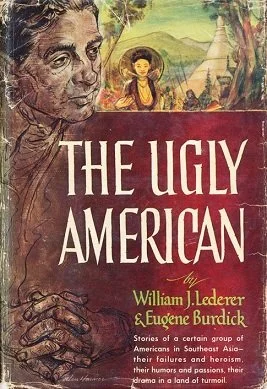
At this point, do I care if Jim Thompson was an official CIA agent? Not really. Here’s why. Jim Thompson’s contacts through the Theodore Roosevelt network were far more influential than the CIA was or has ever been. The CIA was simply a public face for the Roosevelt network to justify its continued government funding after 1947. That government funding came at a heavy cost for men like Thompson when men like Angleton decided to clean the agency of communist sympathizers in the 1950s and 60s— I’m pretty sure that the Lou Ordways of the world didn’t expect Angleton’s patriotic streak. Hence, the Roosevelt network had to protect itself with things like the public relations offensive through The Ugly American during the Kennedy Administration (Robert Kennedy was one of Jim’s guests in Bangkok!); the continued but covert employment of men like Jim by men like Colby; and the continued lionization of Thompson by captured journos which continues to this day.
Two more points on Jim Thompson: in Thailand, he was never very far from Dean Frasche of Union Carbide, often while also in the company of Col. Edwin F. Black. [Warren, 2017. P. 162.] Union Carbide ran the Oak Ridge National Laboratory, part of the Manhattan Project, from 1947 (after the University of Chicago pulled its sponsorship). This site had developed Enrico Fermi’s famous self-sustaining nuclear reactor experiment “The Chicago Pile-1” and continued to produce radio isotopes. In 1946 the facility pioneered the development of “medical isotopes” and by the 1950s was shipping these to hospitals all over the United States. Remember the Hospital Gangsters from Chicago sphere of the OSS? Remember the hapless Chicago playboy Packy MacFarland? Remember Wild Bill Donovan’s shameless plugging of cancer medications in conjunction with the University of Chicago in the 1950s? Remember how the old Chicago OSS hands cheered him?

Suburbanite Economist, April 9, 1952
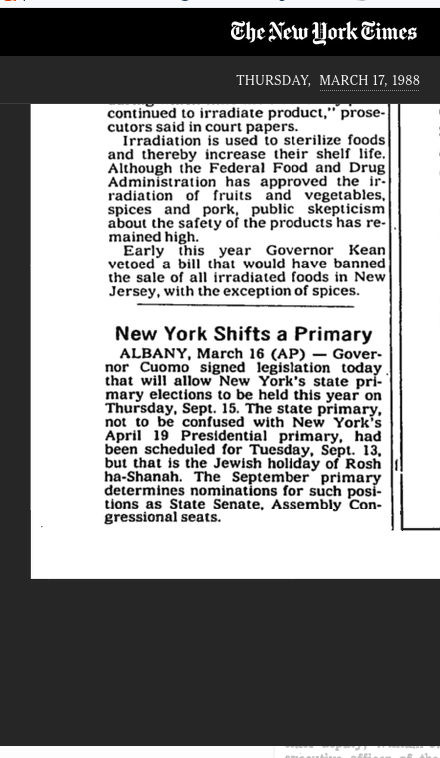
Well, Union Carbide’s Dean Frasche really liked to buy antique art objects from Jim Thompson. [Warren, 2017. P. 139-140.] Thompson’s handler, Col. Black, would get into the radiation business too with “Radiation Technology Inc.”, a food and medical equipment sterilization company, the New Jersey campus of which is now an EPA Super Fund site.
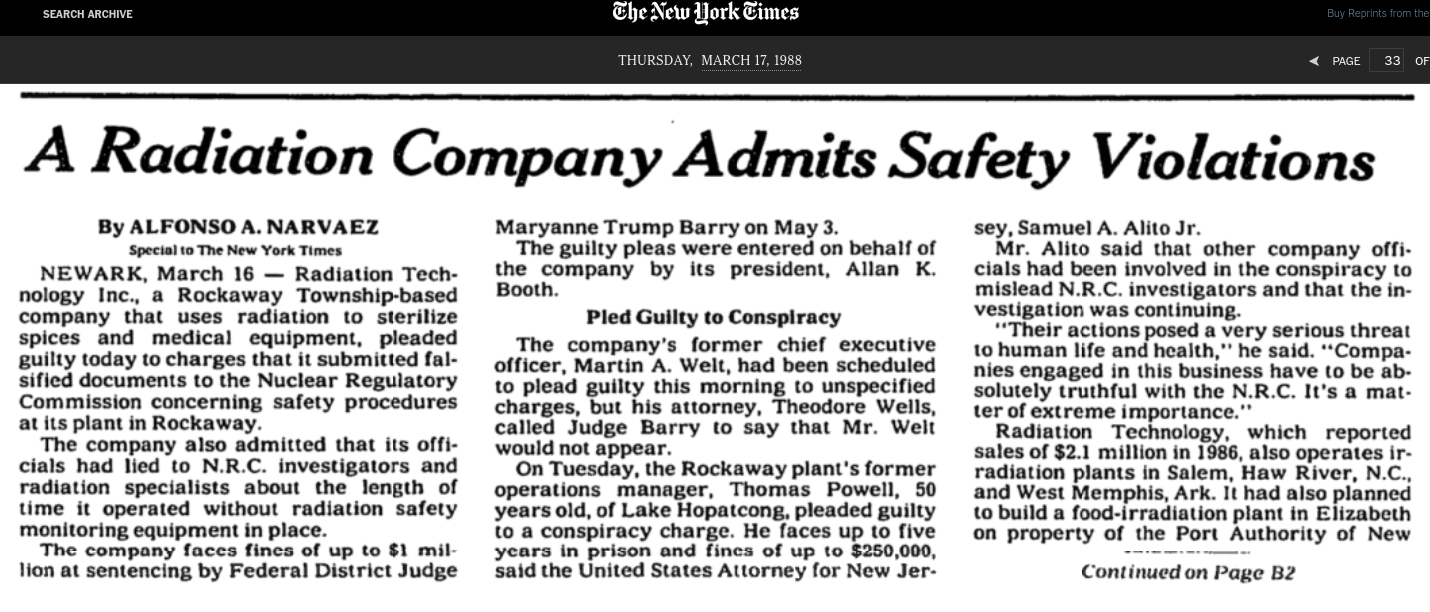
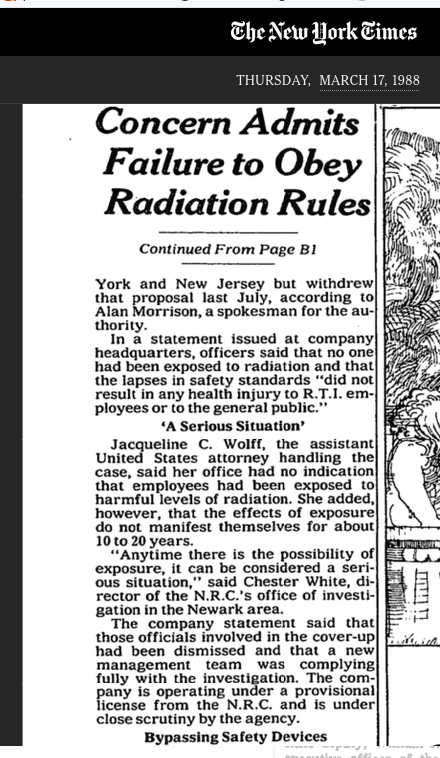
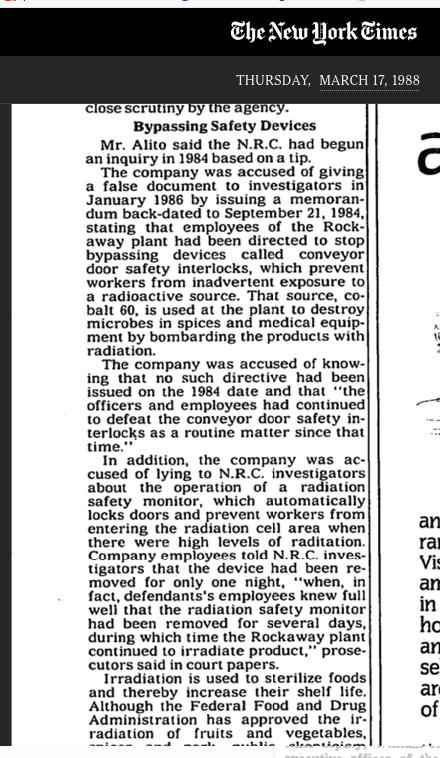
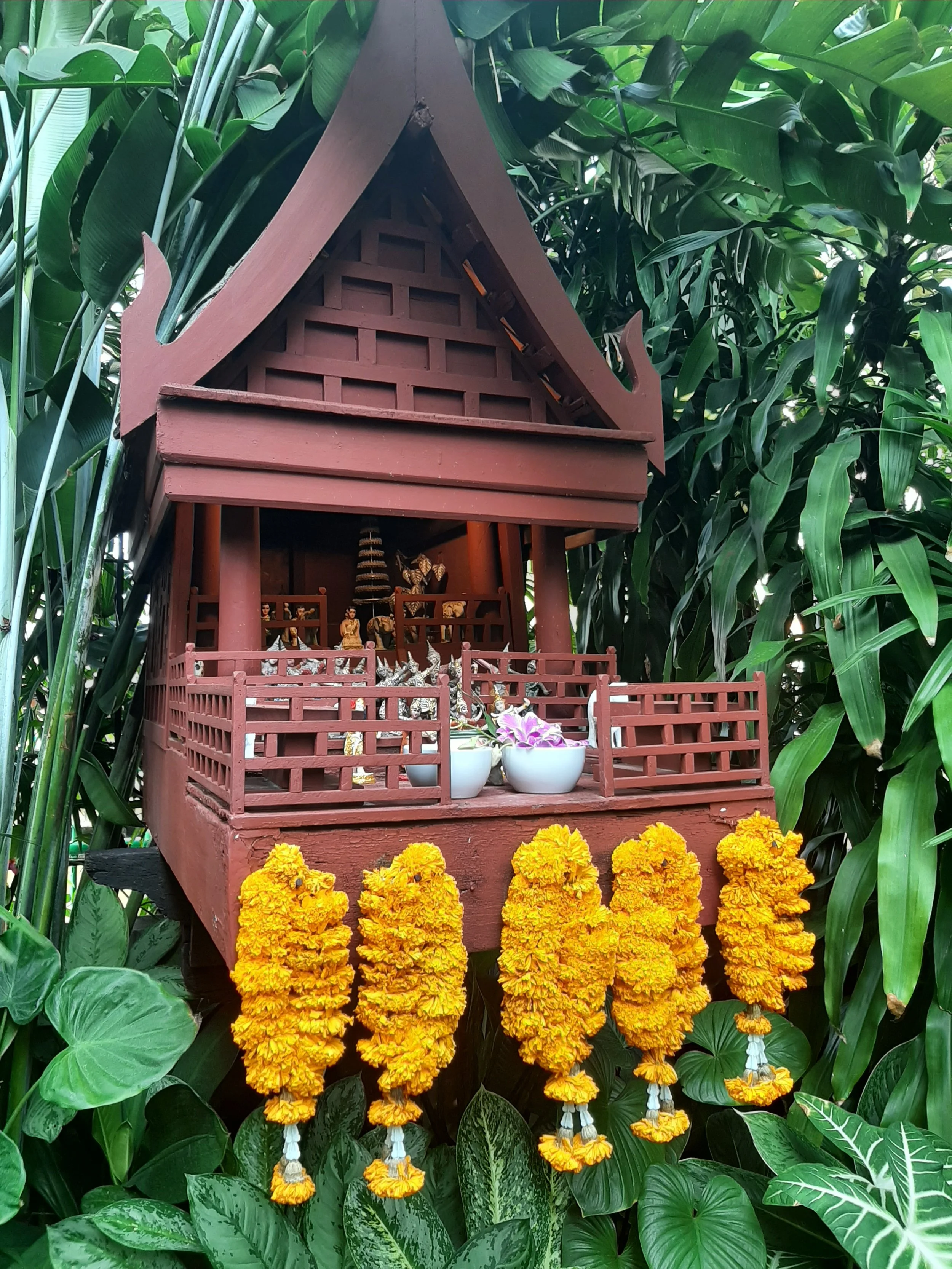
Finally readers, where would we be without the occult angle? Jim Thompson was an occultist, in the “Renaissance Hermeticism” vein, a bit like Empress Sisi. While Thompson was disrespectful of the Thai Buddhist statues he hoarded, he had tremendous respect for indigenous Thai spirit-workings and astrology, which he used to appropriately position his art-house and its protective spirit dwelling, an image of which is the header to this post. Thompson also made sure that construction milestones were initiated on astrologically propitious days.
When Thompson disappeared, scores of indiginous witch-doctors (‘bomoh’) provided Black and Frasche with psychic readings of Jim’s current location, and as Warren states, “all their visions received respectful attention from the searchers.” [p. 168] It wasn’t just Thompson’s Asian contacts that were consulting the spirits: his Delaware family was put in touch with Hollywood psychic Peter Hurkos. Thompson’s sister paid for Hurkos’s mediumistic readings in an attempt to locate Jim. On his way over to find Jim, Hurkos stopped in Hong Kong to observe that city’s border with Communist China for some reason [Warren, P. 177], and was afterwards shepherded around Thompson’s Thai properties by Black and Frasche. When Hurkos envisioned Thompson getting into a truck with uniformed men outside of Moonlight Cottage and began muttering “Pridi”, funding for the the seances was abruptly stopped.
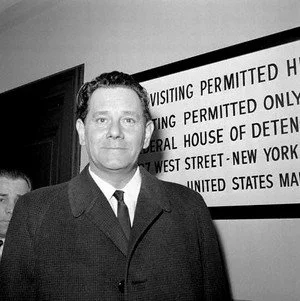
Peter Hurkos, famous for psychic readings about the “Boston Strangler”, was promoted to midcentury television audiences in a way that legitimized mediumship as an aide to police work.
I bring the occult angle up because it is a recurring theme around Bill Colby and his crew at the CIA. Please see my posts on James Angleton’s Decennium Horrendum and the blood workings around Colby’s Nugan Hand Bank in The Australian Connection. Where there’s smoke, there will be fire, readers.