Harry Crandall: Washington D.C.'s Movie King
It’s Roots Saturday here at andreanolen.com: I’m taking readers back to the world of Early Film. As it turns out, Early Film in our nation’s capital was dominated by a theater magnate named Henry Milton Crandall.
Harry was a distant relative of mine, as he was of Prudence Crandall and of Ernest Lindall Crandall, William Wesley Young’s partner on the dubious “Committee on Pedagogical Research in Visual Education” sponsored by Educational Film Magazine. Both Ernest and William Wesley served alongside Sigmund Freud’s lieutenant A.A. Brill engineering the use of film as a mass propaganda tool. As it turns out, Ernest’s relative Harry would then project those propaganda films throughout Washington D.C.

Educational Film Magazine, January 1921
A lot of Crandalls, no? Guess what! They’re all descended from the prominent Crandall family in Newport, RI. These early Newport Crandalls were merchants and radical protestants, take for instance, Joseph Crandall (1716-92), a business partner of the infamous slaving merchant Aaron Lopez, of whom I wrote in Counterfeiting and the Slave Trade. Prudence Crandall, the celebrated anti-slavery activist, is Joseph’s great-grandaughter and her parents or grandparents converted to Quakerism.
John Westerley Crandall, whose father is the family patriarch “Elder John”, married into the infamous Gorton family of Newport, just as did the infamous Miner counterfeiting family of New York. (You can read all about them in my book, Lincoln’s Counterfeiters.) A lot of intergenerational infamy rolling around Newport.
Remember the Miners? Josh Miner, the brilliant if evil organizer of the industrial-scale counterfeiting effort which supplied Lincoln’s counterfeiters, was probably the son of Marinus Willett Miner, whose mother was a Gorton of Newport. The first Newport Gortons founded a Quaker-like radical protestant sect of their own, while the first Newport Crandalls were “Seventh Day Baptists,” i.e. a type of radical Protestantism which follows Jewish sabbath customs. In their day, these radicals were not widely respected and they provided the impetus for the slur “Rhode Island Rogues”.
Why does any of this matter? 19th century counterfeiting was an extended family affair, much like what we expect from the Italian Mafia or the ethnic fraudsters we see in places such as Minneapolis today. Organized crime works this way. Therefore, extended family connections become important when one looks at organized crime networks. You’ll notice that certain groups are more preoccupied with recording genealogies than others, I’m thinking particularly of the Latter Day Saints, “Mayflower Descendants”, descendants of wealthy or politically powerful families, etc. The Crandalls were no exception, and they mythologized themselves with the attention to detail that I would expect from an organized crime family.
So let’s talk about Harry. Harry was born in Montgomery County, Maryland which is now a bedroom community to Washington D.C. Harry’s great-grandfather William had moved there from Durham, New York at least a decade prior to the Civil War and then moved to Washington D.C. proper during the Reconstruction. To give you an idea of William’s political bent, he named Harry’s grandpa after 1836 Whig presidential nominee William Henry Harrison, son of founding father Benjamin Harrison V as well as progenitor of the Harrison clan which gave us the Kentucky Colony, counterfeiters extraordinaire.
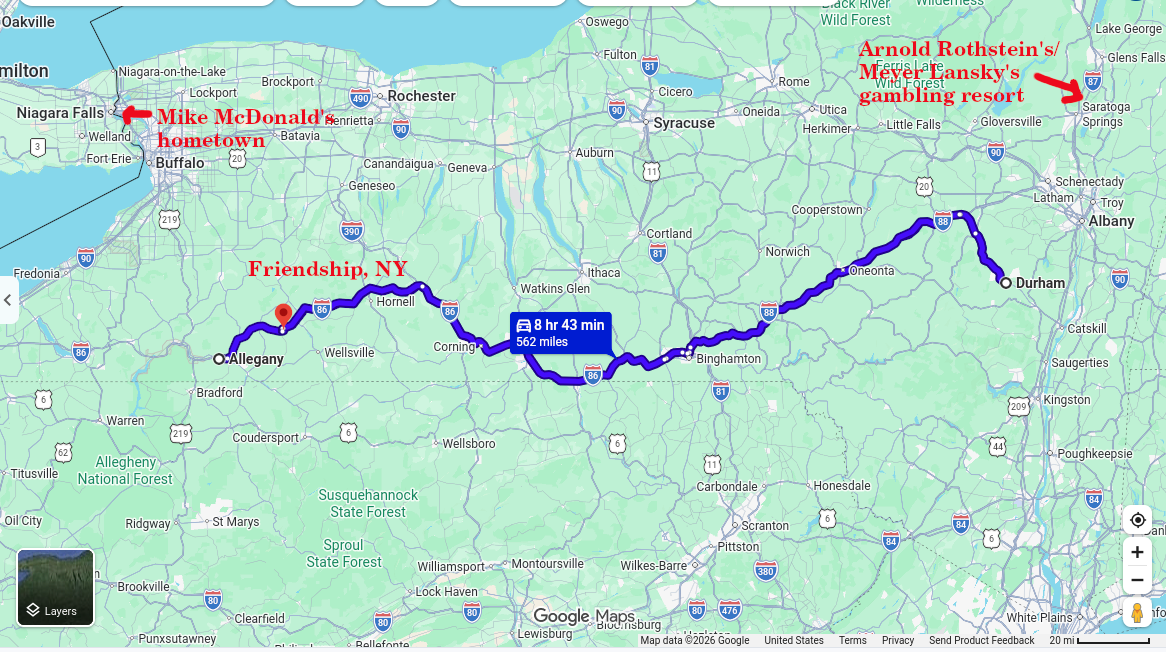
The Crandalls left Durham in the decade before the Civil War, about the same time Josh Miner was leaving Alleghany to go pass counterfeit $5 bills in Ohio.
As the propaganda possibilities of film ignited the imaginations of social planners, Harry Crandall began a rash of theater building across the heart of Washington D.C.. These were palatial structures, if not architecturally sound ones. From “DCpreservation.org”:
One of DC’s earliest theater moguls was native Washingtonian Harry Crandall, whose work ultimately included the Metropolitan, Central, Tivoli, Apollo, Lincoln, Colony, and Savoy Theaters. He was also involved in the construction of the Knickerbocker Theater on 18th Street NW, which became infamous after a roof collapse killed 98 patrons in 1922 (Crandall was cleared of any blame, but haunted by the incident). Crandall became the largest movie theater operator in the city, but was ultimately forced to sell his theaters after the stock market crash of 1929, which led to the Great Depression. Many of Crandall’s theaters were designed by Baltimorean John J. Zink, who drafted the plans and intimately worked on the construction of thirteen of the Capital’s theaters, including the MacArthur, Atlas, and Uptown.
The 1922 Knickerbocker Theater collapse was caused by snowfall which caved in the roof and killed some lawmakers in the process. The Knickerbocker disaster didn’t slow Harry down, he immediately began construction of the Ambassador Theater on the rubble-strewn lot, but under the direction of a different architect. However, in the fifteen years that followed, the three men most responsible for the Knickerbocker collapse all died unnaturally: two by suicide and a third by an I-beam falling on him. Why might this have been?
Harry’s suicide came two months after Franklin Delano Roosevelt entered the White House. Franklin and his in-law Teddy Roosevelt were the two men most responsible for crushing the Edison Trust and handing control of Early Film to the Galician Gang. (As undersecretary of the Navy, Roosevelt closed the Galician bordellos which serviced sailors, but funded the nascent film pornography industry in their stead.) Harry’s suicide came exactly thirty years after that of Charles T. Barney, the president of the Knickerbocker Trust Company, a major Edison Trust investor. Barney committed suicide when the trust was driven to bankruptcy following accusations from the J. P. Morgan faction that the Knickerbocker helped the Heinze Brothers corner the copper market. At the time of his death Harry had already sold out to the theater-guzzling Warner Brothers trust, the same gangsters who tried to eat Leon Goetz, Monroe, WI’s regional theater mogul. Harry was trying to build more theaters in ‘37, with whose money is unclear.

The Washington Herald, February 27, 1937.
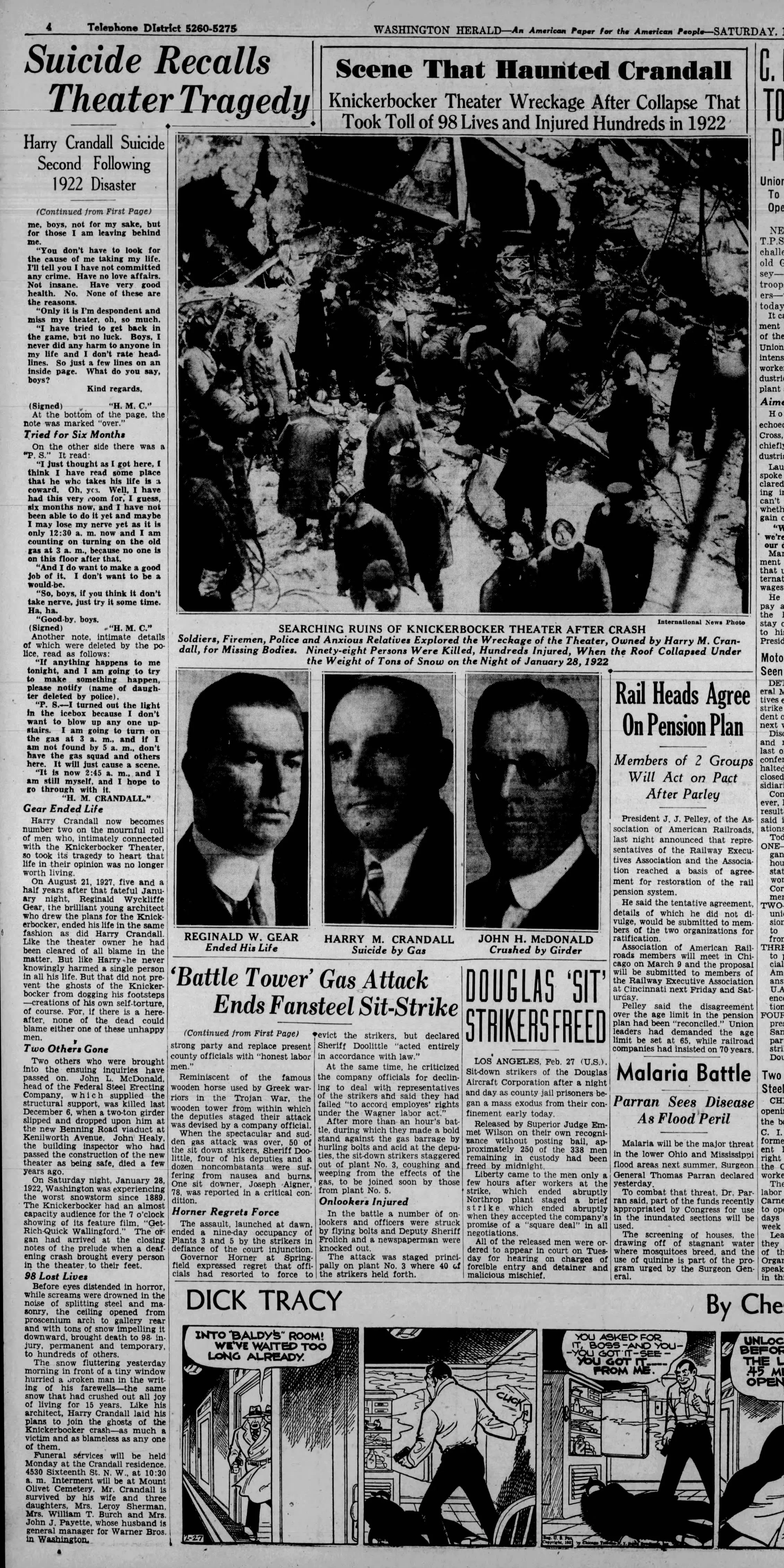
Early Film was a dangerous business, especially for theater operators. The Washinton Herald, February 27, 1937.
Crandall’s D.C. movie chain— eighteen properties in total— was a glamorous undertaking. It must have required an eye-watering credit line to develop, because Crandall himself didn’t come from money. The Library of Congress can provide us with photographs:
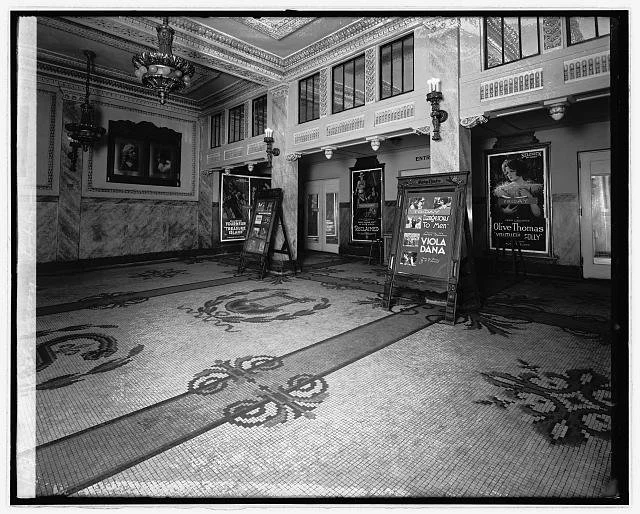
Crandall’s Savoy [theater] lobby, Washington D.C. National Photo Company Collection (Library of Congress). The theater was located on 18th St. NW.
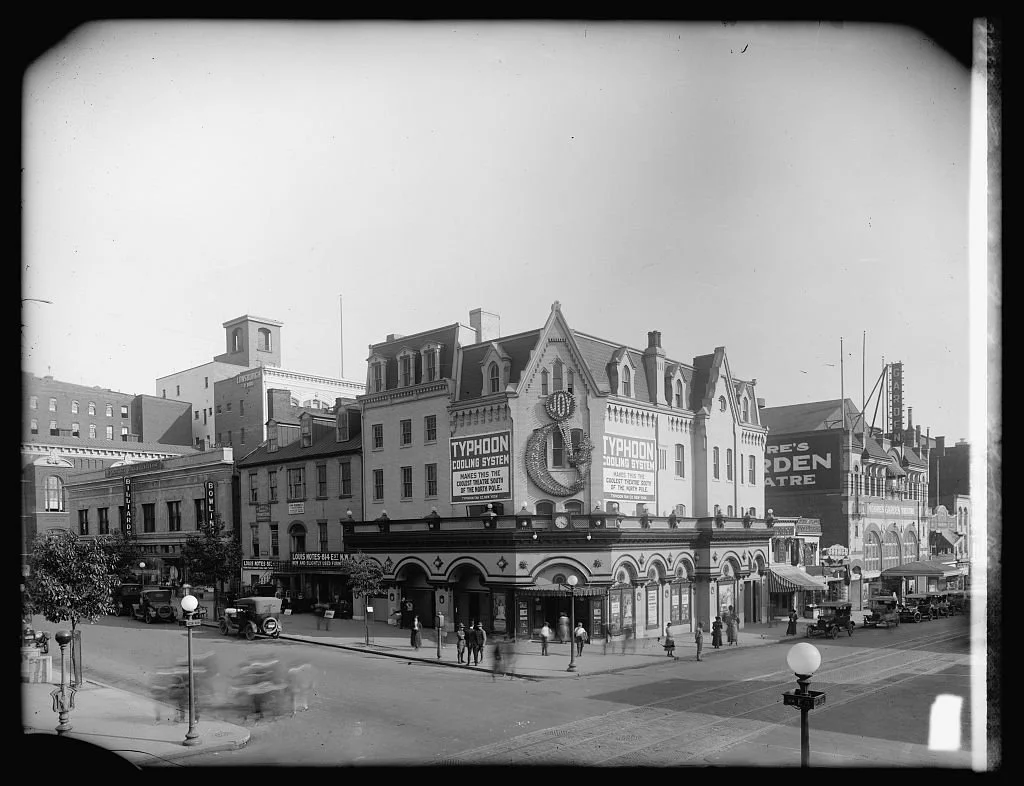
Crandall’s Joy Theater, 1913. LOC. The theater was located at the southeast corner of 9th and E Streets, NW. It cost Harry $25,000 to renovate the department store building and open this, his first theater.
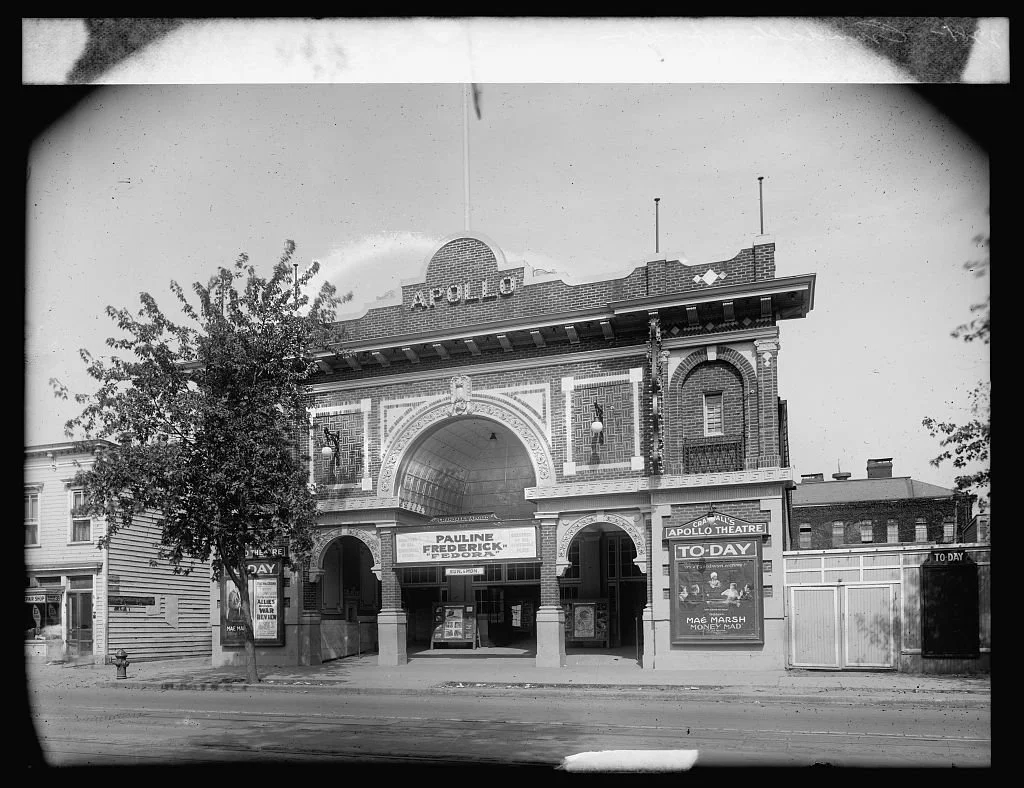
Crandall’s Apollo Theater in Washington D.C. (sometime after 1918 and before 1928).
In keeping with his hereditary predisposition to “help people of color”, Harry Crandall was eager to cater to D.C.’s black market with his Lincoln Theater:
The nation’s capital was segregated when the Lincoln Theatre first opened its magnificent doors 100 years ago, and it quickly established itself as the cultural epicenter of what came to be known as “Black Broadway” – predating and influencing Harlem’s renaissance. Touted by The Afro-American newspaper at the time as “perhaps the largest and finest theater for colored people exclusively anywhere in the U.S.,” the building has catered to artists, presidents, cinema stars, boxers, and hundreds of thousands of Washingtonians alike.
The neoclassical-style theater was commissioned and operated by local theater magnate Harry Crandall and designed by architect Reginald Geare. Initially conceived and built as a segregated movie house for Washington’s Black clientele, the theater brought the latest top Hollywood films directly to a previously underserved audience.
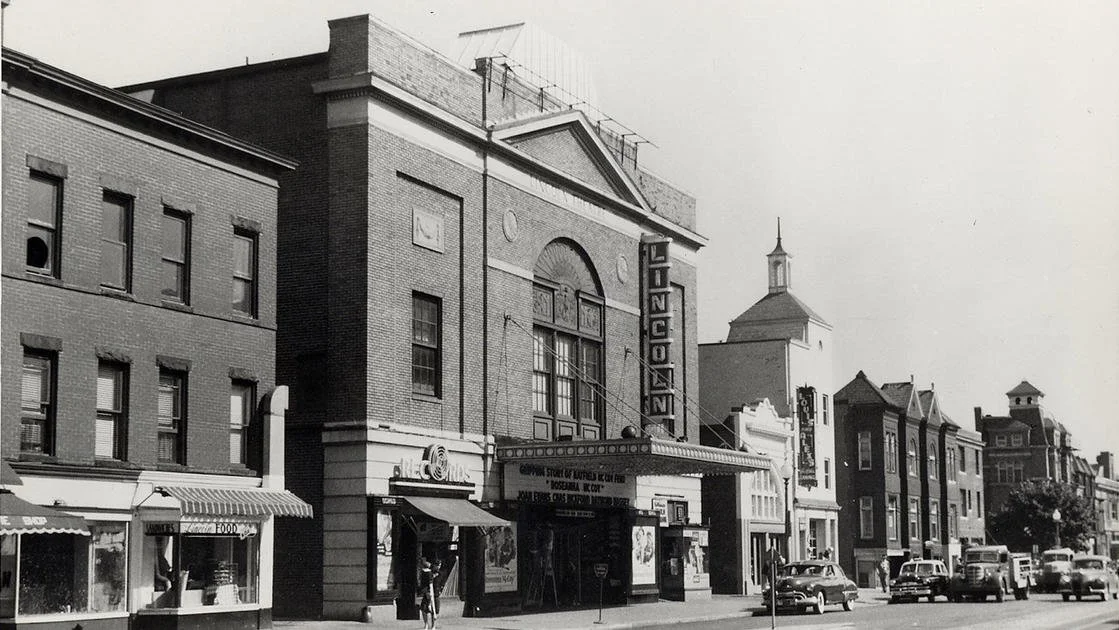
Crandall’s Lincoln Theater, which predated and influenced the ':Harlem Renaissance”.
Of course, andreanolen.com readers know that the Harlem Renaissance was a provocation operation run by spy Otto Kahn and his subordinates Karl van Vechten and Charles Sylvester Viereck. When Viereck was convicted of being a Nazi spy in the 1940s, I believe the “Harlem Renaissance” operation— by 1933 a Nazi supported operation— was adopted by the Roosevelt family network. The Kahn/Vechten/Viereck network was probably the bedrock for 1950s/60s CIA operations countering Soviet propaganda about US race relations in Europe (“Congress for Cultural Freedom”); while its dedicated communist element continued under the patronage of the fifth column represented by Lincoln-crowd trust fund baby Jim Thompson; Thompson’s boss Bill Colby; the Guggenheims and the other bitter OSS’ers.
Black poet Langston Hughes, a communist recruited by Vechten and descended from Lincoln abolitionists like Prudence Crandall, tells us that Crandall’s theater nurtured all the same sorts of dysfunction which we’ve come to expect from the Galician crowd:
Lincoln Theatre
By Langston Hughes
The head of Lincoln looks down from the wall
While movies echo dramas on the screen.
The head of Lincoln is serenely tall
Above a crowd of black folk, humble, mean.
The movies end. The lights flash gaily on.
The band down in the pit bursts into jazz.
The crowd applauds a plump brown-skin bleached
blonde
Who sings the troubles every woman has.
She snaps her fingers, slowly shakes her hips,
And cries, all careless-like from reddened lips!
De man I loves has
Gone and done me wrong ...
While girls who wash rich white folks clothes by day
And sleek-haired boys who deal in love for pay
Press hands together, laughing at her song.
Probably not the type of future for which the Hughes Family nor Prudence hoped, but when one lies with dogs, one rises with fleas. I don’t think we can understand Harry Crandall without looking at his contemporary relative, Ernest Lindall Crandall, educational film proponent extraordinaire.
Ernest Lindall Crandall was a NYC-based Tammany lawyer from Hancock, MA. He began his career as a lawyer-on-call for Democrat vote fraudsters and Irish mob gambling dons, particularly those on the police force. By 1897 Crandall was a legal partner of Tammany stalwart Senator Thomas F. Grady. Ernest had to leave politics (for a spell) when he was caught falsifying literacy examination scores for NYC police recruits. Ernest’s personal life was no less colorful than his public service:
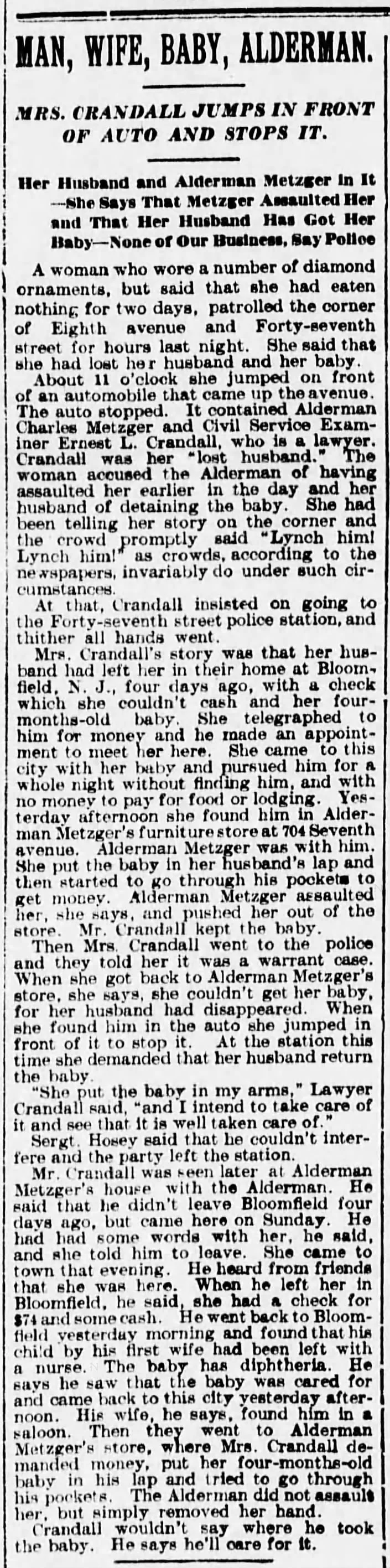
New York Herald, October 3, 1903.
Falsifying police exams scores forced Ernest to go underground and support himself with a syndicated column teaching readers how to finagle public sector jobs. In 1914 he reappeared as a public school principal in the city. Crandall was still politically active and quickly became one of “the big five” borough principals agitating for higher teachers’ wages and, it was alleged, forcing teachers to contribute to his political slush-fund. In 1918 Ernest got appointed to the State Commissioner of Education’s fund disbursement apparatus, and from there he controlled money slated for public lecture courses under the auspices of the school system.
Ernest Crandall used his public money to stump for William Jennings Bryan and other democrat politicians alongside NYC’s leading Zionist Rabbi Stephen Wise. (This was well before the 1939 Hatch Act. William Jennings Bryan was a favorite among the movie biz/sex trade dons in NYC during Edith May’s heyday.) Remember Crandall’s voter fraud work prior to 1907? The largest voter fraud outfits in NYC were run by Irish and Jewish (Galician Gang) gangsters. Ernest used his power over the Department of Education lecture funds to prevent criticism of the immigration which empowered these ethnic criminal organizations:
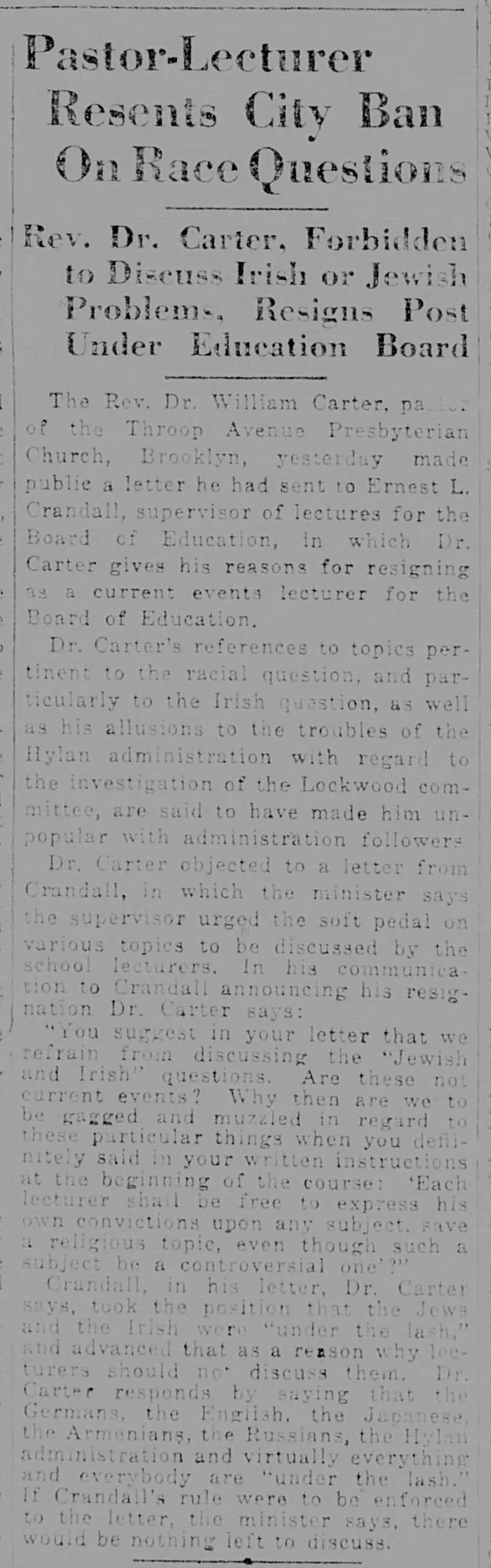
New York Tribune, December 6, 1920.
As I mentioned, Crandall used this lecture series as a platform for Democratic politicians like Ohio Governor James M. Cox (who was running for Democratic presidential nominee), New York Mayor John Francis Hylan, and above all, the Kentucky Colony satellite William Jennings Bryan, who some historians credit with bringing Lincoln’s social policies in as the bedrock of the modern Democratic party platform. In addition, Crandall promoted Woodrow Wilson’s struggling League of Nations, and the legacy of James Gordon Bennet Jr., the New York Herald heir. (Woodrow Wilson became president because of the machinations of Teddy Roosevelt, who torpedoed his own party to maintain control of the White House.) Crandall’s most persistent topic however was promoting the utility of film in the education sector:
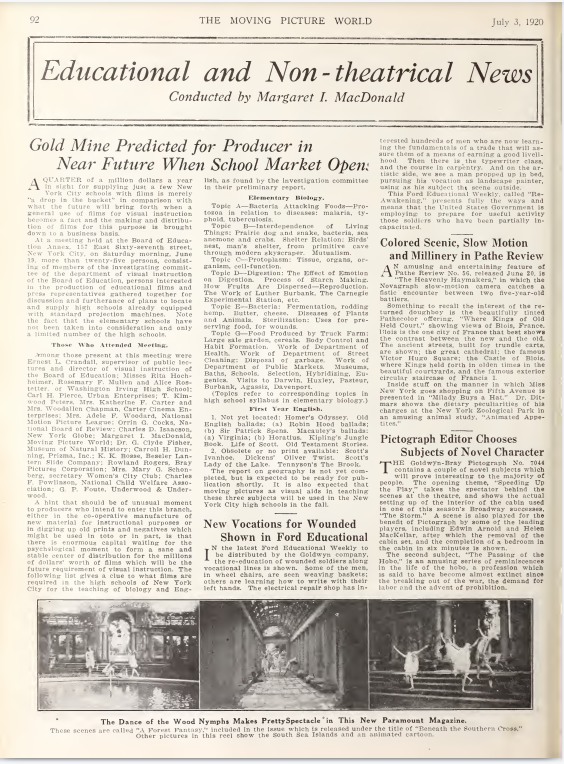
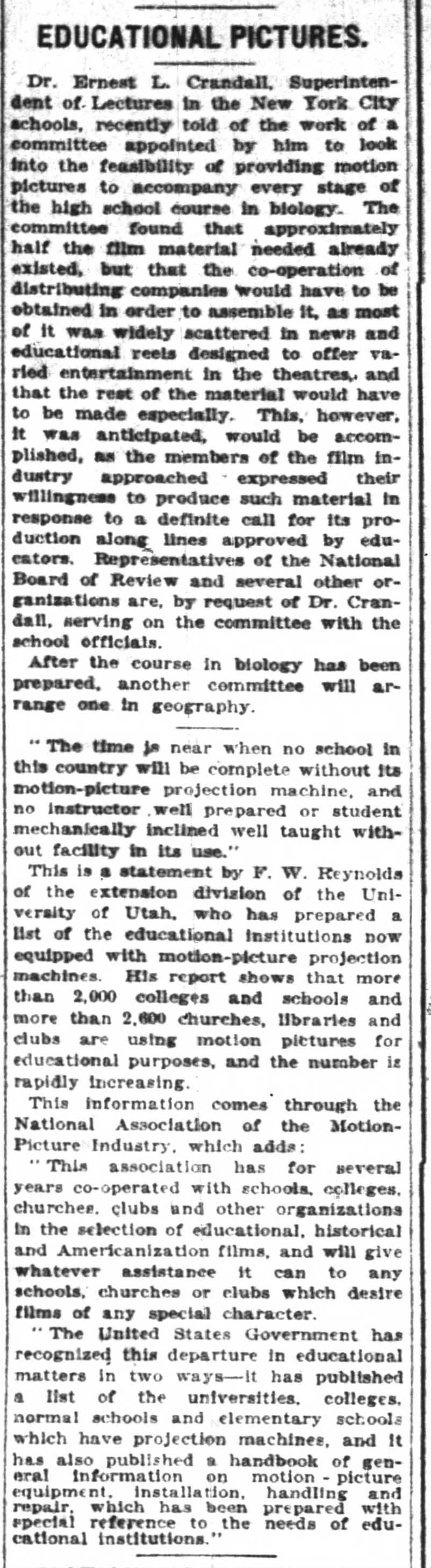
New York Times, June 6, 1920. Ernest suddenly started using the title “Dr.” at this time, but there’s no indication that he had a PhD other than his law degree, which is technically a doctorate.
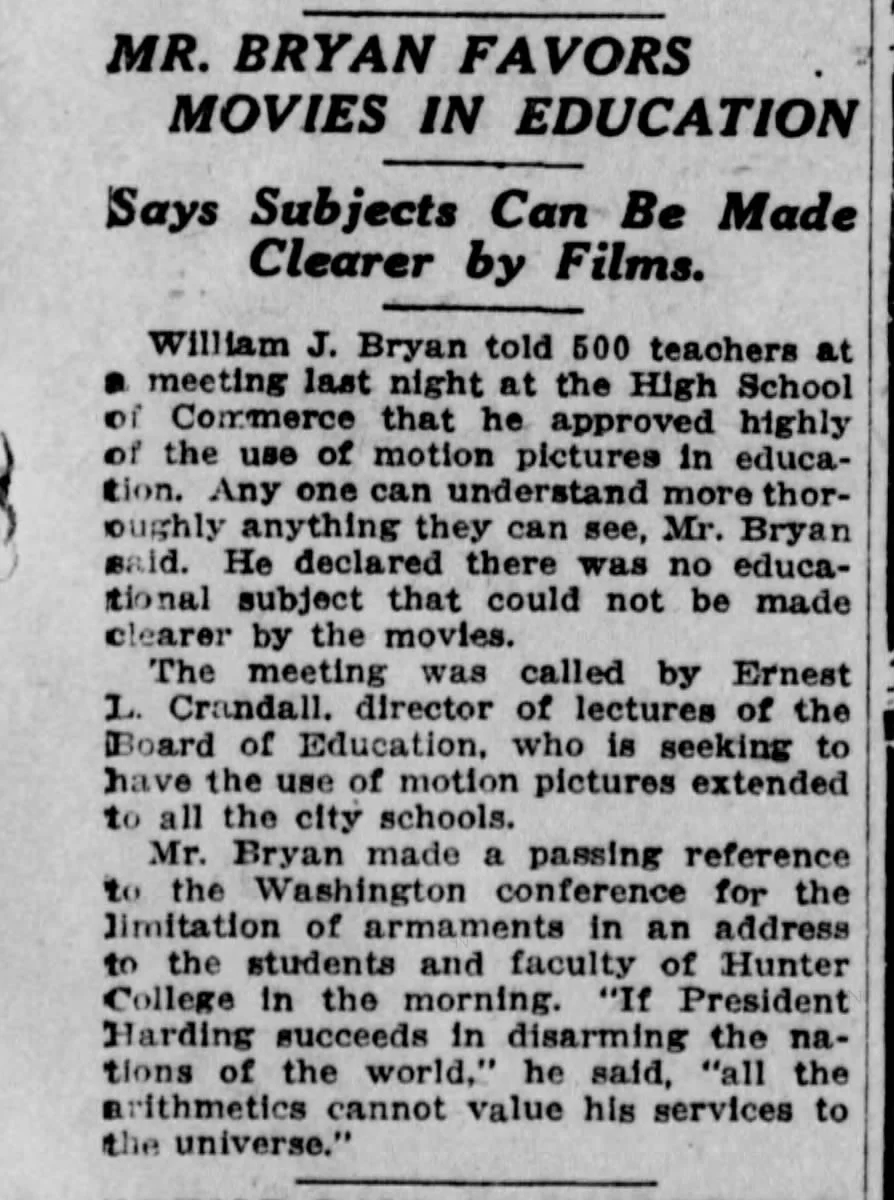
New York Herald, November 3, 1921.
Of course, Crandall gave a podium to Woodrow Wilson’s anti-porn czar William A. Brady, the prize-fight promoter, Galician Gang director Cecil B. DeMille, and Early Film exporter Paul Cromlin, all of whom profited from the industry’s Navy-funded pornography problem. (Check out how that problem got started.) Crandall even arranged things so that these luminaries wouldn’t have to directly face their critics: each side of the debate presented on different days!
William A. Brady loved to compare film censorship to Prohibition— read all about his lobbying in “Liquor-Men to Movie-Men” and “The Tillie Bergsterman Murder”.
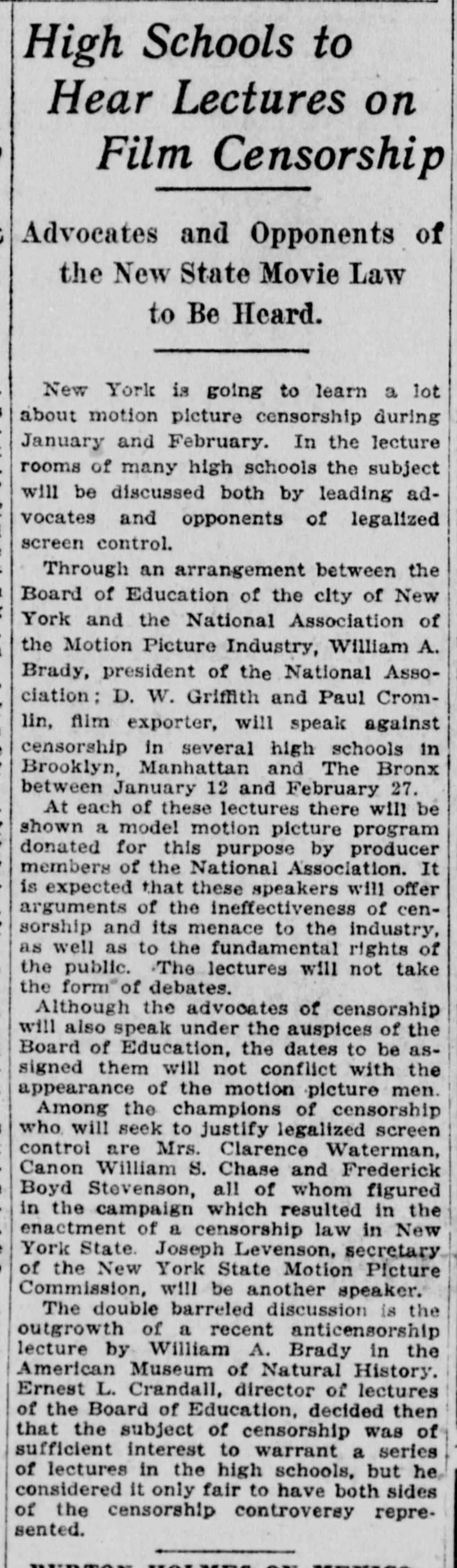
New York Herald, January 8, 1922.
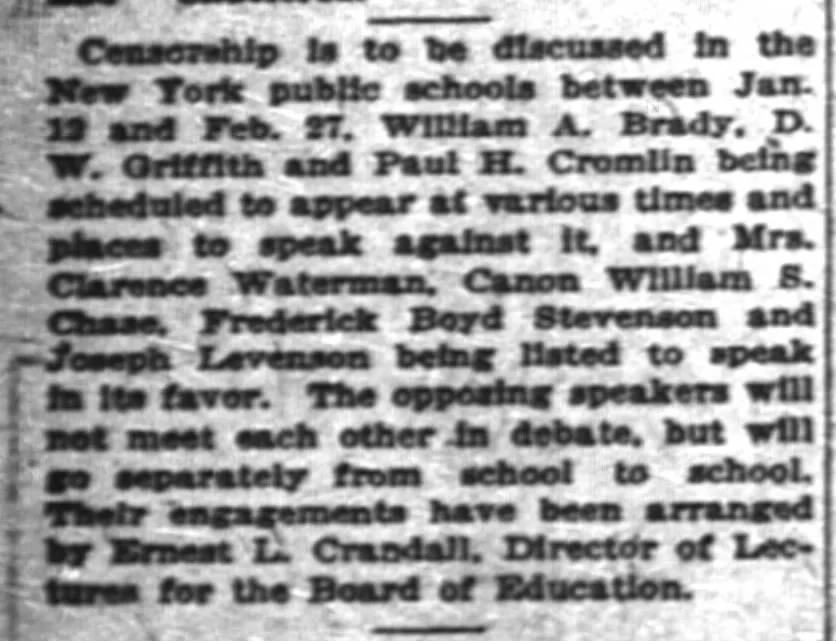
The New York Times, January 8, 1922.
The protection offered to the Film industry by Crandall shouldn’t be surprising, as the industry was already hiring him as a speaker at their public outreach events:
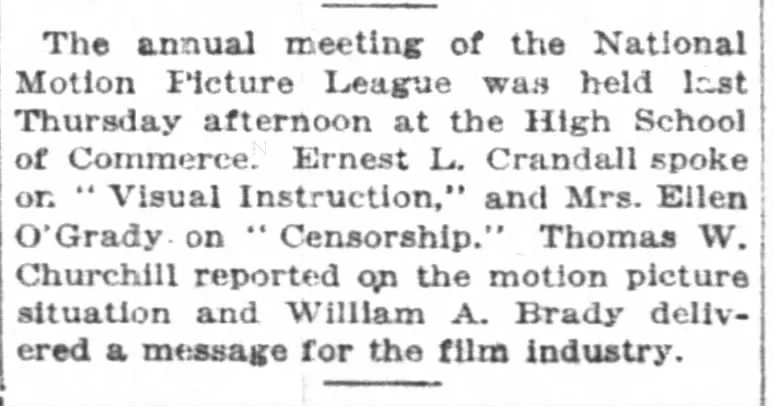
New York Times, June 5, 1921.
At this point readers may remember that Ernest Crandall’s pedagogical research bro William Wesley Young was interested in cashing in on educational pictures, alongside his fellow British intelligence operative Charles Urban. Naturally, William Wesley pursued this “gold mine” from his offices at The Friars’ Club, NYC’s showbiz pedo hangout joint.
What I hope readers can take away from this sad tale is a more thorough understanding of how Lincoln’s agenda affected the American cultural landscape. Much like Arabut Ludlow’s “Union School District” in Green County, WI, New York City’s public education system was used as a spigot for funding the political goals of a very hypocritical, self-serving, and fanatically-inclined segment of the population. Let’s call them the “English Mafia.”